Product Catalog (PCAT)
Unbundled Local Loop - General Information - 115.0

Product Description
Unbundled Local Loop is a facility or transmission path between the Distribution Frame or equivalent in the CenturyLink™ Central Office (CO) and the loop Demarcation Point at the end-user premises. The 'Demarcation Point' is defined as the point where CenturyLink ownership of facilities ceases and Competitive Local Exchange Carrier (CLEC), end-user, owner or landlord ownership of facilities begins. Unbundled Local Loop network element includes all features, functions, and capabilities of the transmission facilities including dark fiber and all attached electronics, with the exception of Digital Subscriber Line Access Multiplexer (DSLAM), owned by CenturyLink, between a CenturyLink CO and the loop Demarcation Point at the end-user premises. Unbundled Local Loop provides a transmission path that is a point-to-point configuration. You gain access to an unbundled local loop at the CenturyLink CO through the establishment of a collocation arrangement. Information for collocation is available in Collocation - General Information. Individual state commissions and Interconnection Agreements determine the structure, pricing and guidelines for Unbundled Local Loop.
Unbundled Local Loop family of products consists of:
- 2-Wire or 4-Wire Analog (Voice Grade) Loop
- 2-Wire or 4-Wire Non-Loaded Loop
- Asymmetric Digital Subscriber Line (ADSL) Compatible Loop
- Digital Service Level 1 (DS1) Capable Loop
- Digital Service Level 3 (DS3) Capable Loop
- Integrated Services Digital Network (ISDN) Basic Rate Interface (BRI) Capable Loop
- Digital Subscriber Line-Integrated Services Digital Network (x-DSL-I) Capable Loop
CenturyLink offers optional processes for facility assignment, conditioning, and testing associated with the 2-Wire or 4-Wire Non-Loaded Loop (LX-N) and Asymmetric Digital Subscriber Line (ADSL) Compatible Loop (LXR-) via an amendment to the CLEC's Interconnection Agreement (ICA). These products are referred to as "LX-N and LXR- xDSL Capable Loops" and refer to 2-wire and 4-wire copper loop(s) that would support transmission of the digital signals needed to provide xDSL Services.
Minnesota Only: In addition to the xDSL Services amendment, CenturyLink also offers an xDSL Services addendum which is optional processes for facility assignment, conditioning, and testing associated with the 2-Wire or 4-Wire Non-Loaded Loop (LX-N) and Asymmetric Digital Subscriber Line (ADSL) Compatible Loop (LXR-) via an xDSL Services addendum to the CLEC’s Interconnection Agreement (ICA). The xDSL Services addendum does not have loop length restrictions for three (3) specific NCI codes for the NC code of LX-N. See additional information below regarding testing performance parameters. CLEC has the option of either the xDSL Services amendment or the xDSL Services addendum.
"LXR- xDSL Capable Loop" means an xDSL Capable Loop that is associated with the ADSL Compatible Loop product and NC Code of "LXR-," including the codes identified with a CenturyLink LXR- NC code in Technical Publication, Interconnection - Unbundled Loop, 77384. LXR- xDSL Capable Loops include Loops with any of the NCI codes used in association with an LXR- NC code to identify the type of xDSL Service.
LX-N xDSL Capable Loop" means an xDSL Capable Loop that is associated with the 2-wire and 4-wire non-loaded loop product and NC Code of "LX-N," including the codes identified with a CenturyLink LX-N NC code in Technical Publication, Interconnection - Unbundled Loop, 77384. LX-N xDSL Capable Loops include loops with any of the NCI codes used in association with LX-N NC code to identify the type of xDSL Service.
Product Diagram
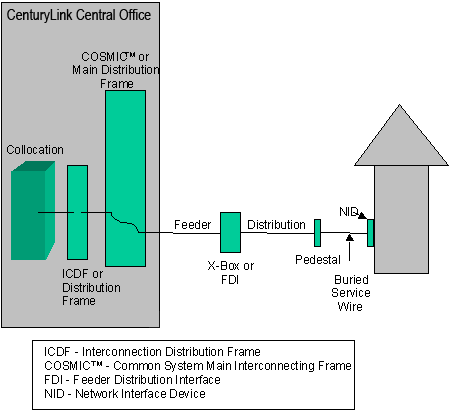
This diagram is intended to generally represent an Unbundled Local Loop configuration. Variations may occur from location to location.
Availability
Unbundled Local Loop is available where facilities exist throughout CenturyLink QC. Exceptions may apply where Commission Orders or state requirements exist.
Non-Impaired Wire Centers and the Omaha Forbearance Wire Centers are described at Non-Impaired Wired Center Lists for Loops and Dedicated Transport. In those cases, the Commercial DS0 Loop Facility is available only via the Commercial DS0 Loop Facility Agreement and the DS1/DS3 equivalent facility is available only via CenturyLink’s Special Access Tariffs.
Terms and Conditions
Unbundled Local Loop product offerings are provided where existing facilities are available and in compliance with provisions of Commission Orders and State Requirements as stated in this web page.
Unbundled Local Loop services that extend to designated high voltage (HV) environments are required to have high voltage protection (HVP). HVP devices may be provided by you, the end user, or may be requested from CenturyLink. General High Voltage Protection activities are described in High Voltage Protection.
Technical Publications
Technical characteristics, including Network Channel/Network Channel Interface (NC/NCI™) codes are described in Technical Publication, Interconnection - Unbundled Loop, 77384.
Collocation information, as it applies to the Unbundled Local Loop product family, is located in Technical Publication, Interconnection and Collocation for transport and Switched Unbundled Network Elements and Finished Services, 77386.
Pricing
Rate Structure
Recurring charges are comprised of the following:
- Interconnection Tie Pair (ITP)
- Unbundled Local Loop (dependent on the specific transmission level of the UBL and the geographic zone of the service)
- Geographic Deaveraging- Information is available in:
Geographic Deaveraging - General Information.
Recurring charges are billed on a month-to-month basis.
When multiple Unbundled Local Loops are ordered from the same Network Interface Device (NID) to the same wire center at the same time, they will be assessed a first and additional nonrecurring charge. Information regarding your rates is available in Exhibit A or the specific rate sheet in your Interconnection Agreement.
Non-Recurring charges are comprised of the following:
- Installation Option chosen
Additional charges that can apply include:
- Grooming
- Conditioning
- Extension Technology
- Private Line to Unbundled Local Loop Conversion
- Transfer of Responsibility
- Miscellaneous Elements
Nonrecurring charges are billed at the time service is rendered. A nonrecurring charge applies to the installation of service(s) and in some states a disconnect service(s) charge will apply.
A nonrecurring customer transfer charge will apply when converting an existing Private Line to Unbundled Local Loop pricing. If you request a dispatch when converting an existing Private Line to Unbundled Local Loop pricing, the nonrecurring installation rate for that specific Installation Options will be assessed. Contact your CenturyLink Sales Executive if an amendment to your Interconnection Agreement is necessary to support Private Line to Unbundled Local Loops pricing.
One-month minimum billing, contract termination liability and associated contract charges for the product from the loop converted will apply. Miscellaneous charges assessed may include, but are not limited to, Due Date Changes; Design Changes; Conditioning; Time and Materials; Maintenance of Service, and Premises Work.
Rates
Wholesale rates for this product or service, including tariff references and any applicable discounts, are provided in your current Interconnection, Resale, Commercial, or other governing agreement.
Tariffs, Regulations and Policy
Tariff, regulations and policies are located in the state specific Tariffs/Catalogs/Price Lists.
Optional Features
Detailed information regarding optional features for each Unbundled Local Loop product is available by selecting the product hyperlink located in the Product Description section of this web page.
Features/Benefits
| Features | Benefits |
| Market Presence |
|
| Low Cost |
|
Applications
See Features/Benefits
Implementation
Product Prerequisites
If you are a new CLEC and are ready to do business with CenturyLink, view the Getting Started as a Facility-Based CLEC. If you are an existing CLEC wishing to amend your Interconnection Agreement or New Customer Questionnaire, additional information is located in the Interconnection Agreement.
Pre-Ordering
The EASE-LSR Users Guide together with the Loop Qualification and Raw Loop Data and CLEC Job Aid details the information applicable to pre-ordering functions.
Loop qualification queries should be used prior to submitting a service request. Use of the queries can greatly reduce service request rejects by ensuring the types of facilities requests are available prior to placing a service request. The query will enable you to verify the type of facility and physical characteristics of the facility. Based on the physical characteristics you can determine if the facility needs to be conditioned, (the removal of load coils or excessive bridged taps - for xDSL Capable Loops), which will assist you in identifying the appropriate service request intervals, as described in the Service Interval Guide (SIG).
Some of these queries are available in EASE-LSR and others are web based. The qualification queries provide you with access to physical characteristics of the CenturyLink Facility from CenturyLink databases. This is the same underlying data that CenturyLink utilizes for its retail product offerings.
- The queries are for informational purposes only and do not restrict or imply that your service will or will not work on a given facility. This determination is your responsibility.
- As mentioned, the physical characteristics provided are based on CenturyLink's plant facility database. If you encounter any inaccuracies in the information, please contact your Account Team / Sales Executives and Service Managers.
EASE-LSR qualification queries are:
- Loop Qualification Query
- Raw Loop Data (RLD) Query
- Plain Old Telephone Service (POTS) Conversion to Unbundled Loop Query (submenu under Check Facility Availability)
- ISDN Facility Availability Query (submenu under Check Facility Availability)
Web based qualification queries are:
- Wire Center RLD
- Fiber Data Reports
For web based queries, contact your CenturyLink Service Manager to request an ID, which will be required to obtain the Digital Certificate required for access to the Wire Center RLD and the Fiber Data Reports. You will need to provide the names and telephone of each staff member that will be accessing the query. After your CenturyLink Service Manager has notified you that the necessary access permissions have been established, and provided you with your ID, you may then initiate the digital certification process.
Optional Loop Qualification Information for xDSL Services
On xDSL Capable Loops (LX-N and LXR-), CenturyLink will provide CLEC with: (1) the formula(s)/algorithm(s) that CenturyLink uses for calculation of EML, and/or (2) a Loop Qualification tool that calculates insertion loss for xDSL Capable Loops, using the same formula(s)/algorithm(s) that CenturyLink uses for calculation of EML.
Information about the EASE-LSR based loop qualification queries are available in the EASE-LSR User's Guide or the Pre-Ordering Overview. The EASE-LSR Loop Qualification and Raw Loop Data-CLEC Job Aid is a web-based training course designed to provide valuable information and instructions on how to use and interpret EASE-LSR-based loop qualification queries and the raw loop data queries.
The Loop Qualification Query can be accessed via EASE-LSR to pre-qualify for High Speed Internet, Unbundled Local Loop and ADSL. If the end-user's telephone number is a Port-Within telephone number also known as a Location Ported telephone number, you must use the address to perform an ADSL qualification. Information regarding the Loop Qualification query is described in the EASE-LSR User's Guide and the Loop Qualification and Raw Loop Data-CLEC Job Aid.
It is important to understand the network topology, in understanding the difference between a 'stand alone' Serving Wire Center or Serving Central Office, a Host Central Office, a remote and a Remote Service Unit (RSU). Generally, Serving Wire Center is a term used to describe a Central Office that directly serves a specific geographic area of end-users. In this circumstance, there are no intermediary offices between the end-user and the Central Office. Contrarily, Host Office is a term generally used to describe a Central Office that directly serves sub-tending office(s) in addition to its own end-users. For example, the Dry Creek, Colorado Central Office has some direct end-users and is also the originating end of the cable that fed the Tech Center in its remote status (not as a stand-alone Serving Central Office). A remote is a piece of field equipment attached to the Serving Wire Center that provides capability that the end-user's distance would otherwise prohibit. Thru time, if or when a remote grows to accommodate a significant number of its own end-users, it can be deemed a sub-tending office. This sub-tending office is generally referred to as an RSU and becomes a Serving Central Office (i.e., no longer a remote, but a Remote Service Unit).
A distinct cable naming convention is used when an end-user is not directly served by the Host Central Office (i.e., served from a remote), an "EX" prefix will appear in the end-users distribution cable pair (e.g., F2 ca EXA7). The "EX" prefix designates the cable that extends from a remote to the end-user. When an end-user is served from a Remote Serving Unit (RSU), Unbundled Local Loops are available only when you are collocated in the same RSU that your end-user is served by. If you are not collocated in the same RSU as an end-user, Enhanced Extended Loops (EELS) are available to serve end users that have EX cable designations in their distribution pair. Where an end-user is fed out of a Serving Central Office other than one where the Collocation is present, an EEL is also used.
Unbundled Loops are available when you are collocated in the same Serving Central Office that your end-user is served by. Generally, once a remote becomes a Serving Central Office, you can now collocate in the RSU and serve the customer with an Unbundled Loop (UBL) or continue to serve from the old Host Central Office under the EEL.
In rare instances where the facility between the Host office serving that RSU and the end user has been included in the Unbundled Loop cost models, CenturyLink will continue to make Unbundled Loops available to you to serve that end user. These instances will need to be evaluated on an ICB basis, contact your CenturyLink Sales Executives for assistance if you believe you have such an instance. The Chandler Main AZ central office is one such exception. Unbundled Loops are available in Chandler Main when an "EX" prefix appears in the end-users distribution cable pair.
During Pre-Order Loop Qualification, when using the Unbundled Loop option, EASE-LSR will return a standard copper retirement message that will include the cross box impacted, if applicable. Refer to the EASE-LSR User's Guide and/or the EASE-LSR Loop Qualification and Raw Loop Data-CLEC Job Aid.
Border Towns
Border town characteristics, including a NPA/NXX matrix are described in the Pre-Ordering Overview.
Border town cities are physically located and tariffed in one state with service provided from a central office located in a different state. The recurring and non-recurring rates for each border town are based on the tariffs of the state where the service is physically located. Taxes are also based on the end user's physical location, not the serving Central Office.
For UBL accounts, the SBN/MAN number, Summary BAN, Geographic Deaveraging Rate Zone, and Exchange Code (Eastern) will be assigned using the END USER State data. The STN (Eastern) and Circuit ID will be assigned using the serving central office State data.
Exceptions occur where a tariff specifically addresses a city by name or by NPA/NXX. In these exception cases, the tariff is the final source of authority for determination of recurring and non-recurring charges as well as late payment charges.
Ordering
General ordering activities are described in the Ordering Overview.
Upon completion of construction or augmentation of your Collocation, CenturyLink provides you with an Alternate Point of Termination (APOT) form. The APOT form will provide you with the specific Collocation terminations at the ICDF frame or the frame where the service terminates. This is your Connecting Facilities Assignment (CFA) information, which you will need when submitting a service request.
Unbundled Local Loop and Unbundled Local Loop with LNP requests requires a facility between the serving wire center and the end-user. Market Expansion Line (MEL) also known as Remote Call Forwarding (RCF) does not have a facility associated with it, therefore, MEL conversion to an Unbundled Local Loop or Unbundled Local Loop with LNP is unavailable.
Unbundled Local Loops can be ordered in conjunction with a Multiplexer (MUX). Refer to Loop MUX Combination (LMC) for more information.
Service requests for multiple Unbundled Local Loops can be submitted on one service request to disconnect, move or change, if the Circuit Identifications terminate at the same end-user address. The requested ACT type must be the same for each loop on the service request. Information is available in the EASE-LSR User's Guide and LSOG.
If you relate Purchase Order Numbers (PON) and associate them to a Project Identification Code, in the PROJECT field on the LSR, or if the LQTY field on the LSR has 25 or more loops, the service request will be handled as a project by the center responsible for handling your account. The installation guidelines for projects are negotiated on an Individual Case Basis (ICB) based on the request.
Unbundled Local Loop Installation Options
Seven installation options are available for Unbundled Local Loop. The following is information regarding each of the provisioning installation options:
Basic Installation -Available for new or existing Unbundled Local Loops. For an existing end-user, the basic installation option is the 'lift and lay' procedure. In this scenario the CenturyLink technician 'lifts' the loop from its current termination and 'lays' it on a new termination connecting to the CLEC. For new end-user service, the basic installation option involves CenturyLink Technicians to complete the circuit wiring and conduct the performance tests to ensure the circuit meets the required parameter. Test results are not provided to the CLEC.
Basic is assumed unless Coordinated Hot Cut (CHC) and Appointment Time (APPTIME) fields are populated.
Basic Installation with Performance Testing * -
Available for new or existing Unbundled Local Loops. For an existing end-user, the 'lift' and 'lay' process is performed. In addition performance testing is done to ensure the circuit meets the required parameters limits. Test results are provided to your designated contact verbally during close-out activities of the order on the due date. For new end-user service, this option requires a dispatch to the end-user premises. The CenturyLink Technician will complete the circuit wiring and conduct performance tests to ensure the circuit meets the required parameter limits. The test results are provided to your designated contact verbally during close-out activities of the order on the due date.
LSR entries include a 'N' or blank in the 'CHC' field and the 'TEST' field contains a 'A' for performance testing.
Basic Installation with Cooperative Testing * -
Available for a new or existing Unbundled Local Loops. For an existing end-user, the 'lift' and 'lay' process described above is performed. Your designated contact is contacted on the due date to perform loop back acceptance test, accept the loop and exchange demarcation information. Test results are provided verbally during close-out activities of the order on the due date. For new end-user service, this option requires a dispatch to the end-users premises. The CenturyLink Technician will complete the circuit wiring and conduct the performance tests to ensure the circuit meets the required parameter limits. Your designated contact is contacted on the due date to perform loop back acceptance test, accept the loop and exchange demarcation information. The test results are provided verbally during close-out activities of the order on the due date.
If CenturyLink fails to perform cooperative testing due to CenturyLink's fault, CenturyLink will waive the nonrecurring charge for the installation option. If you still desire cooperative testing, you and CenturyLink will attempt to set a new appointment time on the same day and, if unable to do so, CenturyLink will issue a jeopardy notice and a FOC with a new Due Date.
LSR entries include a 'N' or blank in the 'CHC' field and the 'TEST' field contains a 'I' for cooperative testing.
Coordinated Installation with Cooperative Testing *,** -
Available for a new or existing Unbundled Local Loops. The service request submitted must designate a specific 'Appointment Time' for the cooperative testing to occur.
For an existing end-user, the 'lift' and 'lay' process is performed, on the due date, at the designated 'Appointment Time', the CenturyLink Technician will contact your designated contact to ensure that you are ready for the installation, at which time the work is initiated and the required performance test conducted. Additional tests requested by you are also performed at this time. The test results are provided verbally during close-out activities of the order on the due date. If you are not ready within thirty (30) minutes of the scheduled appointment time, you must re-schedule the installation by submitting a supplemental service request for a new Due Date and appointment time. If CenturyLink is not ready within thirty (30) minutes of the scheduled appointment time, CenturyLink will waive the nonrecurring charge for the installation option, you and CenturyLink will attempt to set a new appointment for the same day. If CenturyLink fails to perform cooperative testing due to CenturyLink's fault, CenturyLink will waive the nonrecurring charge for the installation option. If you still desire cooperative testing, you and CenturyLink will attempt to set a new appointment time on the same day and, if unable to do so, CenturyLink will issue a jeopardy notice and a FOC with a new Due Date.
For new end-user service, this option requires a dispatch to the end-user premises. On the due date, at the designated ‘Appointment Time’ the CenturyLink Technician will contact your designated contact to ensure that you are ready for the installation, at which time the installation work is initiated and the required performance test conducted. Additional tests requested are also performed at this time. The test results are provided verbally during close-out activities of the order on the due date. When this option is selected with 25 or more DS0 Unbundled Local Loops, or one or more DS1 Capable Loops or DS3 Capable Loops, the parameters for the Project Coordinated Installation can apply. Additional information is located in the Project Coordinated Installation option below.
For Unbundled Loop only requests, the LSR entries should include a 'Y' in the 'CHC' field, the 'APPTIME' field should be populated in military format and the 'TEST' field should contain a 'B' for cooperative testing.
For Loop with Number Portability requests, the LSR entries should include a 'Y' in the 'CHC' field, the 'APPTIME' and Desired Frame Due Time (DFDT) fields should be populated with the same time in military format and the 'TEST' field should contain a 'B' for cooperative testing.
Note:If an LSR to supplement the request is submitted to change the APPTIME, either the value of “override” should be placed in the APT CON field or the LSR must be marked for manual handling by placing a 'Y' in the Manual Indicator (IND) field in order to coordinate the time change with the CenturyLink test team.
Coordinated Installation without Cooperative Testing ** -
Available for a new or existing Unbundled Local Loops to coordinate conversion or CFA change activity. The service request submitted must designate a specific ‘Appointment Time’ to coordinate this activity.
New or Conversion of existing Unbundled Local Loops
For an existing end-user, the 'lift' and 'lay' process is performed, on the due date, at the designated 'Appointment Time'; the CenturyLink Technician will notify you that the conversion activity is beginning. Your designated contact will be notified by the technician once the 'lift' and 'lay process is completed. Performance test results are not provided. If you are not ready within thirty (30) minutes of the scheduled appointment time, then you must reschedule the installation by submitting a supplemental service request. If CenturyLink is not ready within thirty (30) minutes of the scheduled appointment time, CenturyLink will waive the nonrecurring charge for the installation option. You and CenturyLink will attempt to set a new appointment time on the same day and, if unable to do so, CenturyLink will issue a jeopardy notice and a FOC with a new Due Date.
For new end-user service, a dispatch may be required to tie-down the new circuit at the end-user premises. You may elect to specify that no dispatch is requested. This will signal the CenturyLink Technician that they will not need to stay on the premises to perform the Coordinated Installation once the circuit is in place. On the due date, at the designated 'Appointment Time', after the circuit is in place, the CenturyLink Technician will contact you to ensure that you are ready for the installation. The work will be initiated and the required performance tests conducted. Performance test results are not provided, your designated contact is notified when the installation is complete. When this option is selected with 25 or more DS0 Unbundled Local Loops, or one or more DS1 Capable Loops or DS3 Capable Loops, the parameters for the Project Coordinated Installation can apply. Additional information is located in the Project Coordinated Installation option below.
Coordinated CFA Changes
For a coordinated CFA change on your existing Unbundled Local Loop end-user, the ‘lift’ and ‘lay’ process is performed, on the due date, at the designated ‘Appointment Time’; the CenturyLink Technician will notify you that the change activity is beginning. Your designated contact will be notified by the technician once the ‘lift’ and ‘lay’ process is completed. Performance test results are not provided. If you are not ready within thirty (30) minutes of the scheduled appointment time, you must reschedule the change by submitting a supplemental service request. If CenturyLink is not ready within thirty (30) minutes of the scheduled appointment time, CenturyLink will waive the nonrecurring charge for the installation option. You and CenturyLink will attempt to set a new appointment time on the same day and, if unable to do so, CenturyLink will issue a jeopardy notice and a FOC with a new Due Date.
For Unbundled Loop only requests, the LSR entries should include a 'Y' in the 'CHC' field, the 'APPTIME' field should be populated in military format and the 'TEST' field should contain an 'N' for no cooperative testing required.
For Loop with Number Portability requests, the LSR entries should include a 'Y' in the 'CHC' field, the 'APPTIME' and 'DFDT' fields should be populated with the same time in military format and the 'TEST' field should contain a 'N' for no cooperative testing required.
Note: If an LSR to supplement the request is submitted to change the APPTIME, either the value of “override” should be placed in the APT CON field or the LSR must be marked for manual handling by placing a 'Y' in the Manual Indicator (IND) field in order to coordinate the time change with the CenturyLink test team.
Project Coordinated Installation ** -
Available for a new or existing Unbundled Local Loops. The Project Coordinated Installation permits you to obtain a coordinated installation for Unbundled Local Loops with or without LNP, when you order DS1, DS3 or 25 or more DS0 Unbundled Local Loops. The Project Coordinated Installation Option is available with the Coordinated Installation with Cooperative Testing or the Coordinated Installation without Testing. The service request submitted must designate a specific ‘Appointment Time’ to coordinate the conversion activity.
All requests are processed on a first come, first served basis and are subject to CenturyLink’s ability to meet a reasonable demand. CenturyLink will schedule the appropriate number of employees based on the scale and scope of the project based on the information you provided. If you requested Project Coordinated Installation with LNP and the LNP Managed Cut conversion is not successful; you and CenturyLink will jointly isolate and fix the problem in a timeframe agreeable with you and your end-user. If the problem cannot be resolved within an acceptable timeframe, you may request the restoral of CenturyLink service for the ported customer. CenturyLink will ensure that any LNP order activity requested in conjunction with a Unbundled Local Loop Project Coordinated Installation will be implemented in a manner that avoids interrupting service to the end-user, ensuring that the end-user’s CenturyLink loop will not be disconnected prior to confirmation from you that the loop has been successfully installed.
For Unbundled Loop only requests, the LSR entries should include a 'Y' in the 'CHC' field, the 'APPTIME' field should be populated in military format and the 'TEST' field should contain a 'B' for cooperative testing.
For Loop with Number Portability requests, the LSR entries should include a 'Y' in the 'CHC' field, the 'APPTIME' and 'DFDT' fields should be populated with the same time in military format and a 'Y' should be populated in the Manual Indicator (IND) field.
The Remarks section of the LSR must indicate 'Project Coordinated Installation' for both of the above scenarios.
Note: If an LSR to supplement the request is submitted to change the APPTIME, either the value of “override” should be placed in the APT CON field or the LSR must be marked for manual handling by placing a 'Y' in the Manual Indicator (IND) field in order to coordinate the time change with the CenturyLink test team.
For additional information on installation options please refer to the your Interconnection Agreement.
* Upon order close-out, the CenturyLink Implementor/Coordinator will first provide verbally and then email the test results to your permanent email address within two business days. The email notification will only take place if you have provided the permanent e-mail address to your CenturyLink Service Manager. For an example of the Test Results Provider Tested Access (PTA) Test Result Notifications, click here. This option is available with the following provisioning installation options:
- Basic Installation with Performance Testing
- Basic Installation with Cooperative Testing
- Coordinated Installation with Cooperative Testing
** You will be required to attempt an appointment reservation to reserve an appointment, which will populate the APT CON field. This requirement applies when the appointment is made via EASE-LSR. APT CON must have a value for these products when CHC = Y. Information for Schedule Appointment is described in the EASE-LSR User's Guide. Although Field entry requirements are located in the LSOG, CenturyLink lays out some UBL specific information in this section.
Service requests should be placed using EASE-LSR Graphical User Interface (GUI). The EASE-LSR Users Guide specifically details information applicable for the ordering functions.
Circuit ID (ECCKT)
Unbundled Local Loop service requests are identified by using Common Language Circuit Identification (CLCITM). The CLCI is in Serial Number format and is provided to you on your FOC. Once the Circuit Identification is assigned, all subsequent requests must carry the Circuit Identification in the ECCKT field of the LSR. See Circuit ID (ECCKT) for more information.
Conditioning
Conditioning is defined as the removal of Load Coils and Interfering Bridged Tap from DSL Capable facilities. (Interfering Bridged Tap is defined as any amount of Bridged Tap that would cause loss at the end-user location to exceed the amount of loss allowable by the ANSI Standards.) Some services may require CenturyLink to condition facilities (remove Load Coils and Interfering Bridged Tap) in order to provision the type of service you requested. See Unbundled Local Loop Conditioning for more information.
Optional Conditioning Process for xDSL Services
Conditioning is available for xDSL Capable Loops (LX-N, LXR-, and ADU-) via an optional amendment and includes removal of at least load coils, low pass filters, range extenders, any single Bridged Tap(s) greater than 2000 feet, total Bridged Tap(s) greater than 2500 feet, any Near-End Bridged Tap(s), and any Far-End Bridged Tap(s) from a copper unbundled Loop or Subloop. In addition to the xDSL Amendment conditioning option, the CLEC will also have the option of requesting that Remove All Conditioning, be performed under the terms of the amendment.
CLEC will indicate on its service request or repair ticket a request for Conditioning and/or Remove All Conditioning in the event conditioning is necessary. For services available via the xDSL Services Amendment, see Conditioning - xDSL Capable Loops for more information when requesting conditioning during Loop Provisioning or Repair.
Minnesota Only:
The xDSL Services addendum to your ICA allows for the optional conditioning process for xDSL services mentioned above with the following restriction:
- Remove All Conditioning option during provisioning is not available for the following three (3) LX-N loop types (available on Repair Only.)
NC |
NCI |
SECNCI |
LX-N |
02QB5.001 |
02DU5.001 |
LX-N |
02QB9.005 |
02DU9.005 |
LX-N |
04QB5.00F |
04DU5.00F |
Re-Use of Facilities
Re-use of facilities is a CenturyLink priority. Facilities are re-used when an existing end-user is migrated to a CLEC, either from CenturyLink or another CLEC, as long as the loop qualifies for the requested service and both providers are located in the same Serving Wire Center. See Unbundled Local Loop Re-Use Facilities for an ordering scenario and more information.
Service Request Scenarios
Listed below are some of the service request scenarios for Unbundled Local Loop, additional scenarios may apply:
- Private Line to Unbundled Local Loop pricing conversion
- CenturyLink Port Out with UBL Main Number and TER's
- Unbundled Local loop Listings
- EEL or LMC to UBL Conversion
Required Forms and LSR Activity Types
Unbundled Local Loop service requests are submitted using the following Local Service Ordering Guidelines (LSOG) forms:
- Local Service Request (LSR)
- End User (EU)
- Loop Service (LS)
- Loop Service with Number Port (LSNP)
- Directory Listings (DL)
Filed entry requirements are located in the LSOG.
Valid LSR ACT types are:
- C = Change
- D = Disconnect
- N = New Installation
- M = Inside move - Network Interface Device (NID) move
- T = Outside Move
- V = Conversion as specified
- Z = Conversion as specified with no directory listing change is only applicable with Unbundled Local Loop with LNP
Valid REQTYP is AB unless the request involves LNP; then the REQTYP is BB.
Some of the more common information required on Unbundled Local Loop LSR request includes the following information:
- Valid Network Channel (NC) and Network Channel Interface (NCI) codes
- CFA
- Installation Option
- Desired Due Date
- Secondary Location Information
- Contact Information
A Design Layout Record (DLR) request is described in the EASE-LSR XML Network Disclosure Document or the EASE-LSR User's Guide.
Product specific Unbundled Local Loop ordering information is available by clicking on the appropriate product hyperlink located in the Product Description section.
Provisioning and Installation
General provisioning and installation activities are described in the Provisioning and Installation Overview.
Facility Specifications
NC/NCI (Network Channel/Network Channel Interface Codes are used to determine the specifications of the facility you are ordering. Each unique combination sends a different set of instructions to CenturyLink technicians. NC/NCI codes for provisioning are available in the Technical Publication, Interconnection - Unbundled Local Loop, 77384.
Facility Availability
When you submit a request for an Unbundled Local Loop the standard assignment process may include both mechanized and manual processes. Requests that can be provisioned over copper facilities use the mechanized assignment process. The following Facility Processes are described in the Provisioning and Installation Overview:-
Facility Assignment Process -
- Manual Steps Required for Copper Facility Assignment Process - Manual steps required for Copper Facility Assignment process for DS0 and DS1 level services used by CenturyLink to assure consistent handling of DS0 and DS1 service orders that cannot be automatically processed.
- Fiber Facility Assignment Process for DS1 and Above -The Fiber Facility Assignment process is used by CenturyLink to assure the proper methods have been addressed when a service order requesting Fiber Facilities is received. This process differs from the Copper assignment process because all fiber facility assignments are performed manually.
If cable capacity is available, CenturyLink will complete any necessary incremental facility work to provide complete facilities to the end-user premises. This work includes but is not limited to, placement of a drop, addition of a NID at the end-user demarcation point, addition of cards to an existing Subscriber Loop Carrier Systems at the CO and Remote Terminal, addition of CO Tie Pairs, and addition of Field Cross Jumpers. This process will not include the splicing of Unbundled Dark Fiber (UDF). Additional information for UDF can be found in Unbundled Dark Fiber (UDF).
If no facilities are available to meet the parameters required for your requested service, CenturyLink will look for an existing engineering job order that could fill your service request in the future. If an engineering job order is identified, CenturyLink will provide the Ready For Service (RFS) date. You will have the opportunity to wait for the service to be delivered or cancel your service request. For more information see the Availability section.
If the service request involves a 2-Wire or 4-Wire Analog (Voice Grade) Unbundled Local Loop, and the loop is considered primary service the normal assignment process described above will be followed in its entirety. If no facilities are available, and there is No Planned Engineering Job, an engineering job order will be initiated to ensure delivery of the primary service to the end-user. CenturyLink will construct facilities for the 2-Wire or 4-Wire Analog (Voice Grade) loop that are in alignment with its Eligible Telecommunications Carrier (ETC) ) status.
CenturyLink will construct facilities to satisfy the primary 2-Wire or 4-Wire Analog (Voice Grade) lines for the Unbundled Local Loop, in the same manner as CenturyLink constructs these facilities for its end-users.
If you submit a service request for a 2-Wire or 4-Wire Analog (Voice Grade) Unbundled Local Loop, and the loop is considered secondary service the normal assignment process described above will be followed in its entirety. If facilities can not be located and there is No Planned Engineering Job, your service request will be held for 90 business days. Availability of facilities is on first come, first served basis. If spare facilities become available, a Firm Order Confirmation (FOC) is generated and sent to you in response to your original service request. If at the conclusion of the 90-business day hold, facilities are still unavailable, your service request will be rejected. Exceptions may occur, as mentioned above. This information is also described in the Provisioning and Installation Overview. If it is determined that facilities are unavailable, contact your CenturyLink Service Manager for other options. Information for CLEC requested Unbundled Network Elements (UNE) Construction is available in CLEC Requested Unbundled Network Elements (UNE) Construction (CRUNEC).
When you submit an Unbundled Local Loop request for xDSL Services (i.e., 2-Wire or 4-Wire Non-Loaded Loop, ADSL Compatible Loop, ISDN BRI Capable Loop, DSL-I Capable Loop), for or a DS1 Capable Loop or DS3 Capable Loop, the normal assignment process will be followed in its entirety. If facilities can not be located and there is No Planned Engineering Job, your service request will be held for 90 business days. Availability of facilities is first come, first serve basis. If spare facilities become available, a FOC is generated and sent to you in response to your original service request. If at the conclusion of the 90 business day hold facilities are still unavailable, your service request will be rejected. Exceptions may occur, as mentioned above. This information is also described in the Provisioning and Installation Overview. If it is determined that facilities are unavailable, contact your CenturyLink Service Manager for other options. Information for CLEC requested UNE Construction is available in CLEC Requested UNE Construction (CRUNEC).
Optional Facility Assignment Process for xDSL Services
CenturyLink will take into account the NC code and the NCI code when assigning facilities for xDSL Capable Loops (LX-N, and LXR-). Additional information on Facility Assignment for these services via the xDSL Services Amendment may be found in Assignment of Facilities - xDSL Capable Loops.
Minnesota Only: The xDSL Services addendum to your ICA allows for the optional facility assignment process for xDSL services mentioned above with the following addition:
- The following three (3) xDSL Capable Loops have no loop length limitations:
- LX-N, 02.QB5.001-02DU5.001 (Spectrum Management Class 1
- LX-N, 02QB9.005-02DU9.005 (Spectrum Management Class 5)
- LX-N, 04QB5.00F-04DU5.00F (Spectrum Management HDSL4. Technology Specific).
Jeopardies
A jeopardy on a service order request results if a condition exists that threatens timely completion of the request. Jeopardy notifications are described in the Provisioning and Installation Overview.
Testing
Specific Performance Testing is conducted to ensure that a circuit meets the required parameters and objectives of the requested loop type. Performance tests are conducted based on the Unbundled Local Loop product being converted to or installed. Product information is available on each product by selecting the product hyperlinks included in the Product Description section. Performance information is located in the Technical Publication, Interconnection - Unbundled Loop, 77384. Additional information can be found in the Installation Options in the Ordering section.
Optional Testing Process for xDSL Services
Testing performed for xDSL Capable Loops (LX-N and LXR-) available via the xDSL Services Amendment is described in Performance Testing-xDSL Capable Loops. CenturyLink will conduct the Performance Parameter Tests as needed to fully resolve the trouble. When CenturyLink completes testing, results will be provided to CLEC through Customer Electronic Maintenance and Repair-Maintenance Ticketing Gateway (CEMR-MTG). Other testing may be needed to repair a loop so that it performs consistent with industry standards for the type of xDSL Service deployed. If the trouble is not resolved, CLEC may escalate directly to its CenturyLink service manager, who will immediately escalate internally to ensure needed testing is identified and conducted to resolve the trouble.
Minnesota Only:
The xDSL Services addendum to your ICA allows for the optional facility assignment process for xDSL services mentioned above with the following addition:
CenturyLink will perform these tests and report the results of the tests to you. For the following loops with NC code of LX-N and NCI code of the following:
NC |
NCI |
SECNCI |
LX-N |
02QB5.001 |
02DU5.001 |
LX-N |
02QB9.005 |
02DU9.005 |
LX-N |
04QB5.00F |
04DU5.00F |
CenturyLink will deliver the best possible loop to you, but is not required to meet the associated performance parameters required in the xDSL Services Addendum for the other LX-N NCI codes. The reported results will serve as a benchmark for repair purposes. Refer to the xDSL Services Addendum, Attachment 3 Performance Parameter Tests for details.
Additional information on Testing performed for services available via the xDSL Services Addendum may be found in Testing - xDSL Capable Loops (Minnesota Only).CenturyLink will provision an Unbundled DS1 Loop to meet American National Standards Institute (ANSI) standards. Depending on the type of installation option you choose, test results may or may not be provided at time of test and turn up.
CenturyLink does not have an option for you to request a 0dB level on your Unbundled DS1 circuit. However, when you order a Basic Installation with Cooperative Testing or Coordinated Installation with Cooperative Testing, your technicians have the opportunity to conduct joint testing with the CenturyLink technician and to mutually share relevant/applicable information pertaining to the demarcation information. If the prescribed transmission parameters (i.e., ANSI standards) do not work for your equipment or you are still experiencing problems with the circuit, CenturyLink will alter the dB loss setting where technically feasible, to make the circuit functional.
For additional information see the Provisioning and Installation Overview.
If you have not requested Cooperative Testing as part of your installation option, and you are experiencing problems with the Unbundled DS1 circuit, your order will be completed and you will be required to open a repair ticket utilizing the QCCC Warranty process. Detailed information for the QCCC Warranty process can be found in the Maintenance and Repair Overview.
Migration to Unbundled Local Loop
For Unbundled Local Loop , the migration activities will not exceed forty-five (45) minutes. For more information on migrations and conversion, see Migrations and Conversions Procedural.
Account Activity Reporting
CenturyLink is responsible for notifying you of any activity associated with your account. This includes transfers of your end-users to other Local Exchange Carriers and order completion on requests you have submitted. Loss and Completion Reports are generated based on loss and gain account activity. Information regarding completion notification, including Loss and Completion Reports, is described in the Provisioning and Installation Overview.
Spectrum Management
Spectrum Management is the administration of outside loop plant to assure spectral compatibility for services and technologies that use pairs in the same cable. In general, spectrum compatibility refers to the ability of loop technology to operate and reside in the same or adjacent binder groups without causing an unacceptable degradation of service from the end-user's perspective.
Spectrum Management process applies to digital loops, (e.g., xDSL Loops).
- 2-Wire or 4-Wire Non-Loaded Loop
- ADSL Compatible Loop
- DS1 Capable Loop
- ISDN BRI Capable Loop
- xDSL-I Capable Loop
The NC/NCI codes submitted on your LSR describe the type of technology, fitting within a Power Spectral Density (PSD) mask. These codes will provide CenturyLink with the technical parameters at which the newly deployed or changed technology will operate. Detailed information is available on each product by selecting the product hyperlinks included in the Product Description section. The NC/NCI codes are specified in the Technical Publication, Interconnection - Unbundled Loop, 77384.
- CenturyLink will treat NC/NCI code information provided by you as proprietary
information. This proprietary information will be used for Spectrum Management
administration purposes only. The PSD mask on all loops, within a binder group,
will be disclosed only if trouble or interference occurs on the end-user's xDSL-I
loop.
NOTE: Optional NC/NCI Process for xDSL Services
For those CLECs that have terms in the Interconnection Agreement requiring it to do so, CenturyLink will use the NC/NCI codes for purposes of provisioning, maintenance and repair, in addition to using them for Spectrum Management. - If trouble or interference, found by either you or CenturyLink, is degrading the performance of other advanced services or traditional voice band services, the carrier experiencing the interference will notify the causing carrier. When notified of the problem, the causing carrier, given reasonable opportunity to correct the problem, shall promptly take action to bring its facilities/technology into compliance with industry standards.
- If a carrier's end-user experiences interference problems, CenturyLink will provide binder group information to you within 48 hours, after receiving a trouble resolution request. In the trouble isolation process, you will need to test the pairs in the binder group and identify the spectrum class causing the problem. Once isolated, CenturyLink will then provide you with names of the carriers and the spectrum classes in the affected binder group.
- If you are unable to isolate trouble to a specific pair within the binder group, CenturyLink, upon receipt of a trouble resolution request, will perform a main frame pair by pair analysis and provide results within five business days. Contact your CenturyLink Service Manager regarding your request.
- CenturyLink will not have the authority to unilaterally resolve any dispute over spectral interference among carriers.
- CenturyLink shall not disconnect carrier services to resolve a spectral interference dispute, except when voluntarily undertaken by the interfering carrier or CenturyLink is ordered to do so by a state commission or other authorized dispute resolution body.
- The Federal Communications Commission (FCC) has designated that within the CenturyLink network there are "known disturbers," such as T1 Transport, and CenturyLink will spectrum manage "disturber" technology as required by FCC rules.
Order Status
For order status information for Unbundled Local Loops above DS0 signal levels, refer to CEMR-MTG. This tool requires a digital certificate. For additional information about CEMR-MTG, access CEMR-MTG Online Help.
Constructions Plans
CenturyLink Outside Plant (OSP) and Interoffice (IOF) engineering jobs may be viewed in the ICONN database. For specific details and instructions see the Tariffs, Regulations, and Policies Section of the Provisioning and Installation Overview.
Upgrades of Interoffice Facilities may allow copper interoffice facilities to be redesigned as available for loop facilities. When copper interoffice facilities become available, these copper loop facilities will be available as spare for you to use as unbundled local loops to your end-users. This spare copper will be indicated as spare facilities in the Raw Loop Data (RLD) Tool.
Service Intervals
The due date interval for Unbundled Local Loops depends on the type of loop that is being installed. Service and FOC intervals are available in the Service Interval Guide (SIG). Additional state specific information is available in Exhibit C for the relevant state.
If the requested installation interval specified is less than the standard interval, your request will be processed with the intervals found in the SIG. If you requested an installation interval that is greater than or equal to the standard interval, the requested installation interval will be assigned. The standard intervals and critical dates are available in the SIG.
Additional information regarding Extension Technology is described in ISDN BRI Capable Loop and DSL-I Capable Loop. Information regarding Loop Conditioning is located in the Ordering section of this web page.
The provisioning intervals for converting from Private Line to Unbundled Local Loop pricing are located in the SIG. The intervals will be consistent with the type of loop you are converting to, e.g., Private Line DS1 to Unbundled Local Loop DS1 Capable Loop Pricing, your provisioning interval would be for DS1 Capable Loop.
Quick Loop
Quick Loop provides a reduced provisioning interval for Unbundled Local Loops when certain conditions are met. Additional information regarding Quick Loop is described in 2-Wire or 4-Wire Analog (Voice Grade) Loop and 2-Wire or 4-Wire Non-Loaded Loop.Hours of Operation
CenturyLink normal hours of operations are 8:00 AM to 5:00 PM, Monday through Friday, excluding CenturyLink Holidays. Installations requested outside of the normal operating hours are considered to be Out of Hours Installations. All Out of Hours installations require a coordinated installation option as defined in the Ordering section. Contact your CenturyLink Service ManagerService Manager for information regarding this process. Out of Hours rates are assessed for this service. These rates appear in Exhibit A or the specific rate sheet in your Interconnection Agreement.
CenturyLink technicians do not provide service past the Demarcation Point at the end-user premises on an Unbundled Local Loop.
Maintenance and Repair
General maintenance and repair activities are described in the Maintenance and Repair Overview.
You retain the right to request reconciliation of trouble reports in order to minimize repeat reports. You can initiate the reconciliation process through your CenturyLink Service Manager.
Trouble isolation and testing is a joint process. Details of this process are described in the Test Results Information download found in the Maintenance and Repair Overview under CenturyLink Design Services Trouble Ticket Codes and CenturyLink Non-Design Disposition & Cause Codes.
Billing
Customer Records and Information Systems (CRIS) billing is described in Billing Information - Customer Records and Information Systems (CRIS).
CenturyLink is responsible for notifying you of any activity associated with your account. This includes transfers of your end-users to other Local Exchange Carriers and order completion on service requests you have submitted. Loss and Completion Reports are generated based on loss and gain account activity. Information regarding completion notification, including Loss and Completion Reports, is described in the Provisioning and Installation Overview.
Training
Local CenturyLink 101 "Doing Business With CenturyLink"
- This introductory web-based training course is designed to teach the Local CLEC and Local Reseller how to do business with CenturyLink. It will provide a general overview of products and services, CenturyLink billing and support systems, processes for submitting service requests, reports, and web resource access information. Click here for Course detail and registration information.
Unbundled Loop
- This instructor-led process and systems training course is designed to introduce and teach the Unbundled Loop (UBL) products, instructing CLEC's on how to request service for Unbundled Loops. This course will provide and overview of the current UBL products, and address the Pre-Order, Order, Post-Order, Provisioning, Billing and CMER Maintenance and Repair. Click here to learn more about this course and to register.
EASE-LSR "Hands On"
- This introductory instructor-led training course teaches you how to use CenturyLink's EASE-LSR Graphical User Interface (GUI) to order wholesale products. You will experience interactive software demonstrations and participate in hands-on practice sessions to familiarize your self with the EASE-LSR GUI system. Click here to learn more about this course and to register.
Directory Listing Providers Business Procedures
- The Directory Listing Providers Business Procedures describes CenturyLink processes and business rules for working with you to establish and maintain directory listing information throughout CenturyLink QC. You provide end-user directory listing information to CenturyLink to ensure that the end-user listings in CenturyLink's listing database are current and accurate. This makes your listings available to CenturyLink's Directory Assistance (DA) and for publication in published directories based on contractual agreements. Maintaining a comprehensive listing database, regardless of each end-user's Local Service Provider, ensures that end-users have access to complete DA Information and the option to appear in a published White Page Directory. Click here to learn more about this course and to register.
EASE-LSR Facility Based Directory Listing Training
- This course introduces the participant to the EASE-LSR functionality as well as the processes that need to be followed to establish, change and/or delete directory listing information. The participant will review the resources available to assist with Directory Listing questions and processes. A significant amount of time will be spent reviewing CenturyLink listing business rules and how to complete an Ordering and Billing Forum (OBF) Directory Form via EASE-LSR. Click here to learn more about this course and to register.
View additional CenturyLink courses by clicking on Course Catalog.
Contacts
CenturyLink contact information is located in Wholesale Customer Contacts.
Frequently Asked Questions (FAQs)
This section is being compiled based on your feedback.
Last Update: February 13, 2020
Last Reviewed: November 7, 2023
CLLI™, CLCI™, NC/NCI™ are trademarks of
iconectiv®.
COSMIC™ is a trademark of Lucent Technologies, Inc.
Common Language is a registered trademark of iconectiv®.