Product Catalog (PCAT)
Unbundled Dark Fiber (UDF) - V45.0

NOTE: The Federal Communications Commission ("FCC" or "Commission") released Order FCC 20-152 on October 28, 2020, a Report and Order in WC Docket 19-308 for the Modernizing Unbundling and Resale Requirements in an Era of Next-Generation Networks and Services ("Order"), which became effective February 8, 2021, and altered CenturyLink's obligations to provide certain unbundled network elements. As such, these services will no longer be available after the following transition periods, consistent with the terms of the UNE Modernization Forbearance Amendment: 1) DS1- new orders not available after February 8, 2023; 2) DS3- new orders not available as of February 8, 2021; 3) DS0/ADSL/xDSL/ISDN BRI - new orders not available after February 8, 2023; 4) UNE Subloops and NIDs- new orders not available as of February 8, 2021; 5) Dark Fiber Transport- new orders not available as of February 8, 2021; and, 6) OSS- subject to the transition periods applicable to the corresponding UNEs. The wire center lists pertaining to this order can be found at: http://www.centurylink.com/wholesale/clec.html.
Product Description
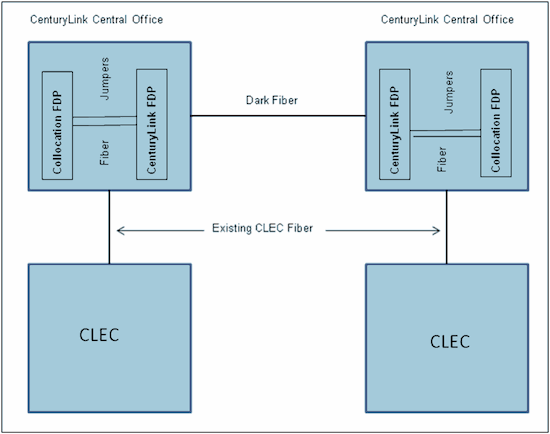
Unbundled Dark Fiber (UDF) is a deployed, unlit strand or pair of fiber optic strands that connects two points within CenturyLink™’s network within the same LATA and state. UDF is a single, existing transmission path that terminates on a CenturyLink Fiber Distribution Panel (FDP) or equivalent, between two CenturyLink Wire Centers or at an Multi-Tenant Environment (MTE) for UDF Subloop access to inside wiring.
Unbundled Dark Fiber (UDF) is offered in the following configurations:
- Unbundled Dark Fiber (UDF) Interoffice Facility (UDF-IOF) provides a deployed route between two CenturyLink Wire Centers.
- MTE Subloop Dark Fiber allows access to inside wiring of multi-unit dwellings.
Product Diagram
Unbundled Dark Fiber Interoffice Facility (UDF-IOF)
Availability
Unbundled Dark Fiber (UDF) is available throughout CenturyLink QC between CenturyLink Wire Centers where impairment exists,when spare fibers are available in the same state and in the same Local Access and Transport Area (LATA). ‘Spare’ means fibers beyond those that would be normally held for maintenance (5% of fibers in a sheath) and approved jobs.
Terms and Conditions
Your Interconnection Agreement must specifically address the types of UDF (and the applicable rates and charges) you require in order to request UDF. If your Interconnection Agreement does not include the type of UDF you are requesting, you will need to amend your Interconnection Agreement. For additional information on amending your Interconnection Agreement, refer to the Product Prerequisites section of this web page.
CenturyLink will provide unbundled access to UDF IOF when either end of a requested route is a Tier 3 Wire Center.
In addition to the TRRO Tier classifications of transport and pursuant to the Omaha Forbearance Order (OFO), CenturyLink is no longer required to, and will not provide UDF IOF in nine Wire Centers located in Omaha, Nebraska. The Omaha Forbearance Wirecenters are described at Non-Impaired Wired Center Lists for Loops and Dedicated Transport. CenturyLink shall provide unbundled dark fiber transport if a Wire Center on either end of a requested route is a Tier 3 Wire Center that is not a Forbearance Wire Center.
Unbundled Dark Fiber (UDF) is provided where facilities exist and/or where you have CLEC Requested UNE Construction (CRUNEC) per the terms and conditions of your Interconnection Agreement.
Unbundled Dark Fiber (UDF) access is provided at accessible terminals such as FDPs MTEs. You may request placement of an FDP at any building in the CenturyLink network in order to access unterminated UDF.
You must have an established collocation or other technically feasible (and mutually agreeable) means of network demarcation at both terminating points of the UDF-IOF.
A network demarcation point must be established in order to accommodate UDF optical terminations through an existing collocation. A request for UDF will not be provisioned until the collocation build is completed. If collocation and/or other network demarcation arrangements have not yet been completed, you must obtain a preliminary Alternate Point of Termination (APOT) and Carrier Facility Assignment (CFA) for your network demarcation points in each CenturyLink Wire Center where the UDF terminates. You must obtain the final APOT prior to ordering UDF service. If the final APOT is different from the preliminary APOT, the UDF provisioning interval may be affected. Additional APOT information is located in Collocation - General Information. If your collocation is being augmented for fiber terminations, you must provide your CenturyLink Service Manager with the service order number and due date of the augmentation.
CLEC to CLEC UDF-IOF connections with UDF are permissible with the mutual exchange of traffic as outlined in your Interconnection Agreement.
CenturyLink does not have an obligation to unbundle UDF, unless otherwise stated in your Interconnection Agreement.
CenturyLink will provide access to deployed UDF facilities that include all local exchange UDF that CenturyLink owns directly or has a right to access under agreements with other parties, affiliated or not, based on the terms and conditions of the agreement between CenturyLink and the other party. Refer to your Interconnection Agreement to determine accessibility. All terms, conditions, and policies for interconnection with other companies may apply for a request to terminate UDF in wire centers located outside CenturyLink QC.
Technical Publications
Technical characteristics, including Network Channel/Network Channel Interface (NC/NCI™) codes are described in Technical Publication, TRRO - Unbundled Dark Fiber, 77416.
Pricing
Rate Structure
Recurring charges bill on a month-to-month basis; term contracts are not available.
Recurring charges are comprised of the following rate elements:
- UDF-IOF Termination (fixed rate element)
- UDF-IOF Fiber Transport (per fiber strand or fiber pair)
- UDF-IOF Fiber Cross Connect (a minimum of two per fiber strand or fiber pair)
- UDF MTE Sub-Loop Termination (fixed rate element )
- UDF MTE Sub-Loop Fiber (per fiber strand or fiber pair)
- UDF MTE Sub-Loop Fiber Cross Connect (per fiber strand or fiber pair)
Nonrecurring charges are comprised of the following rate elements:
- Initial Records Inquiry (IRI)
- Engineering Verification (EV)
- FV/QP
- Order charge (initial and each additional UDF per pair/strand/route/order)
- Splicing
- This rate element is for work performed at the first manhole or splicing location associated with a UDF MTE Subloop order.
Rates
Wholesale rates for this product or service, including tariff references and any applicable discounts, are provided in your current Interconnection, Resale, Commercial, or other governing agreement.
Tariffs, Regulations and Policies
Tariffs, regulations and policies are located in the state specific Tariffs/Catalogs/Price List.
Directory Listings are not part of the UDF product offering.
An IRI is required prior to requesting provisioning of UDF. The IRI process is described in Pre-Ordering section of this web page.
During collocation builds, UDF may be reserved for 30, 60, or 90 calendar days. The reservation may be extended for the same length of time of the original request, if there is a delay in the completion of the collocation build. In addition, CenturyLink will allow UDF reservations, if the affected collocation needs to be augmented for the initial fiber terminations. At the time that the UDF IRI is submitted and reservations are requested due to a collocation augment, you must provide CenturyLink with the augmentation order number and due date. UDF reservations will also be accepted for a six-month period if your Collocation Application has not been filed. To continue the UDF reservation, CenturyLink must receive a Collocation Application no later than the last business day of the six-month period. In all cases, to extend UDF reservations, the CLEC must contact CenturyLink with information that authorizes the extension or the UDF will be reclaimed following the reservation expiration date. If you do not contact CenturyLink, CenturyLink will discontinue the reservation and stop the billing on the first calendar day following the reservation requested interval (i.e., 31st, 61st, 91st calendar days).
UDF-IOF reservation recurring charges include fiber transport, cross connects and terminations. The recurring charges will be assessed at the start of the reservation; the nonrecurring charges will be assessed after installation.
CenturyLink will provide you with access to deployed UDF facilities. You will be responsible for obtaining and connecting electronic equipment to both ends of the UDF, and you will be able to use the regenerating equipment that already exists in the facility. UDF technical parameters and related design requirements are described in Technical Publication, Unbundled Dark Fiber, 77383.
During the IRI process, CenturyLink will contact you by phone or email of the availability of either offering.
When UDF is disconnected, the UDF must be returned to CenturyLink in the same condition it was originally provided to you.
You are required to notify and ensure that all of your end-users are disconnected from the UDF prior to your requested disconnect due date.
Optional Features
No optional features are available with UDF.
Features/Benefits
| Features | Benefits |
| Provides unlimited bandwidth capabilities to you. |
|
Applications
See Features/Benefits.
Implementation
Product Prerequisites
If you are a new CLEC and are ready to do business with CenturyLink, view Getting Started as a Facility-Based CLEC. If you are an existing CLEC wishing to amend your Interconnection Agreement or New Customer Questionnaire, information is located in the Interconnection Agreement.
Pre-Ordering
Prior to ordering UDF the following pre-ordering functions may apply according to the terms and conditions of your Interconnection Agreement:
- Establish collocation or other technically feasible means network demarcation.
- Determine if your UDF request is an IRI-simple or IRI-complex inquiry, refer to the definitions below.
- Check the Fiber Data Reports Tool to determine if spare UDF is available.
- Complete and submit an Initial Request Inquiry (IRI) Form .
- Request reservation of spare UDF, if desired.
UDF requests that are IRI-simple include:
- IOF between two CenturyLink Wire Centers
UDF requests that are IRI-complex include a UDF MTE Subloop connection.
To investigate the availability of spare UDF, you may access the Fiber Data Reports Tool.
In order to access the Fiber Data Reports Tool, you must download a digital certificate from the OSS Overview. Once you have a digital certificate, you will be able to access the Fiber Data Reports and the Fiber Data Reports User Guide. The Fiber Data Report Tool can be accessed by clicking here. The Fiber Data Reports User Guide can be accessed by clicking here.
The Fiber Data Reports Tool is not a guarantee of availability of spare UDF. CenturyLink will verify if UDF is available when you submit an IRI.
You may access the following reports to check the availability of spare UDF:
- A-Z Location Fiber Inventory
- Building Electronics Inventory
- Fiber Products Spare Count
You must submit an Initial Request Inquiry (IRI) Form to verify that spare UDF exists for the route requested, unless otherwise stated in your Interconnection Agreement. Information describing form content is in the Initial Request Inquiry (IRI) Form Instructions
If you wish to reserve UDF using the IRI, you will be asked to specify the time period of the UDF reservation. If you wish to reserve UDF during a collocation augmentation for initial fiber terminations, you must provide CenturyLink with the augmentation order number and due date on the order. You may choose to reserve UDF at a later date by using the UDF Reservation Request form as described below.
Once the IRI form is complete, submit the form to CenturyLink via email to the Wholesale Service Support Team (WSST) wholesale.servicesupportteam@centurylink.com. If spare UDF is available, you will receive the Unbundled Dark Fiber IRI/Reservation Confirmation Form containing:
- Up to five routes
- Intermediate wire centers, if applicable, for each route
- An estimate of recurring and nonrecurring charges for each route
- A confirmation of the length of the UDF reservations
- The Reservation Effective Date
- UDF in strand or by the pair
The routes available will be displayed from shortest to longest, and if you requested a reservation of UDF on the IRI form, the route reserved will be the first route listed on the response. If more than five routes are available, your CenturyLink Service Manager will contact you by phone or email that the additional routes exist and negotiate how the information will be made available.
To view an example of a completed Unbundled Dark Fiber IRI/Reservation Confirmation Form click here. You will receive this form in response to submitting an IRI.
If the UDF request is an IRI-complex you are required to complete the Field Verification / Quote Preparation (FV/QP) Formfor CenturyLink to verify the locations for access to MTE Subloops and the fieldwork required access. CenturyLink will verify the spare UDF and observe the facility or manhole for access to the MTE. You may complete the FV/QP form and return the request towholesale.servicesupportteam@centurylink.com. Refer to the Field Verification / Quote Preparation (FV/QP) form Instructions to obtain information on how to complete the FV/QP form.
The FV/QP process is 20 business days. The FV/QP process initiates the quote and due date for access to the existing structure or splicing locations. As a part of the FV/QP process, EV will identify additional engineering records with MTE access and availability. The EV starts the FV/QP timeframe of 20 business days. If access to the MTE is not available over the requested route, CenturyLink will terminate the request, and you will be billed for the EV portion of the FV/QP. If access to MTE via UDF Subloop is available and you want to move forward with the process, the timeline for the FV/QP will remain on schedule for the remainder of the 20 business days and you will be billed for the FV/QP. The cost of the EV is deducted from the total charge of the FV/QP.
If you did not reserve spare UDF using the IRI, you may choose to complete the UDF Reservation Request. Information describing form content is in the UDF Reservation Request instructions. Submit the completed UDF Reservation Request to: wholesale.servicesupportteam@centurylink.com.
To cancel a UDF reservation, complete and submit the UDF Disconnect/Reservation Cancellation Form.
Ordering
UDF products are ordered using the Access Service Ordering Guidelines (ASOG) forms with unique NC/NCI codes identified in Technical Publication, TRRO - Unbundled Dark Fiber, 77416. Form and field entry requirements are described in the ASOG. The Order and Billing Forum (OBF) nationally agree upon the ASOG forms.
The standard ASOG forms used for ordering UDF products are:
| ASOG forms | UDF-IOF | E-UDF | UDF MTE Sub-Loop | UDF Loop, UDF Sub-Loop |
| Access Service Request (ASR) | X | X | X | X |
| Additional Circuit Information (ACI) | X | X | X | X |
| Transport form | X | X | X | X |
| Service Address Location Information (SALI) form | X | X | X |
Although additional forms and fields are required, the following field entries identify the order as a UDF product.
| Form Name | Field Name | Definition | Valid Entry |
| ASR | REQTYP | Request Type. | S |
| SPEC |
Service and Product Enhancement Code.
Will be populated with the type of UDF being ordered. |
If ordering: UDF-IOF = UDFTSP UDF MTE Subloop = UDFSLP |
|
| REMARKS | If you have UDF reservation include the Reservation CLO(s). |
UDF Reservation CLO(s) __________."
A Reservation CLO includes 3 alpha characters and 9 numeric characters. |
|
| Include the name and contact information of the person who accessed the Fiber Data Reports Tool, along with the date the Fiber Data Reports Tool was checked. | UDF is available per the Fiber Data Reports Tool on MM/DD/YY for more information contact ________at ___-___-____." | ||
| If the desired route contains intermediate wire centers, include the CLLI codes found on the Unbundled Dark Fiber IRI/Reservation Confirmation form. | CLLI code(s) identifying the intermediate wire centers. | ||
| If UDF IOF/UDF Loop premises combination | This is a UDF IOF/UDF Loop premises combination" | ||
| If this a UDF-IOF request | CLLI Code(s) identify the test wire center for CenturyLink Technicians to provide light detector | ||
| If IRI performed | Must have a BAN for IRI | ||
| IMPCON | Implementation ContactIdentifies the person responsible for UDF continuity testing. | First and last name of continuity testing contact, this field allows 15 alphanumeric characters. | |
| TEL NO (IMPCON) | Telephone number for the UDF continuity testing contact. | This field allows 17 numeric characters (including 3 preprinted hyphens). |
Service interval guidelines are located in the SIG.
The Design Layout Record (DLR) allows you to obtain design layout records leased by your company. The DLR request is described in the EASE-LSR XML Network Disclosure Document or the EASE-LSR User's Guide.
Provisioning and Installation
General provisioning and installation activites are described in the Provisioning and Installation Overview.
CenturyLink will contact you by phone or email to arrange joint continuity testing within the provisioning interval identified in the SIG. CenturyLink and your continuity testing contact identified on the ASR form in the IMPCON field, must coordinate the date and time of the continuity testing. As part of our respective duties regarding the continuity test, CenturyLink will furnish a light detector at one termination point of the UDF, and you will furnish the light generating equipment at the other termination point of the UDF as described below:
- UDF-IOF: CenturyLink and your contact will mutually agree on the wire center where CenturyLink must provide a light detector and the wire center where your contact must provide the light generating equipment. In some states, you may specify the wire center where CenturyLink will provide the light detector according to the terms and conditions of your Interconnection Agreement.
- UDF MTE Sub-Loop: CenturyLink will joint test at an agreed upon time scheduled with your contact and CenturyLink.
Firm Order Confirmation (FOC) and other UDF service intervals are located in the SIG.
A jeopardy occurs on an order if a condition exists that threatens timely completion. Detailed information regarding jeopardy codes are described in the Provisioning and Installation Overview.
Maintenance and Repair
CenturyLink cannot monitor UDF. Such monitoring is normally completed using electronic equipment connected to the fiber provided by you. However, in the case of a major cable failure affecting the entire cable, CenturyLink would normally detect problems on our fibers, taking appropriate action to restore fiber-based services.
You are responsible for trouble isolation before reporting trouble to CenturyLink. Joint testing between you and CenturyLink may occasionally be necessary to isolate trouble. Both parties will perform cooperative testing and trouble isolation to identify where trouble points exist. You are responsible for repairing your cross connections; CenturyLink cross connections will be repaired by CenturyLink.
If it is determined that the UDF does not meet the minimum fiber parameters of Technical Publication,TRRO - Unbundled Dark Fiber, 77416 and the trouble is in the CenturyLink UDF facility, CenturyLink will attempt at no additional cost to repair the UDF as it relates to CenturyLink cross connects and jumper. If CenturyLink cannot repair the UDF to meet these minimum parameters, CenturyLink will replace the UDF at no additional cost, if suitable UDF pair(s) are available.
General maintenance and repair activities are described in the Maintenance and Repair Overview.
CenturyLink includes unbundled dark fiber in the facilities for which it will provide Customer notice via a phone call for planned maintenance activities.
Billing
The IRI, EV and FV/QP will be billed to you as soon as these services are requested and payment is due upon receipt of the bill. The IRI, EV and FV/QP are billed through the Billing and Receivable Tracking (BART). BART billing is described in Billing Information - Billing and Receivable Tracking (BART). For UDF requests involving the FV/QP process, 50% of the quote provided during the FV/QP process must be received prior to intiating the work. The remaining 50% must be remitted prior to sending a service request. All recurring and nonrecurring charges associated with the installation are billed through the Carrier Access Billing System (CABS™). CABS billing is described in Billing Information - Carrier Access Billing System (CABS™).
Training
Local CenturyLink 101 "Doing Business With CenturyLink"
- This introductory web-based training course is designed to teach the Local CLEC and Local Reseller how to do business with CenturyLink. It will provide a general overview of products and services, CenturyLink billing and support systems, processes for submitting service requests, reports, and web resource access information. Click here for Course detail and registration information.
Unbundled Loop (UBL)
- This instructor-led process and systems training course is designed tointroduce and teach the Unbundled Loop (UBL) products, instructing CLECs on how to request service for Unbundled Loops. This course will provide an overview of the current UBL products, and address the PreOrder, Order, Post-Order, Provisioning, Billing and CEMR-MTG Maintenance and Repair. Click here to learn more about this course and to register.
View additional CenturyLink courses in the Course Catalog.
Contacts
CenturyLink contact information is located in the Wholesale Customer Contacts.
Frequently Asked Questions (FAQs)
This section is currently being compiled based on your feedback.
Last Update: November 18, 2021
Common Language® is a Registered Trademark of Telcordia
Technologies, Inc.
CLLI™ and LERG™ are Trademarks of
Telcordia Technologies, Inc.