Product Catalog (PCAT)
Unbundled Local Loop - Digital Subscriber Line - Integrated Services Digital (xDSL-I) Capable Loop - V27.0

NOTE: The Federal Communications Commission ("FCC" or "Commission") released Order FCC 20-152 on October 28, 2020, a Report and Order in WC Docket 19-308 for the Modernizing Unbundling and Resale Requirements in an Era of Next-Generation Networks and Services ("Order"), which became effective February 8, 2021, and altered CenturyLink’s obligations to provide certain unbundled network elements. As such, these services will no longer be available after the following transition periods, consistent with the terms of the UNE Modernization Forbearance Amendment: 1) DS1- new orders not available after February 8, 2023; 2) DS3- new orders not available as of February 8, 2021; 3) DS0/ADSL/xDSL/ISDN BRI - new orders not available after February 8, 2023; 4) UNE Subloops and NIDs- new orders not available as of February 8, 2021; 5) Dark Fiber Transport- new orders not available as of February 8, 2021; and 6) OSS- subject to the transition periods applicable to the corresponding UNEs. The wire center lists pertaining to this order can be found at: http://www.centurylink.com/wholesale/clec.html.
Product Description
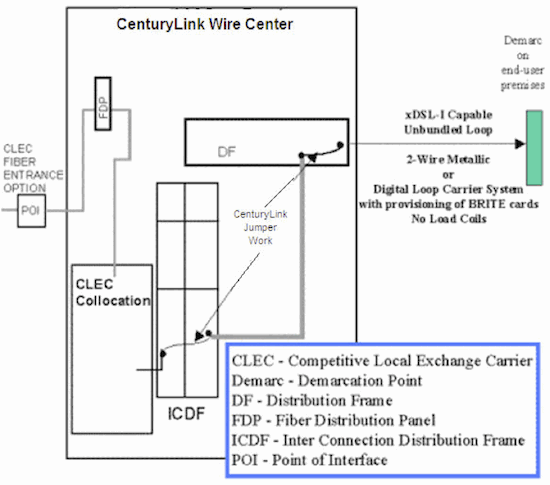
The Unbundled Local Loop Digital Subscriber Line - Integrated Services Digital Network (xDSL-I) Capable Loop is a 2-wire facility that provides a transmission path from the CenturyLink™ Central Office (CO) Distribution Frame, or equivalent, to the loop demarcation point at the end-user premises. This loop transports bi-directional, 2-wire signals with a nominal transmission rate of 160 kilobits per second (kbps). It will permit access to 144 Kbps unchannelized payload bandwidth for transport of services.
The xDSL-I Capable Loop is typically provided in one of the following configurations:
- A non-loaded metallic loop technically qualified for xDSL-I transmission without the need for additional equipment
- A combination of a long non-loaded metallic loop, a mid-span regenerator and a CO power unit referred to as Extension Technology.
- A combination of Universal Mode Subscriber Loop Carrier (SLC) channels and qualified non-loaded metallic loop.
Technical Publication 77392, provides information on High Speed Internet
Technical Publication 77399, provides information on Digital Data Service 2-Wire, reads: "The transmission path’s facility is consistent with Telcordia Technical Reference, TR-TSY-00393, ISDN Basic Access Digital Subscriber Lines and ANSI T1.601.1992, Telecommunications – Integrated Services Digital Network (ISDN) Basic Access Interface for Use on Metallic Loops for Application on the Network Side of the NT (Layer 1 Specification)."
Therefore, when CenturyLink refers to Integrated Services Digital Network (ISDN) or xDSL-I in Wholesale documentation, including the Product Catalogs (PCATs), Technical Publications or the Local Service Ordering Guidelines (LSOG), CenturyLink is referring to the same physical facility capabilities. You can use these terms interchangeably only when talking about loop qualification or facility capabilities. Likewise, the loop make-up information in the Raw Loop Data (RLD) Tool will indicate the same physical make-up for ISDN or x-DSL-I requests.
The difference between ISDN and x-DSL-I is that each can require specific transmission equipment in the CO to generate the appropriate signal. Although the facilities offer the same payload (144 kbps), the equipment causes the distinction in the signal (i.e., ISDN = 2B+D channelized signal vs. x-DSL-I = full payload unchannelized signal).
General information regarding Unbundled Local Loop is located in Unbundled Local Loop - General Information.
Product Diagram
Availability
DSL-I Capable Loop is available where facilities exist throughout CenturyLink QC.
Terms and Conditions
General Interconnection Agreement, regulations and policy information for the xDSL-I Capable Loop is described in the Terms and Conditions section of Unbundled Local Loop - General Information.
Technical Publications
Technical recommendations, including Network Channel/Network Channel Interface (NC/NCI™) codes, operational characteristics and available interfaces for xDSL-I Capable Loop are specified in:
- Technical Publication, Interconnection - Unbundled Loops, 77384
- Technical Publication, High Speed Internet Services, 77392
- Technical Publication, CenturyLink Digital Data Service 2-Wire,77399
Pricing
Rate Structure
Recurring charges f are comprised of the following rate elements:
- Digital Capable/ xDSL-I Capable Loop
- Interconnection Tie Pair (ITP), per connection
- Extension Technology, if applicable
Recurring charges are billed on a month-to-month basis.
Nonrecurring xDSL-I Capable Loop charges include:
- The installation option selected for xDSL-I Capable Loop
- Extension Technology, if ordered subsequent to initial installation
Nonrecurring charges are billed after the service is rendered. Term contracts are not available. A nonrecurring charge applies to the installation of service(s) and in some states a disconnect service(s) charge will apply.
Additional charges can apply. See the Rate Structure section under Pricing section of Unbundled Local Loop - General Information.
Rates
Wholesale rates for this product or service, including tariff references and any applicable discounts, are provided in your current Interconnection, Resale, Commercial, or other governing agreement.
Tariffs, Regulations and Policy
Tariff, regulations and policies are located in the state specific Tariffs/Catalogs/Price Lists.
Optional Features
Extension Technology is the physical placement of range extension devices, CO powering or regenerator(s), either at the CO or in the Outside Plant (OSP) facilities within the CenturyLink network. Extension Technology may be required in order to bring the circuit to the specifications necessary to accommodate the requested service. If the Circuit Design requires Extension Technology, to bring it up to the design standards, it will be added by CenturyLink , at no charge. Extension Technology can also be requested with the ISDN BRI Capable Loop to meet your specific needs. If Extension Technology is requested by the CLEC, but is not required to meet the technical standards, then CenturyLink will provide the requested Extension Technology and will charge the CLEC as indicated in your Interconnection Agreement. You may use the CenturyLink loop qualification tools to determine if Extension Technology is required.
Extension Technology consists of one or a combination of the following components and may require additional equipment:
- CO based loop extension cards
- CO based and/or mid-span repeaters
- Higher bandwidth Universal Mode SLC with remote terminals
Extension Technology is not available if any of the following conditions exist on the loop:
- Pair gain, either Universal or Integrated
- Basic Rate Interface Transmission Extension (BRITE) cards
Provisions for Extension Technology is in your Interconnection Agreement. If you do not have provisions for Extension Technology and you and would like to initiate the process for an amendment, refer to Negotiations Template Agreement or contact your CenturyLink Service Manager.
Features/Benefits
| Features | Benefits |
| Market Presence |
|
| Low Cost |
|
Applications
See Features/Benefits.
Implementation
Product Prerequisites
If you are a new Competitive Local Exchange Carrier (CLEC) and are ready to do business with CenturyLink, view Getting Started as a Facility-Based CLEC. If you are an existing CLEC wishing to amend your Interconnection Agreement or your New Customer Questionnaire, additional information is located in the Interconnection Agreement.
Pre-Ordering
General pre-ordering information is described in the Pre-Ordering Overview. The EASE-LSR User's Guide specifically details the information applicable to pre-ordering functions.
Loop Qualification
CenturyLink strongly recommends use of pre-ordering functionality to assist in achieving increased service order flow through and accuracy, which will result in reduced service order rejects.
The following activities may need to be performed by you in preparation for the issuance of an ordering request:
- Validate address
- Check facility availability
- Validate Connecting Facility Assignment (CFA)
- Review Customer Service Record (CSR)
- Query RLD
- Query Integrated Services Digital Network (ISDN) Facility Availability Tool
More information can be found on these activities in the Loop Qualification and Raw Loop Data - CLEC Job Aid.
These activities will enable you to verify the type of facility and the loop make-up of the Unbundled Local Loop, which will assist you in identifying the appropriate ordering intervals, described in the Service Interval Guide (SIG).
Additional pre-ordering information is available in the Pre-Ordering section of Unbundled Local Loop - General Information.
Ordering
General ordering activities are identified in the Ordering Overview. Additional ordering information is available in the Ordering section of Unbundled Local Loop - General Information.
Unbundled Local Loop Installations Options:
Six installation options are available for Unbundled Local Loop. Detailed information about the different installation options is available in the Ordering section of Unbundled Local Loop - General Information.
Circuit ID (ECCKT)
xDSL-I Capable Loop are assigned with Circuit Identification numbers. Detailed information about the Circuit Identification number format is available in the Ordering section of Unbundled Local Loop - General Information.
Conditioning
xDSL-I Capable Loop may require conditioning (removal of Load Coils and/or Interfering Bridged Taps). Specific information on loop conditioning is available in the Ordering section of the Unbundled Local Loop - General Information.
Required Forms and Activity Types
xDSL-I Capable Loop orders are submitted using the following LSOG forms:
- LSR
- End User (EU)
- Loop Service (LS)
- Directory Listing (DL), if appropriate
Field entry requirements are described in the LSOG. Valid LSR ACT types are described in the Ordering section of Unbundled Local Loop - General Information.
Orders should be placed using <EASE-LSR Extensible Markup Language (XML) or EASE-LSR Graphical User Interface (GUI).
Service interval guidelines are found in the SIG. The installation interval for Unbundled Local Loop depends on work associated with conditioning of the facility, if applicable.
A Design Layout Record (DLR) request is described in the EASE-LSR XML Network Disclosure Document and in the EASE-LSR User's Guide.
Orders can be rejected for various reasons. Error and rejection notifications are described in the Ordering Overview.
Upon receipt of a complete and accurate LSR, CenturyLink will review the facilities information and design the Unbundled Local Loop based on the ANSI Standard T1.601 technical parameters. CenturyLink will determine if Extension Technology is required in order to meet ANSI Standards. If Extension Technology is required, CenturyLink will provision the Unbundled Local Loop requested and place the Extension Technology equipment at no additional cost to you.
You can request Extension Technology to meet your specific needs. To request Extension Technology be applied to a loop, you will need to supply the following information on the LSR:
- MANUAL IND field with `Y', which will ensure manual handling
- DSPTCH field with 'Y'
In the Remarks section of the LSR you will need to request Extension Technology. For more information about Extension Technology, refer to the Optional Features section.
Provisioning and Installation
General provisioning information is available in the Provisioning and Installation Overview and in the Provisioning section of Unbundled Local Loop - General Information.
Firm Order Confirmation (FOC) intervals are located in the SIG.
A jeopardy occurs on a service order if a condition exists that threatens timely completion. Jeopardy notifications are described in the Provisioning and Installation Overview.
Performance testing available on the xDSL-I Capable Loop includes:
- No Load Coils, Opens, Grounds, Shorts, Noise, or Foreign Volts
- Insertion Loss at 40 kilohertz (kHz)
- Automatic Number Identification (ANI) when dial-tone is present prior to conversion of a CenturyLink circuit to a CLEC
Transmission performance parameters and limits are available in Technical Publication 77384.
Loss and Completion Reports are generated based on loss and gain account activity. Loss and Completion Reports are described in Billing Information - Additional Output - SMDR, Completion Report, Loss Report.
Spectrum Management information is available in the Provisioning and Installation section of Unbundled Local Loop - General Information.
Refer to section 9.2.2.7 in the SGAT regarding the statement that CenturyLink is not obligated to provision xDSL-I, capable Loops to End User Customers in areas served exclusively by Loop facilities or transmission equipment that are not compatible with the requested service.
Hours of Operation
Installation hours are described in the Provisioning and Installation section of Unbundled Local Loop - General Information.
Maintenance and Repair
General maintenance and repair activities are described in the Maintenance and Repair Overview.
Billing
Customer Records and Information System (CRIS) billing is described in Billing Information - Customer Records and Information System (CRIS).
Training
View CenturyLink courses by clicking on Course Catalog.
Contacts
CenturyLink contact information is located in Wholesale Customer Contacts.
Frequently Asked Questions (FAQs)
This section is being compiled based on your feedback.
Last Update: November 4, 2021
Last Reviewed: November 3, 2023
NC/NCI™ is a Trademark of iconectiv®.