Product Catalog (PCAT)
Commercial Shared Distribution Loop (SDL) - V17.0

NOTE: The Federal Communications Commission ("FCC" or "Commission") released the Triennial Review Order, 18 FCC Rcd 16978 in 2003, and altered CenturyLink's obligations to provide certain unbundled network elements. As such, these services will no longer be available after the following transition periods, consistent with the terms of the FCC Orders: 1) Loop Splitting - new orders not available after 2004; 2) Line Splitting - new orders not available after 2004; 3) Line Sharing - new orders not available after 2004; 4) Shared Distribution Loop - new orders not available after 2004.
Product Description
Commercial Shared Distribution Loop (SDL) replaces the Interconnection Shared Distribution Loop (SDL) product which is no longer available for new service requests after October 2, 2004 pursuant to the Federal Communications Commission's (FCC's) Triennial Review Order.
Commercial SDL provides you with the opportunity to offer advanced data services on the distribution portion of a loop simultaneously with an end-user's existing analog voice grade service (also known as Plain Old Telephone Service (POTS)), which is provided by CenturyLink.
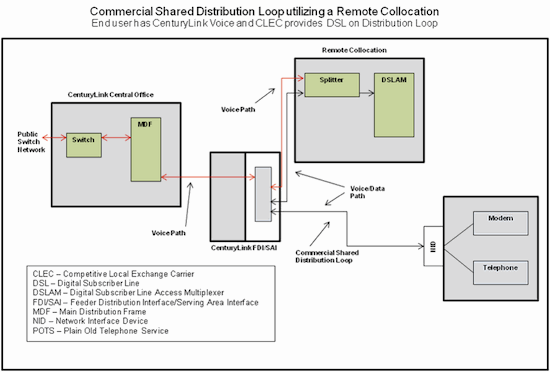
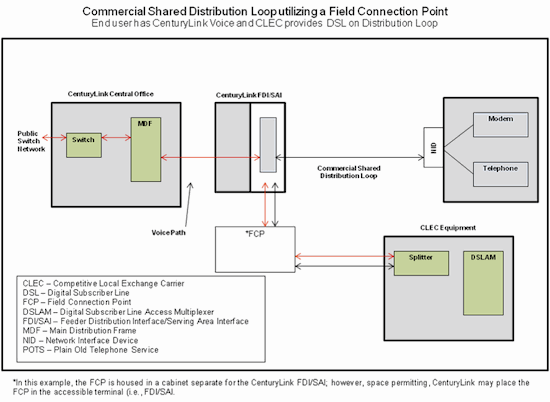
The Sharing of the POTS loop is accomplished by utilizing the high frequency range above the voice band range on the distribution portion of the copper loop. There may only be one Data Local Exchange Carrier (DLEC) at any given time that provides advanced data service on any given distribution loop. The voice circuit must originate at the CenturyLink Central Office (CO) and terminate at the Network Interface Device (NID) at the customer location. The data portion of the circuit originates at your Remote Collocation or a Field Connection Point (FCP), which has been established at a technically feasible distribution interface point within the local loop.
You are required to gain access to the Commercial SDL through an established technically feasible interface point at a Field Distribution Interface (FDI)/ Serving Area Interface (SAI) by establishing a Remote Collocation or a FCP.
You must also have a Digital Subscriber Line Multiplexer (DSLAM) and a Splitter installed at your Remote Collocation or FCP Terminations that have been established specifically for SDL may also be used for Commercial SDL, but must be established before placing the Commercial SDL request. The end-user must have dial tone originating from a CenturyLink switch in the Serving Wire Center. You must provide the end-user with, and are responsible for, the installation of any equipment necessary for the end-user to receive separate voice and data service across the copper loop.
Other alternatives for providing data services:
Line Splitting is available with compatible commercial local exchange services products (e.g. CenturyLink Local Service Platform™ (CLSP™)).
Resale - CenturyLink Commercial Broadband Services are available with compatible Resale and commercial local exchange services.
If you have Unbundled Loop at a CO based collocation, you have the following options:
- Commercial Line Sharing provides you with the ability to order new commercial line shared service from your CO collocation. See Commercial Line Sharing
- Loop Splitting provides combined voice and data services on the same facility. See Loop Splitting
- Stand-alone Competitive Local Exchange Carrier (CLEC) data services.
Product Diagram
Availability
Commercial SDL is available where facilities exist throughout CenturyLink QC and where existing compatible facilities are available. Commercial Shared Distribution Loop is not available on Fiber To The Building (FTTB) or Fiber To The Premise (FTTP) facilities.
You are responsible for determining whether the physical characteristics of the facility are compatible with your data service. Technical requirements for compatibility for Commercial SDL are the same as for Unbundled Distribution Loop (UDL). CenturyLink's Interconnection - Unbundled Sub-Loops and Field Connection Technical Publication 77405 informs you which facilities are compatible with UDL.
Prior to requesting Commercial SDL, you must also have an amendment with provisions for Commercial SDL in your Interconnection Agreement. You must also sign a separate SDL Commercial Agreement. If you would like to initiate the process for obtaining these agreements, see the Wholesale Interconnection Agreements & Amendments web site.
Terms and Conditions
You must have a Remote Collocation or FCP installed to access the distribution portion of the loop. You must provide and own the Splitter as well as terminations established specifically for Commercial SDL. All must be in place prior to submitting service requests for Commercial SDL.
You are responsible for the additional structure including but not limited to your Remote Collocation and FCP. The electronics and the cables between the structure and the Remote Collocation or FCP are your responsibility. You are also responsible for repair and maintenance of the splitter.
You must provide the end-user with, and are responsible for, the installation of a splitter/filter(s) and other equipment necessary at the end-user's premise for the end-user to receive separate voice and data service across a single copper loop.
For Commercial SDL, there may only be one DLEC at any given time that provides advanced data service on any given distribution loop.
The Splitter and DSLAM must comply with American National Standards Institute (ANSI) T1.413 Annex E and must meet CenturyLink's Collocation equipment guidelines.
The data service must comply with ANSI T1. 417 as well as CenturyLink's technical requirements detailed in CenturyLink's Interconnection - Unbundled Sub-Loops and Field Connection Technical Publication 77405. The ANSI On Line web site allows you to search for ANSI Standards documents.
Technical Publications
Technical characteristics, including Network Channel/Network Channel Interface (NC/NCI™) codes are described in Technical Publication, Interconnection - Unbundled Sub-Loops and Field Connection, 77405.
Pricing
Rate Structure
Recurring charges for Commercial SDL may consist of the following:
- Operational Support Systems (OSS)
- The Commercial SDL
- Two Interconnection Tie Pairs (2 ITPs), 1 for voice and 1 for combined voice/data, per connection
Nonrecurring charges for Commercial SDL may consist of the following:
- Any additional testing performed by CenturyLink after trouble has been isolated to the portion of the network for which you are responsible
- Installation charge, per loop
- Loop Conditioning charge
For any elements/charges associated with the construction of the Remote Collocation or the FCP, see the Remote Collocation or the FCP.
Additional rate structure information can be found in your Interconnection Agreement.
Recurring charges bill on a month-to-month basis; term contracts are not available.
One-month minimum billing, contract termination liability and associated contract charges for the product from which the service is being converted will apply.
Rates
Wholesale rates for this product or service, including tariff references and any applicable discounts, are provided in your current Interconnection, Resale, Commercial, or other governing agreement. Regulations and Policies
CenturyLink must provide the end-user's POTS. If the end-user disconnects their POTS with CenturyLink, the data portion of the loop will also be disconnected. This information will be reflected in the Loss and Completion Report. Information regarding Loss and Completion Reports is described in the Provisioning and Installation Overview.
Features/Benefits
| Features | Benefits |
| Provides data and voice on the same copper distribution loop. | Enables you to offer data services quickly and affordably, without the cost of separate unbundled loops or new facilities even when an end-user is served by Digital Loop Carrier facilities. Enables end-users to receive data over the high frequency portion of their existing line and eliminates the need to invest in an additional line. |
| Provides access to facilities throughout CenturyLink QC. | Provides service in rapidly-growing areas, including those where there may be a shortage of facilities. |
Applications
The following are examples of how Commercial SDL could be offered:
- XYZ Carrier is offering a competitive DSL service and is contacted by an interested small business owner who does not want to purchase another line specifically for data. The owner seems ready to request the service, but is informed that he is served on Digital Loop Carrier facilities. XYZ Carrier's Customer Service Representative learns that the small business currently has voice service from CenturyLink. This small business is also served out of a remote terminal where XYZ Carrier has a Remote Collocation with Splitters and DSLAMs installed. The carrier does a loop qualification and finds that its DSL service, which is acceptable for Commercial SDL, can be added to the business' existing line. The owner's objection to installing a second line is overcome as need for a second line is negated because it is no longer required. XYZ Carrier gains a new DSL service customer.
- A consumer contacts ABC Telecom about obtaining its data service. But the company learns that there are no spare facilities running to this individual's location and they are served on Digital Loop Carrier facilities. ABC finds the consumer has voice service from CenturyLink and determines that ABC Telecom has Splitters installed at the remote terminal serving the customer. ABC Telecom performs a loop qualification and determines that its data service, which is acceptable for Commercial SDL, can be added to the individual's existing voice line. When CenturyLink and ABC Telecom have completed provisioning and installation, the consumer is able to obtain data service-even though there were no spare facilities available.
Implementation
Product Prerequisites
Prior to requesting Commercial SDL, you must have an amendment with provisions for Commercial SDL in your Interconnection Agreement. You must also sign a separate SDL Commercial Agreement. If you do not have an amendment and would like to initiate the process for an amendment, see Wholesale Interconnection Agreement and Amendments.
If you are a new CLEC and are ready to do business with CenturyLink, view Getting Started as a Facility-Based CLEC. If you are an existing CLEC wishing to amend your Interconnection Agreement or New Customer Questionnaire, additional information is located in the Interconnection Amendment and Commercial Agreement documents.
Pre-Ordering
General pre-ordering activities are described in the Pre-Ordering Overview.
Requirements for pre-ordering are described in Local Service ordering Guidelines (LSOG), Pre-Order.
CenturyLink recommends use of Pre-Ordering functionality to assist in achieving increased service request flow through and accuracy that will result in reduced service request rejects.
The loop qualification query should be used prior to submitting a service request. Use of these queries can greatly reduce service request rejects by ensuring the types of facilities requested are available prior to placing a service request. The queries will enable you to verify the type of facility and the physical characteristics of the facility. Based on the physical characteristics you can determine if the facility needs to be conditioned, i.e., the removal of load coils or bridged tap, which will assist you in identifying the appropriate service request intervals, described in the Service Interval Guide (SIG) for Resale and Interconnection Services. Some of these queries are available in EASE-LSR and others are web-based. The queries are available for you to access the physical characteristics of the CenturyLink loop facility and are based on data obtained from CenturyLink's underlying network records. This is the same underlying data that CenturyLink utilizes for its retail product offerings.
The following applies to the loop qualification queries:
- The queries are for informational purposes only and do not restrict or imply that your service will or will not work on a given facility. This determination is your responsibility.
- Some of the queries offered include CenturyLink's evaluation of the recorded and calculated loop characteristic information.
- As mentioned, the physical characteristics provided are based on CenturyLink's plant facility database. If you encounter any inaccuracies in the information, contact your CenturyLink Service Manager.
- The data provided to you at the time you perform a query may be refreshed on a periodic basis and could change by the time you submit your service request.
EASE-LSR queries are:
- ADSL Qualification
- Loop Qualification
- Raw Loop Data (RLD)
Web based queries is:
- Wire Center RLD
The Wire Center RLD provides wire center specific information. This query provides the physical characteristics of the facilities for an entire wire center. The wire center raw loop data is presented as a comma delimited file and needs to be downloaded into a database or spreadsheet to analyze the individual facilities. Contact your CenturyLink Service Manager to request an ID, which will be required to obtain the digital certificate, required to access this query. You will need to provide the names and telephone numbers of your employees that will be accessing the query. After your CenturyLink Service Manager has notified you that the necessary access permissions have been established, and provided you with your ID you may then initiate the digital certification process.
The ADSL Qualification Query can be accessed via EASE-LSR to pre-qualify the requested facility, inquiring against the existing telephone number or service address. This query provides some basic physical characteristics of the facility and provides you information, which allows you to determine if the facility qualifies for a Commercial SDL. If the end-user's telephone number is a Port-Within telephone number also known as a Location Ported telephone number, you must use the address to perform a loop qualification. Information regarding the Loop Qualification query is described in the EASE-LSR User's Guide.
Information about the EASE-LSR based loop qualification queries are available in the EASE-LSR User's Guide or the Pre-Ordering Overview. The EASE-LSR Loop Qualification and Raw Loop Data-CLEC Job Aid is a web-based training course designed to provide valuable information and instructions on how to use and interpret EASE-LSR-based loop qualification queries and the raw loop data queries.
Ordering
General ordering activities are described in the Ordering Overview.
The EASE-LSR User's Guide specifically details the information applicable to ordering functions.
Valid NC/NCI™ codes are required on all Commercial SDL requests. They are described in Technical Publication, Interconnection - Unbundled Sub-Loops and Field Connection, 77405.
The Basic Installation option is available for Commercial SDL. For an existing end-user, the Basic Installation option is the 'lift and lay' procedure. The CenturyLink technician 'lifts' the loop from its current termination and 'lays' it on a new termination connecting to the CLEC. Test results are not provided to the CLEC.
Service requests should be placed using EASE-LSR Extensible Markup Language (XML) or EASE-LSR Graphical User Interface (GUI).
The limitations when requesting multiple lines for Commercial SDL on a single service request are as follows:
- CenturyLink will accept multiple Commercial SDL requests on a single service request if the telephone numbers are associated with the same Customer Service Record (CSR). When you submit a service request requesting Commercial SDL for multiple telephone numbers from the same CSR, the quantity on the LQTY field on the LS form of the service request must be equal to the number of lines to which Commercial SDL is being added.
- Quantities equal to or greater than 25 are considered a project. Projects.
Commercial SDL service requests are submitted using the Local Service Ordering Guidelines (LSOG) forms. Detailed information describing field entry requirements are available on the LSOG. Commercial SDL service requests are placed using the following LSOG forms:
- Local Service Request (LSR)
- End User (EU)
- Loop Services (LS)
Valid LSR ACT type is a 'C' for Change (existing POTS account); the valid REQTYP on the LSR is 'AB'. Some of the more common information required on the LSR include:
- Valid NC and NCI Code
- Desired Due Date
- Contact Information
Some of the more common information required on the LS include:
- End-user telephone number to be shared
- Splitter information
Valid LNA field types on the LS are:
- D = Disconnect
- M = Inside Move
- N = New Installation
- V = Conversion As Specified
You will need the following information on your service request:
| Form(s) | Field | Populate with this Information |
| LS | POTSSPLITTER LOC | |
| LS | LINE SHARED TN | End-user's telephone number to be shared |
| EU, LS, LSR | REMARKS | The DSLAM and cable and the pair, (e.g. DSL3743EAT, PR 0001). |
| EU, LS, LSR | MANUAL IND | "Y" |
An Alternate Point of Termination (APOT) form is provided to you as part of the Remote Collocation or FCP hand-off process. The splitter meet points for the Commercial SDL are identified on the APOT form. Information contained on the APOT form is required on all Commercial SDL requests.
The following table provides an example of format used to identify the splitter location.
| Character Field Location | Field Entry * |
| Characters 1 through 3 | vda |
| Characters 4 through 8 | Cable Pair |
| Characters 9 through 11 | Voice Pair |
* vda.ALT06.201 is an example of the format.
You can request conditioning on the loop. If your loop requires conditioning, CenturyLink will perform the requested conditioning on the loop to remove load coils and excessive bridged taps. Charges for removal of load coils and excessive bridged taps on SDL are contained in the Exhibit A of the SDL Commercial Agreement and ICA Amendment.
If you request conditioning and the conditioning significantly degrades the voice services on the loop to the point where it is unacceptable to the end-user, charges will be assessed to recondition the loop. You may request bridge tap and load coil removal by entering a 'Y' in the SCA field of the LSR.
The following applies when loop conditioning is requested on the service request:
Whether or not conditioning is required per the systems:
- Upon receipt of an accurate and complete service request, you will receive a Firm Order Confirmation (FOC) based on the standard interval found in the SIG. Separate intervals apply based on whether or not conditioning is required.
The following applies when loop conditioning is not requested on the service request:
If conditioning is not required per the systems (qualification passed):
Upon receipt of an accurate and complete service request, CenturyLink will perform an initial evaluation to determine if the loop will support Commercial SDL. If the initial evaluation reflects that loop conditioning is not required to support Commercial SDL, you will receive a FOC based on the standard interval.
- If at any time, after you receive the FOC and prior to the scheduled due date, CenturyLink determines the qualification was a false positive (when loop qualification is successful but Commercial SDL cannot be provisioned on the line without conditioning). CenturyLink will make every attempt to provision the Commercial SDL request, including Line Conditioning, within the original scheduled DD without requiring a supplemental service request. In the event that the conditioning work cannot be completed within the original scheduled DD the CLEC will receive a jeopardy and will be required to submit a Sup with a Y in the SCA field authorizing the standard line conditioning interval.
If conditioning is required per the systems (qualification failed):
- If it is determined by the initial CenturyLink evaluation that the loop cannot support Commercial SDL without performing conditioning, and no authorization has been given, the service request will be rejected and you will be required to resubmit the service request authorizing conditioning on the loop.
Standard intervals and critical dates are available in the SIG.
If qualified facilities are unavailable, the service request will be rejected for a No Facilities reason. Reject notification information is described in the Ordering Overview.
Projects
Quantities equal to or greater than 25 are considered a project. If you relate Purchase Order Numbers (PONs) and associate service requests to a Project Identification Code in the PROJECT field on the LSR, or if the LQTY field on the LS has 25 or more loops, the request will be handled as a project by the Center responsible for handling your account. When you submit a service request requesting Commercial SDL for multiple telephone numbers from the same CSR, the quantity on the LQTY field must be equal to the number of lines to which Commercial SDL is being added. The installation guidelines for the project are negotiated on an Individual Case Basis (ICB) based on the request. The main point of contact for your project will be your CenturyLink Service Manager.
Provisioning and Installation
Provisioning information and design requirements for Commercial SDL are the same as those for UDL. They are found in CenturyLink's Interconnection - Unbundled Sub-Loops and Field Connection, Technical Publication, 77405.
General provisioning and installation activities are described in the Provisioning and Installation Overview.
Intervals for Commercial SDL and Firm Order Confirmation (FOC) can be found in the SIG.
A jeopardy occurs on a service request if a condition exists that threatens timely completion. Jeopardy notification information is described in the Provisioning and Installation Overview.
Performance/Acceptance Testing is described in Technical Publication, Interconnection - Unbundled Sub-Loops and Field Connection, 77405.
Loss and Completion Reports are based on loss and gain account activity. Completion notification, including Loss and Completion Reports, is described in the Provisioning and Installation Overview.
Maintenance and Repair
General maintenance and repair activities are described in the Maintenance and Repair Overview.
Billing
Customer Records Information System (CRIS) billing is described in Billing Information - Customer Records and Information System.
More details and associated rates for Commercial SDL can be found in the appropriate section(s) of your Interconnection Agreement.
Training
View available CenturyLink courses in the Course Catalog.
Contacts
For questions or additional information, please contact your CenturyLink Service Manager.
CenturyLink contact information is available in Wholesale Customer Contacts.
Frequently Asked Questions (FAQs)
1. What is Commercial SDL?
Commercial SDL provides a way for you to share the distribution
portion of the copper loop, which CenturyLink uses to provide the end-user's
POTS. You share the distribution loop by using the high frequency
range above the voice band range and use it to offer advanced data
services to the end-user. CenturyLink must provide the voice service (POTS).
What are the advantages of Commercial SDL?
2. What are the advantages of Commercial SDL?
Commercial SDL enables you to provide data service on an end-user's
existing analog voice-grade service that may be served on Digital
Loop Carrier facilities. Commercial SDL also eliminates the need
to purchase a separate loop for data service. Commercial SDL will
enable you to provide data service to customers who do not have
spare facilities at their location or who do not desire to purchase
an additional line.
3. What forms do I need to order Commercial SDL?
You need to submit the LSR, EU and the LS using LSOG
guidelines. Be sure to include all special information required
on the LSR, EU or the LS for Commercial SDL.
4. Can I order Commercial SDL before installing our splitters?
No. All splitter installations at a Remote Collocation or FCP must
be completed before Commercial SDL can be ordered.
5. Who installs and maintains the splitter at the Remote Collocation
or FCP?
You must provide and own the Splitters and DSLAM. You are also responsible
for repair and maintenance of the Splitters and DSLAM.
6. How is Remote
Collocation or FCP ordered?
Remote Collocation, or FCP.
7. Who is responsible for repair?
CenturyLink is responsible for repairing voice services provided over
Commercial SDL, as well as for the physical line between the network
interface device at the end-user premises and the point of demarcation
in CenturyLink Wire Centers. You are responsible for repairing data services
provided on Commercial SDL. You and CenturyLink are responsible for maintaining
your own equipment.
8. How do I let CenturyLink know of a possible problem on a Commercial
SDL?
Initiate a trouble ticket. For information about reporting trouble,
Maintenance and Repair
Overview.
9. Where are the access points for Commercial SDL?
The access points for Commercial SDL at the established demarcation
point established with your Remote Collocation or FCP.
10. What are the rates for Commercial SDL?
See your Interconnection Agreement for current rates.
11. How do I get additional questions concerning Commercial
SDL answered in the future?
Call your CenturyLink
Service Manager with any questions you have about Commercial
SD L.
Last Update: November 18, 2021
Last Reviewed: October 27, 2023
CLLI™ and NC/NCI™ are trademarks of iconectiv®
CenturyLink High-Speed Internet™ is a trademark of CenturyLink™
Common Language® is a registered trademark of iconectiv®.
CenturyLink Local Services Platform (CLSP™) is a trademark of CenturyLink™