Product Catalog (PCAT)
Remote Collocation - V36.0

Product Description
Remote Collocation products are offered in all CenturyLink™ remote premises. Each premises will be evaluated to determine if your Collocation requirements can be met (e.g., space, power, and heat dissipation).
Types of Remote Collocation are:
- Physical Remote Collocation - Allows you to physically collocate your own equipment in a CenturyLink remote premises.
- Virtual Remote Collocation - Allows the placement of your equipment in a CenturyLink remote premises, however CenturyLink will install, maintain and repair your collocated equipment. In a virtual remote collocation arrangement, you do not have physical access to your virtually collocated equipment in the CenturyLink remote premises.
- Louvered Pedestal Collocation - Allows a Competitive Local Exchange Carrier (CLEC) to place its equipment in a CenturyLink owned louvered pedestal. The louvered pedestal is not environmentally controlled. CenturyLink will provide the following elements as part of the louvered pedestal space offering:
- One space increment in a louvered pedestal is defined as; 18 inches vertical by 16 inches horizontal by 4 inches in depth.
- Louvered Pedestal Collocation also includes FDI terminations in 25 pair increments and line powering from the central office or local power in one amp increments.
- Adjacent Remote Collocation - Allows you to place your equipment in or on CenturyLink property that is contiguous to a CenturyLink Premises, and is available only when CenturyLink does not have space in the remote premises to allow you to collocate your equipment. The property must be CenturyLink owned or controlled and adjacent to a CenturyLink remote premises (e.g., Remote Terminal, Feeder Distribution Interface (FDI) or Controlled Environmental Vault (CEV)).
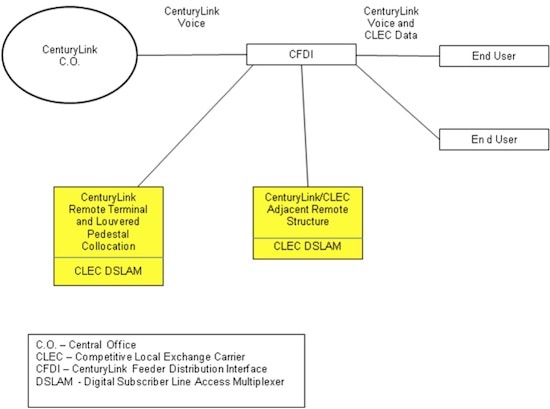
Product Diagram
Availability
Remote Collocation is available where facilities exist throughout CenturyLink QC.
Terms and Conditions
Terms and conditions are included in your Interconnection Agreement; if these terms differ from those set forth in this web page, then the terms of your Interconnection Agreement may prevail.
Information regarding Collocation terms and conditions is located in the Terms and Conditions section of Collocation - General Information.
Terms and conditions for Physical Remote Collocation are the same as those for Physical Collocation as appropriate to the specific remote premises structure and are subject to technical feasibility. Space will be offered in increments appropriate to the remote premises structure (e.g., by shelf or by relay rack).
The terms and conditions for Adjacent Remote Collocation are listed below, however the terms and conditions for Adjacent Collocation also apply.
You must have terms and conditions for Louvered Pedestal Collocation in your Interconnection Agreement. If terms and conditions for Louvered Pedestal Collocation are not in your Interconnection Agreement an amendment must be negotiated before an application may be submitted.
If space is not available in an existing CenturyLink premises, CenturyLink shall permit you to construct or otherwise procure an adjacent remote structure on property owned, leased or otherwise controlled by CenturyLink.
The structure will be subject to Occupational Safety and Health Administration (OSHA), Environmental Protection Agency (EPA), federal, state, and local laws, safety and maintenance requirements.
You, as the owner or leasing party, must obtain any necessary variances, permits and/or approvals from the local municipality and/or other governing body. CenturyLink will provide the necessary authorization to facilitate you in obtaining the permits and approvals.
Your adjacent remote structure must be constructed in accordance with CenturyLink design and space planning requirements for the site. You may propose the design for the adjacent remote structure subject to CenturyLink's approval. Modular buildings owned by you and designed for telecommunications functions may also be submitted to CenturyLink for approval.
It is recommended that you conduct a joint site visit to the property with CenturyLink to determine if suitable arrangements can be made on CenturyLink's property for an adjacent structure. Exact locations and spacing for individual or multiple structures on the property are evaluated and approved on an Individual Case Basis (ICB), and will require field verification for CenturyLink concurrence and application approval. The cost of this premises evaluation or feasibility study includes:
- Evaluation of the premises by CenturyLink Real Estate Architectural Consultants for locating adjacent remote premises structures, determining the amount of land assigned per premises and preparing a premises plan with CenturyLink-approved locations. The premises plan is required to obtain approvals and permits from the local building jurisdiction and other governing body.
- A land survey may be needed to re-establish property lines and easement locations. You are responsible for obtaining approvals and permits from the applicable governing authorities associated with replatting, zoning issues or easements.
Scheduling of the site evaluation and feasibility study is subject to availability of retained architectural and engineering consulting resources at the time of application and joint feasibility visit.
You are responsible for construction and the procuring of all building and zoning permits as designated by the municipality and certifying such compliance in writing to CenturyLink, prior to any turnover of CenturyLink space for construction or placement of a CLEC-owned structure on CenturyLink property. If you are allowed to construct while approvals are pending and subsequently building or zoning regulations are not met, you are required to cure the deficiencies. If you do not cure such deficiencies within the time frame the municipality requires, CenturyLink will seek to remove the structure, based upon municipal orders or as otherwise required and allowed by law. Costs of such removal and actions will be borne by you.
Property leased to you by CenturyLink for placement of a modular building or construction of an adjacent structure will be based on current market value of the land at that location.
You will be responsible for any neighbor or community complaints regarding the structure or use of the structure.
Powering for the new structure may be obtained using one of the following options:
- You provide power by placing an Alternating Current (AC) / Direct Current (DC) power plant and/or engine as part of your unit and obtain an AC feed from the local power utility company.
- The power source must meet all regulations and ordinances (federal, state and local for noise, emission, fuel type, storage arrangements, etc.).
- CenturyLink provides the power source to the adjacent structure, AC feed only or both AC/DC:
- If CenturyLink provides essential AC power.
- You provide an entrance into the structure and a main distribution panel/box to which CenturyLink can terminate the AC feed.
- In some cases, essential AC capacity may not be available immediately, necessitating a delay in provisioning of services. CenturyLink may need to make arrangements with the local commercial power utility for a separate AC feed to the structure.
- If you choose CenturyLink to supply the DC power, CenturyLink will deliver the DC power using AC power to the Adjacent Remote Collocation site and convert it to DC power in your Adjacent Remote Collocation site.
- You must supply space for all rectifiers and battery strings when you request CenturyLink to supply DC power.
- You provide 24/7 access for CenturyLink to your Adjacent Remote Collocation site when CenturyLink supplies DC power.
- CenturyLink will run power cable (when requested) from the CenturyLink remote premises power plant to the Adjacent Remote Collocation structure you own and that is placed on CenturyLink property, if technically feasible.
- Power cable running to such structures on CenturyLink property requires trenching and conduit placement for the cables involved. All costs and intervals are ICB, based on the cabling requirements, distances and trenching activities.
- You pay all costs related to CenturyLink supplied power.
- If CenturyLink provides essential AC power.
- CenturyLink provides line power for Louvered Pedestal Collocation in the following manners based on CenturyLink availability:
- Line Powering - Power draw can be no more than 40 watts per space increment, the power voltage provided will be between +/-65 volts DC and +/- 130 volts DC. CenturyLink will provide line powered pairs at the louvered pedestal pursuant to the CLEC's louvered pedestal collocation request and technical feasibility.
- Local power in one (1) amp increments is similar to power provided to other existing types of Remote Collocation.
If a new structure is to be constructed, an interval for the Adjacent Collocation will be developed on an ICB, to allow for the granting of permits, approvals or Rights-of-Way (ROW). If required, the provision of Adjacent Remote Collocation services by CenturyLink will be provided in accordance with your application and your construction of the adjacent remote premises.
To construct an Adjacent Remote Collocation structure on or under CenturyLink-owned or controlled property, submit a Remote Collocation Application form (refer to the ordering section for the form) for Adjacent Remote Collocation if space is unavailable at the remote premises. In addition to governmental approvals, CenturyLink's approval of the application is based, in part, on concurrence that the location of the adjacent remote structure will not conflict with:
- Existing structures
- Future building or premises expansion plans (five years out)
- The performance of CenturyLink or other telecommunications systems, including microwave and wireless
- Above or below ground utilities, cabling or easements serving the remote premises, including access for excavation or hoisting equipment
- Traffic flow, parking, or ingress/egress to and from the building or property, including fire truck access
- Property grade, drain or retention
- Maintenance of building and grounds
- Local, state and federal laws, environmental permits and ordinances for "minimum set-backs" from property lines
- Safety of personnel or the protection of property
- Premises acceptance by the community, if applicable
If the property is within CenturyLink's secured area (e.g., fence), the process for your personnel to obtain access will be handled under Collocation - CenturyLink Premises Access Overview procedures.
You are responsible for the security of your adjacent remote premises.
You are responsible for repairing any damages to CenturyLink property that may result due to construction of the Adjacent Remote Collocation.
You are responsible for any fines, penalties and expenses for zoning, environmental safety, sanitation, property infringement, noise, quality of life, property or other violations or lawsuits associated with the structure and its associated power and any additional tax assessment levied on CenturyLink as a result of the adjacent remote structure.
If you vacate/terminate the adjacent remote structure, CenturyLink will have the right of first refusal before you propose any transfer to another CLEC.
If you abandon or otherwise fail to remove your structure due to lack of payments, CenturyLink will determine the best use of the structure and any appropriate action relating to the adjacent remote premises. For more information regarding Reclamation and Reconditioning of Space refer to the Negotiations Template Agreement section 8.2.1.14.
You are responsible for:
- All alarming and monitoring within your adjacent remote premises.
- All engineering and installation activities and costs associated with placing the adjacent remote premises.
- Ownership of the adjacent structure.
- CenturyLink assumes no responsibility for protection or liability for damages to your owned structure placed on CenturyLink property due to theft, vandalism, fire, moving vehicles or natural disasters.
- Placement of a visual sign on your structure that includes your company name and an emergency contact name and number.
The terms and conditions for Virtual Remote Collocation are the same as those for Virtual Collocation as is technically feasible for the specific remote premises. Space is offered in increments appropriate to the remote premises structure (e.g., by shelf or by relay rack).
Remote Terminal / Feeder Distribution Interface Move with CLEC Presence
The Move RT/FDI with CLEC Presence is a CenturyLink initiated procedure established for moving and or relocating a CenturyLink remote premise or a feeder distribution interface.
If a requirement identifies that a remote terminal or feeder distribution interface should be moved or relocated, i.e. roadway expansion, each CLEC with a presence in the premise will be notified by email of the impending relocation activity.
The Collocation Project Management Center (CPMC) will contact each CLEC to schedule a coordination call. During this call, CPMC will inform the CLEC of any options they may have involving the premise move, establishment of a timeline, and review the design job. While attending this call, you are expected to identify the methodology by which you will affect the transfer of equipment and/or services to the new location. For example, you will be required to indicate whether you will duplicate your equipment at the new site or do an "Out Of Service" cutover utilizing the existing equipment. A site survey, consisting of a coordinated review of potential work, is scheduled during this meeting. The site survey occurs within a few days from the coordination call.
The CLEC is expected to notify Collocation Project Management Center, (CPMC) State Project Manager via Email sent to rfsmet@centurylink.com of its finalized methodology choice within 10 calendar days after the site visit. If the notification is not received within 10 calendar days from the site visit, CenturyLink will move forward with the methodology indicated during the coordination call.
Remote Terminal and Feeder Distribution Interface relocations may require CLLI changes, which will require changes to account records. Updating account records will be handled as a project within the overall premise relocation project.
All relocation projects and the responsibility of charges for each sites relocation will be handled on an individual case basis, (ICB).
When the project is complete CenturyLink will send out a notification via email and coordinate a site acceptance walk-through.
Technical Publications
Technical characteristics, including design layout and service offerings, regarding Remote Collocation are described in Section 2.4 of Technical Publication, Interconnection - Unbundled Sub-Loops and Field Interconnection, 77405.
CenturyLink's Technical Publications with reference to Collocation are located in the Technical Publications section of Collocation - General Information.
Pricing
Rate Structure
Collocation rate elements are located in the Pricing section of Collocation - General Information.
Remote Collocation charges are based on information you provide on your Collocation Application and the work to be performed. The following charges are associated with Physical, Adjacent and Virtual Remote Collocation and may be charged differently depending on the premises and the type of Remote Collocation requested. Applicable charges to this product are:
Recurring charges are comprised of the following rate elements:
- FDI Terminations in 25 pair increments
- Power(in amperes)
- Space (per standard mounting unit)
Nonrecurring charges are comprised of the following rate elements:
- FDI Terminations in 25 pair increments
- Space (per standard mounting unit)
- Maintenance Labor
- Training Labor
Charges for Adjacent Remote Collocation are developed on an ICB, depending on your needs and the nature of the available adjacent remote space (i.e., existing structure or new structure to be constructed).
Charges unique to Adjacent Remote Collocation are:
- AC/DC Power Feed Maintenance
- DC Power Feed
- Digital Signal Level 1 (DS1) Coax Feed
- Power costs for AC feed usage (dependent on whether purchased from CenturyLink)
- Pro-rated Building and Grounds Maintenance charges
- Rent
- Site evaluation and feasibility
- Special Construction for conduit
Charges that are unique to Louvered Pedestal Collocation for Line Power and Local Power are:
Recurring charges for Line Power:
- Space and Line Power combined
Recurring charges for Local Power:
- Space
- Local Power
Nonrecurring charges for Space with Line Power is:
- Space and Power per unit with line powering
Nonrecurring charges for separate space and local power are:
- Space without line powering
- Local power per DC amp
Rates
Wholesale rates for this product or service, including tariff references and any applicable discounts, are provided in your current Interconnection, Resale, Commercial, or other governing agreement.
Tariffs, Regulations and Policies
For terms and conditions applicable to CenturyLink retail products available for resale, view FCC1 or the state specific Tariffs/Catalogs/ Price Lists.
Additional information can be found in your Interconnection or Resale Agreement or in the Statement of Generally Available Terms and Conditions (SGAT) for the relevant state.
Optional Features
There are no optional features associated with this product.
Features/Benefits
| Feature | Benefit |
| Remote Collocation |
Applications
This product can be utilized for many different applications. The following are examples of the most common applications. Contact your CenturyLink Sales Executive for additional information.
- The following Remote Collocation diagram is the placement of Digital Subscriber Line Access Multiplexer (DSLAM) equipment in a premises located remotely from a CenturyLink CO. This allows you to overcome most distance limitations associated with delivering your end-users xDSL type services.
The following Remote Collocation diagram is applicable when you place equipment at an existing remote terminal premises. For example, your equipment will be a Digital Loop Carrier (DLC), and the premises will be an existing CenturyLink CEV.
Implementation
Product Prerequisites
If you are a new CLEC and are ready to do business with CenturyLink, view Getting Started as a Facility-Based CLEC. If you are an existing CLEC wishing to amend your Interconnection Agreement or New Customer Questionnaire, additional information is located in the Interconnection Agreement.
Pre-Ordering
General pre-ordering activities are described in the Pre-Ordering section of Collocation - General Information.
The following tools are specific to Remote Collocation:
The Distribution Area (DA) Map is at a wire center level, and used to determine which DAs serve a particular area. The DA Map also contains the DA number that is needed on the order form. Application and APOT(s) forms specific to Remote Collocation can be found under Applications and APOT forms table in the Collocation - General Information.
You can request the DA Map by Remote Terminal Common Language Location® Identifier (CLLI™) code. The CLLI™ code can be obtained from the Distribution Area (DA) Map which links to a list of all the remote terminals in CenturyLink QC.
CenturyLink provides a list of remote terminals being constructed where you can place your equipment along with CenturyLink. This information is located at the at the ICONN Database.
- The Remote Premises Space Inventory Availability Report provides the following information regarding specific remote collocation locations:
- Amount of Collocation space available (number of mounting units available)
- Number of CLECs within the space
- Number of terminations available at the FDI
- Whether sufficient DC power is available to meet your specific requests
- Whether the remote premises is equipped with DS1 capability between the CenturyLink CO and the FDI
- CenturyLink's plan for making additional space available (e.g., growth jobs)
CenturyLink will respond within 10 calendar days from receipt of the Remote Collocation Available Space Inventory Application. The cost for this report is determined on an ICB; based on the CenturyLink Engineering hours required to create the report.
* CenturyLink Collocation Space Reports identify CenturyLink premises with space-exhaust conditions and premises where collocation requests have been denied due to insufficient space. For more information see Outside Plant (OSP) Space Denial Report or the Outside Plant (OSP) Space Exhaust Report.
Application and APOT(s) forms specific to Remote Collocation can be found under Applications and APOT forms table in the Collocation - General Information.
Ordering
General ordering activities are described in the Ordering section of Collocation - General Information.
Submit a Remote Collocation Application form to order Remote Collocation in a particular CenturyLink premises. Application and APOT(s) forms specific to Remote Collocation can be found under Applications and APOT forms table in the Collocation - General Information.
In addition to the general ordering information, the following information is required to process an Adjacent Remote Collocation request:
- Dimensions of the planned structure
- Weight and material specifications of the structure and architectural diagrams
If you want to make changes to your order after you have submitted the application to CenturyLink, review the Major/Minor Matrix in Collocation - General Information to obtain the effect on the interval.
Information on how to cancel a Remote Collocation order already in progress is located in the Collocation - Cancellation Overview. Use the Remote/Adjancent/Facility Connected Collocation Cancellation Decommission form. Application and APOT(s) forms specific to Remote Collocation can be found under Applications and APOT forms table in the Collocation - General Information.
Information on how to decommission a completed Remote Collocation site is in the Collocation - Decommissioning Overview process. Application and APOT(s) forms specific to Remote Collocation can be found under Applications and APOT forms table in the Collocation - General Information.
Provisioning and Installation
General provisioning and installation activities are described in the Provisioning and Installation section of Collocation - General Information.
Provisioning activities for Virtual Remote Collocation are the same as those for Virtual Collocation.
Maintenance and Repair
General maintenance and repair activities are described in the Maintenance and Repair section of Collocation - General Information.
You are responsible for the maintenance and repair of your equipment located within your Physical and Adjacent Remote Collocation space. You will have 24/7 access to your equipment. If you need to access your equipment, contact CenturyLink before accessing the premises because of alarms that are part of the CenturyLink remote premises. To notify CenturyLink, contact the CenturyLink Wholesale Repair Center at 800-223-7881.
CenturyLink will notify you if the CenturyLink remote premises is experiencing problems that affect all users of the CenturyLink remote premises.
Maintenance activities for Virtual Remote Collocation are the same as those for Virtual Collocation.
Billing
General billing activities are described in the Billing section of Collocation - General Information.
Training
Local CenturyLink 101 "Doing Business with CenturyLink"
- This introductory, web-based, course is designed to teach the Local CLEC and Local Reseller how to do business with CenturyLink. It will provide a general overview of products and services, CenturyLink systems, ASR/LSR, reports, and web resource access information. Click here to learn more about this course and to register.
Collocation
- This is a self-directed, web-based training course that provides the participant with an overview level of knowledge of Collocation products, concepts, features, requirements, configurations, entrance facility options, test points, and policies. Click here to learn more about this course and to register.
View additional CenturyLink courses by clicking on Course Catalog.
Contacts
CenturyLink contact information is located in Wholesale Customer Contacts.
Frequently Asked Questions (FAQs)
1. Can a CLEC place any type of equipment at the Remote Collocation premises?
A CLEC can place any type of equipment as long as it meets the technical requirements of the space at which the CLEC wishes to collocate and the equipment is used for the purpose for which Remote Collocation is intended.
2. What type of information will be provided to the CLEC about the remote terminal premises?
The CLEC will be given a geographic map of the distribution area, which will show the street names and other geographic information.
Last Update: April 6, 2015
Common Language® is a Registered Trademark of Telcordia Technologies, Inc.
CLLI™ is a Trademark of Telcordia Technologies, Inc.