Product Catalog (PCAT)
Sub-Loop - V38.0

NOTE: The Federal Communications Commission ("FCC" or "Commission") released Order FCC 20-152 on October 28, 2020, a Report and Order in WC Docket 19-308 for the Modernizing Unbundling and Resale Requirements in an Era of Next-Generation Networks and Services ("Order"), which became effective February 8, 2021, and altered CenturyLink's obligations to provide certain unbundled network elements. As such, these services will no longer be available after the following transition periods, consistent with the terms of the UNE Modernization Forbearance Amendment: 1) DS1- new orders not available after February 8, 2023; 2) DS3- new orders not available as of February 8, 2021; 3) DS0/ADSL/xDSL/ISDN BRI - new orders not available after February 8, 2023; 4) UNE Subloops and NIDs- new orders not available as of February 8, 2021; 5) Dark Fiber Transport- new orders not available as of February 8, 2021; and 6) OSS- subject to the transition periods applicable to the corresponding UNEs. The wire center lists pertaining to this order can be found at: http://www.centurylink.com/wholesale/clec.html.
Product Description
A Sub-Loop is defined as the distribution portion of a copper Loop comprised entirely of copper wire or copper cable that acts as a transmission facility between any point that is Technically Feasible to access at terminals in CenturyLink™'s outside plant (originating outside of the Central Office), including inside wire owned or controlled by CenturyLink, and terminates at the End-User Customers premises. An accessible terminal is any point on an Unbundled Local Loop where technicians can access the copper wire or fiber within the cable without removing a splice case to reach the wire within. Such points may include, but are not limited to Feeder Distribution Interface (FDI), Minimum Point of Entry (MPOE), Network Interface Device (NID), pedestal, pole, Remote Terminal (RT), Service Area Interface (SAI), and Point of Interconnection (POI).
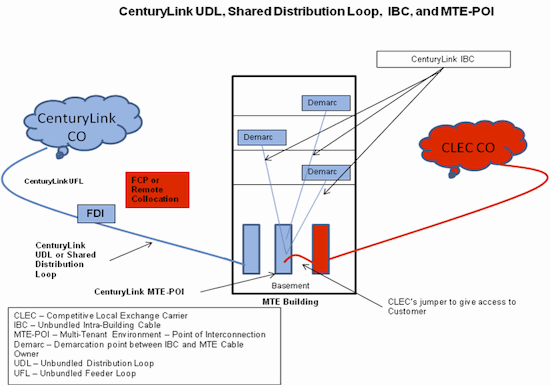
By establishing a Field Connection Point/Cross Connect Collocation (FCP) at an accessible terminal or a Remote Collocation,you can obtain access to the UDL, and Campus Wire (from a detached terminal). Access to IBC and Campus Wire (from an attached terminal) is gained by obtaining an established Multi-Tenant Environment - Point of Interconnection (MTE-POI) arrangement.
In Colorado, you may reserve UDL Sub-Loop elements at the time you establish your FCP. Refer to FCP for more information about the Colorado Sub-Loop Reservation Process.
The following is a list of CenturyLink Sub-Loop products:
- Unbundled Distribution Loop (UDL)
- 2-Wire/4-Wire Non-Loaded
- 2-Wire/4-Wire
- Campus Wire (only available in Arizona and Nebraska)
- Intra-Building Cable (IBC) CenturyLink owned inter-building cable (in the case of an Attached Terminal that serves multiple buildings in a campus environment) or intra-building cable
2-Wire Non-Loaded Distribution Loop is a CenturyLink provided facility from the CenturyLink FDI (or other accessible terminal) to the end-user's NID. It is a metallic, wire cable pair with no load coils, and, depending on the service you intend to transmit on the 2-Wire Non-Loaded Distribution Loop, some limited length of bridged taps. 2-Wire Non-Loaded Distribution Loop has the following characteristics:
- Access is obtained at the FDI (or other accessible terminal) through an established FCP or Remote Collocation
- May contain a mixture of cable gauges
- Metallic facilities only, no carrier segments
- No load coils or build out capacitance
- Tolerant of some bridged taps
4-Wire Non-Loaded Distribution Loop is a CenturyLink provided facility from the CenturyLink FDI (or other accessible terminal) to the end-user's NID. It is a metallic, wire cable pair with no load coils, and depending on the service you intend to transmit on the 4-Wire Non-Loaded Distribution Loop, some limited length of bridged taps. 4-Wire Non-Loaded Distribution Loop has the following characteristics:
- Access is obtained at the FDI (or other accessible terminal) through an established FCP or Remote Collocation
- May contain a mixture of cable gauges
- Metallic facilities only, no carrier segments
- No load coils or build out capacitance
- Tolerant of some bridged taps
2-Wire UDL is a CenturyLink provided facility from the CenturyLink FDI (or other accessible terminal) to the end-user's NID. 2-Wire UDL includes, but is not limited to, distribution facilities, from a detached terminal, that serves multiple buildings in an MTE. 2-Wire UDL is suitable for local exchange type services within the analog voice frequency range of 300 to 3000 Hertz (Hz). 2-Wire UDL has the following characteristics:
- Access is obtained at the FDI (or other accessible terminal) through an established FCP or Remote Collocation
- May contain a mixture of cable gauges
- Metallic facilities only, no carrier segments
- No load coils or build out capacitance
- Tolerant of some bridged taps
4-Wire UDL is a CenturyLink provided facility from the CenturyLink FDI (or other accessible terminal) to the end-user's NID. 4-Wire UDL has the following characteristics:
- Access is obtained at the FDI (or other accessible terminal) through an established FCP or Remote Collocation
- May contain a mixture of cable gauges
- Metallic facilities only, no carrier segments
- No load coils or build out capacitance
- Tolerant of some bridged taps
For Campus Wire and IBC, the following definitions apply:
On a case-by-case basis CenturyLink will determine, in its full discretion, whether each situation warrants MTE or FCP.
-
Attached Terminal - Terminals determined by CenturyLink, to require an MTE/POI.
Detached Terminal - All accessible terminals other than Attached Terminals. These terminals commonly reside in a cabinet (metal terminal) at one location on the 'campus' and provide termination for the cable that feeds a number of buildings on that campus.
Campus Wire, only available in Arizona and Nebraska, is a CenturyLink provided 2-Wire or 4-Wire, Loaded or Non-Loaded, distribution facility from a CenturyLink detached terminal serving a single piece of property that contains multiple buildings, i.e., a campus environment. A campus environment is an environment in which voice and/or voice and data end-users are spread out over a broad geographic area, such as in a university, hospital, medical center, prison, apartment or business complex. There may be several different communications providers. The area may be served by a FDI (or other accessible terminal) or by a direct CO feed. Campus Wire originates at the CenturyLink owned terminal and extends to the CenturyLink demarcation point. You can obtain access to the Campus Wire at the detached terminal by establishing an FCP.
Campus Wire and IBC (defined below) have a very specific step-by-step ordering process and cannot be provisioned in a short time-frame.
IBC is a CenturyLink provided 2-Wire or 4-Wire facility that extends from an MTE terminal, or other accessible attached terminal, to the end-user's NID. This Sub-Loop element applies when CenturyLink owns the IBC or the cable/wire between the buildings from the attached terminal. IBC and Campus Wire (defined above) have a very specific step-by-step ordering process and cannot be provisioned in a short time-frame.
Product Diagram
Availability
Sub-Loop is available where facilities exist throughout CenturyLink QC. Campus Wire is only available in Arizona and Nebraska. The Sub-Loop Reservation Process is only available in Colorado.
CLEC shall not have access on an unbundled basis to a feeder subloop defined as facilities extending from the Central Office (CO) to a terminal that is not at the End User Customer's premises or multiple tenant environment (MTE). CLEC shall have access to the feeder facilities only to the extent it is part of a complete transmission path, not a sub loop, between the CO and the End User Customer's premises or MTE.
Non-Impaired and the Omaha Forbearance Wire Centers Only
Non-Impaired Wire Centers and the Omaha Forbearance Wire Centers are described at CenturyLink Non-Impaired Wired Center Lists for Loops and Dedicated Transport. In those cases, the DS1 equivalent facility is available only via CenturyLink's Special Access Tariffs.
Terms and Conditions
You must have an established FCP or Remote Collocation at the accessible terminal (FDI) prior to submitting UDL Sub-Loop requests.
If you are requesting Campus Wire, you must have an established FCP at the detached terminal that serves the campus you intend to serve prior to placing a service request. Additionally, the FCP and the detached terminal must serve only a single campus and not buildings on other pieces of property.
If you are requesting IBC, there must be an established MTE-POI in place at the attached terminal that serves the end-user prior to placing a service request. When you access an Attached Terminal for IBC, you should adhere to generally accepted best engineering practices in accordance with industry standards. You are required to clearly label your cross-connections and your wiring should be neatly dressed. Refer to CenturyLink's Standard MTE Terminal Access Protocol for detailed information.
You may access the MTE Terminal at the MTE -POI as a test access point for IBC Sub-Loop.
You must provide the necessary space and meet all premises requirements described in Interconnection - Unbundled Sub-Loops and Field Interconnection Technical Publication 77405.
Technical Publications
Technical characteristics, including Network Channel/Network Channel Interface (NC/NCI™) codes are described in Technical Publication, Interconnection - Unbundled Sub-Loops and Field Interconnection 77405.
Pricing
Rate Structure
Recurring charges are comprised of the following rate elements:
- Sub Loop Element
Nonrecurring charges are comprised of the following rate elements:
- Installation charges for Campus Wire, IBC, UDL
- Reservation Process, only available in Colorado
- Loop Conditioning/Cable Unloading and Bridged Tap Removal Charge for UDL as applicable
Additional rate structure information is available in your Interconnection Agreement.
One-month minimum billing, contract termination liability and associated contract charges for the product from which the loop is being converted will apply and will be assessed to the end-user as described in the Local Exchange Tariff for the applicable state.
Information regarding Geographic Deaveraging is available in Geographic Deaveraging - General Information.
Rates
A nonrecurring charge applies to the installation of service(s) and in some states a disconnect service(s) charge will apply. Wholesale rates for this product or service, including tariff references and any applicable discounts, are provided in your current Interconnection, Resale, Commercial, or other governing agreement.
Tariffs, Regulations, and Policies
Tariffs, regulations and policies are located in the state specific Tariffs/Catalogs/Price Lists.
Access to the UDL and Campus Wire Sub-Loop (from a detached terminal)is at the FDI or any other technically feasible point through the establishment of a FCP or Remote Collocation. Access to the IBC Sub-Loop (from an attached terminal) is at the MTE-POI. If access is requested at a point other than the FDI, MTE-POI or any other technically feasible point, the request should be submitted using the Bona Fide Request (BFR) Process.
When you submit your service request and facilities are not available, your request may be held for 90 business days. For exceptions and detailed information, refer to the Provisioning and Installation Overview.
Any technically feasible non-standard Sub-Loops will be handled through the Special Request (SR) Process.
Directory Listings are not part of the Sub-Loop product offering.
Optional Features
There are no optional features available with Sub-Loop.
Features/Benefits
| Features | Benefits |
| Flexibility to order portions of the loop. | Sub-Loop allows you to access CenturyLink owned portions of Unbundled Local Loop at the CO and/or at accessible terminals in the outside plant of the Unbundled Local Loop provided the loop terminates at the end-user demarcation point. |
Applications
Sub-Loops can be used in conjunction with your facilities to provide services to end-users. These combinations free you from having to install the entire loop facilities required to reach the end-user's location.
Implementation
Product Prerequisites
If you are a new Competitive Local Exchange Carrier (CLEC) and are ready to do business with CenturyLink, view Getting Started for Facility-Based CLECs. If you are an existing CLEC wishing to amend your Interconnection Agreement or New Product Questionnaire, additional information is located in the Interconnection Agreement.
Campus Wire, which is only available in Arizona and Nebraska, requires a signed amended Interconnection Agreement with provisions and rates for Campus Wire.
To reserve Sub-Loop elements in Colorado, you need provisions for the Reservation Process added to your Interconnection Agreement.
An MTE-POI, the demarcation point between your facilities and CenturyLink's facilities, is required for accessing the IBC from an Attached Terminal. CenturyLink will create the cross-connection at the building terminal that will allow connection of your facilities to the IBC at the MTE-POI.
Pre-Ordering
General pre-ordering activities are described in the Pre-Ordering Overview and in Unbundled Local Loop - General Information.
Border town characteristics, including a NPA/NXX matrix are described in the Pre-Ordering Overview.
Requirements for pre-ordering are described in Local Service Ordering Guidelines (LSOG) Pre-Order.
The EASE-LSR User's Guide specifically details the information applicable to Pre-Ordering functions.
Pre-Ordering activities include utilizing CenturyLink's loop qualification query. The Raw Loop Data (RLD) tools provide the physical characteristics of the facility at either the wire center level or at the individual loop level. Data available includes the physical characteristics by segment:
- Bridged Taps
- Cable and Pair make-up
- Common Language® Location Identifier (CLLI™) code
- Load Coils
- Spare Facility
- Wire Gauge
There are two RLD tools, an EASE-LSR tool and a web-based Wire Center tool.
- The Wire Center RLD tool provides the physical characteristics of the facilities for an entire Wire Center. The wire center RLD is presented as a comma delimited file and needs to be downloaded into a database or spreadsheet to analyze the individual facilities. Contact your CenturyLink Service Manager to request an ID, which will be required to obtain the digital certificate e required to access this tool. You will need to provide the names and telephone numbers of your employees that will be accessing the tool. After your CenturyLink Service Manager has notified you that the necessary access permissions have been established, and provided you with your ID you may then
- The EASE-LSR RLD tool provides loop specific information. This tool also enables you to obtain the physical characteristics of facilities. Information regarding the EASE-LSR RLD tool is described in the EASE-LSR User's Guide.
The loop qualification tools should be used prior to submitting a service request. Use of these tools can greatly reduce service request rejects by ensuring the types of facilities requested are available prior to placing an order. Based on the physical characteristics, you can determine if the facility needs to be conditioned, i.e., the removal of load coils or bridged taps, which will assist you in identifying the appropriate ordering intervals, as described in the Service Interval Guide (SIG).
The EASE-LSR Loop Qualification and Raw Loop Data-CLEC Job Aid provides information and instructions on how to use the EASE-LSR based loop qualification query and interpret the information provided.
Before ordering a Sub-Loop that is accessible at terminals located in CenturyLink's outside plant, including inside wiring, you must perform the following steps:
-
For access to Sub-Loops (UDL and Campus Wire) from a detached terminal:
- Establishment of a Field Connection Point (FCP) or Remote Collocation is required.
-
For access to IBC from an attached terminal:
- MTE-POI Application is required. This is a 2-step process:
- Submit completed MTE-POI Application with Part 1 to OSPteam@centurylink.com. This will determine if CenturyLink owns the IBC you are attempting to use.For an initial inquiry at that address, CenturyLink will return a response within 10 business days
- For a non-initial inquiry at that address, CenturyLink will return a response within 2 business days
-
Submit completed MTE-POI Application with Part 2 to OSPteam@centurylink.com. This will identify that CLEC plans to interconnect at this location and identify the number of units the CLEC plans to serve
- CenturyLink will contact CLEC to meet at the particular location within 3 business days of receipt of application
- Due to the vast disparity between locations, (some are terminated inside, some out; some are terminated in close quarters, some with plenty of room�etc.) CenturyLink and CLEC will jointly determine the means of interconnection at this location. CenturyLink will construct such interface under the rearrangement provisions of your contract or, where construction is not required, provide CLEC inventory (location of Inside Wire terminations) at this location within 5 business days of receipt of application.
- CLEC will be billed the MTE-POI Site Inventory Charge from Exhibit A of their Interconnection Agreement.
- CenturyLink may seek an extended interval if the work cannot reasonably be completed within the time frames depicted above. In such cases, CenturyLink shall provide written notification to CLEC of the extended interval CenturyLink believes is necessary to complete the work. CLEC may dispute the need for, and the duration of, an extended interval, in which case CenturyLink must request a waiver from the Commission to obtain an extended interval.
The intervals provided above apply to the first five (5) MTE-POI Applications per CLEC, per week, per state. If six (6) or more MTE-POI Applications are submitted by CLEC in a one (1) week period in the state, intervals for the MTE-POI Applications in excess of the first five (5) will be individually negotiated, but in no event will the interval exceed twenty (20) business Days. CenturyLink will accept more than five (5) MTE-POI Applications from CLEC per week per state.
Only after these steps are completed (or underway) can an LSR be submitted for access to the end-user on CenturyLink facilities.
Ordering
General ordering activities are described in the Ordering Overview.
The EASE-LSR User's Guide specifically details the information applicable to ordering functions.
Sub-Loop service requests are submitted using the following LSOG forms:
- Local Service Request (LSR)
- End User (EU)
- Loop Service (LS)
- Loop Service with Number Portability (LSNP), if applicable
Field entry requirements are described in the LSOG.
If you are requesting IBC (from an attached terminal), you must have an established MTE-POI at the attached terminal that serves the end-user prior to placing a service request.
Service requests should be placed using EASE-LSR Extensible Markup Language (XML) or EASE-LSR Graphical User Interface (GUI).
Valid NC/NCI codes are required on all Sub-Loop requests. Information regarding NC/NCI codes is located in Technical Publication, Interconnection - Unbundled Sub-Loops and Field Interconnection, 77405.
You can request conditioning on the Unbundled Distribution Loop. CenturyLink will provide removal of load coils and excessive bridged taps on UDL.
If your UDL requires conditioning, CenturyLink will perform the requested conditioning on the loop to remove load coils and excessive bridged taps. If you request conditioning and the conditioning significantly degrades the voice services on the loop to the point where it is unacceptable to the end-user, charges will be assessed to re-apply the necessary load coils to the loop.
You may request loop conditioning by entering a 'Y' in the SCA field of the LSR.
The following applies when loop conditioning is requested on the service request:
-
Whether or not conditioning is required per the systems:
-
Upon receipt of an accurate and complete service request, you will receive a Firm Order Confirmation (FOC) based on the standard interval found in the SIG. Separate intervals apply based on whether or not conditioning is required.
The following applies when loop conditioning is not requested on the service request:
If conditioning is not required per the systems (qualification passed):
Upon receipt of an accurate and complete service request, CenturyLink will perform an initial evaluation to determine if the loop will support the Sub Loop service requested. If the initial evaluation reflects that loop conditioning is not required to support the Sub Loop service requested, you will receive a FOC based on the standard interval.
If at any time, after you receive the FOC and prior to the scheduled due date, CenturyLink determines the qualification was a false positive (when loop qualification is successful but the Sub Loop service requested cannot be provisioned on the line without conditioning). CenturyLink will make every attempt to provision the Sub Loop request, including Line Conditioning, within the original scheduled DD without requiring a supplemental LSR. In the event that the conditioning work cannot be completed within the original scheduled DD the CLEC will receive jeopardy and will be required to submit a Sup with a Y in the SCA field authorizing the standard line conditioning interval.
If conditioning is required per the systems (qualification failed):
If it is determined by the initial CenturyLink evaluation that the loop cannot support the Sub Loop service requested without performing conditioning, and no authorization has been given, the service request will be rejected and you will be required to resubmit the service request authorizing conditioning on the loop.
Campus Wire does not carry its own NC/NCI codes. You will need to use the NC/NCI codes applicable to the UDL. In the REMARKS field of the LSR, enter "Campus Wire" and the NC/NCI codes for the UDL in the appropriate fields. For example, when you order Campus Wire on a 2-Wire Non-Loaded UDL, enter the following information:
- In the REMARKS field of the LSR: Campus Wire - On a 2-Wire Non-Loaded UDL
- In the NC field on the LSR: Enter the NC code for 2-Wire Non-Loaded UDL
- In the NCI field on the LSR: Enter the NCI code for 2-Wire Non-Loaded UDL
- In the SECNCI field on the LSR: Enter the Secondary NCI code for 2-Wire Non-Loaded UDL
Service interval guidelines are described in the SIG.
Circuit Identification numbers are assigned by CenturyLink upon receipt for Sub-Loop requests. The Circuit Identification number is provided to you on the Firm Order Confirmation (FOC). Information describing Circuit Identification number format is available in Unbundled Local Loop General Information.
A CenturyLink technician dispatch is required on UDL and Campus Wire Sub-Loop new service requests. For IBC, you will dispatch a technician to run a jumper between your Sub-Loop elements and CenturyLink's Sub-Loop elements at the MTE-POI.
For access to IBC prior to the completion of the MTE-POI inventory process, you are still required to submit a service request. CenturyLink will:
- Secure cross connect information (You will obtain cross connect information from the CenturyLink technician who performs the Inventory process).
After you receive Inventory information for the MTE-POI, then all subsequent service requests for IBC at the same MTE must utilize that inventory information. CenturyLink shall be entitled to charge for IBC as of the time that you submitted the service request.
Local Number Portability (LNP) can be ordered with IBC, UDL and Campus Wire.
If you relate Purchase Order Numbers (PON) and associate orders to a Project Identification Code in the PROJECT field on the LSR, or if the LQTY field on the LSR has 25 or more loops from the same CSR, the request will be handled as a Project by the Center responsible for handling your account. The installation guidelines for a Project are negotiated on an Individual Case Basis (ICB) based on the request. The main point of contact for a Project will be your CenturyLink Service Manager.
Provisioning and Installation
General provisioning and installation activities are described in the Provisioning and Installation Overview.
Provisioning information and design requirements are available in Technical Publication, Interconnection - Unbundled Sub-Loops and Field Interconnection 77405.
FOC intervals are located in the SIG. Additional information about FOC is available in the Provisioning and Installation Overview.
Sub-Loop is provided where existing facilities are available. If no facilities can be found, and there is No Planned Engineering Job, the service request will be rejected for a No Facilities reason and the order cancelled. Your CenturyLink Service Manager should be contacted if you are requesting CLEC Requested UNE Construction (CRUNEC) per the terms and conditions of your Interconnection Agreement. Information regarding reject codes is available in the Ordering Overview. Refer to your Interconnection Agreement for options available to you when facilities are not available.
Basic Installation is available for Sub-Loops. For an existing end-user, Basic Installation is the 'lift and lay' procedure. In this scenario the CenturyLink technician 'lifts' the loop from its current termination and 'lays' it on a new termination connecting to the CLEC. Test results are not provided to the CLEC. Detailed information about this option is located in your Interconnection Agreement.
Maintenance and Repair
General maintenance and repair activities are described in the Maintenance and Repair Overview.
Billing
The account will be established in Customer Records and Information System (CRIS) effective with the completion date of the conversion order and/or new service request. Charges will be billed on a CRIS Summary Bill on a month-to-month basis; term contracts are not available. Charges for circuits are itemized by Circuit Identification number on the CRIS Summary Bill, at the sub account level. Information regarding Circuit Identification number format is described in the Ordering section of Unbundled Local Loop - General Information. Information regarding the CRIS Summary Bill, Inquiry and Disputes is described in Billing Information - Customer Records and Information System (CRIS).
Training
View CenturyLink courses by clicking on Course Catalog.
Contacts
CenturyLink contact information is located in Wholesale Customer Contacts.
Frequently Asked Questions (FAQs)
1. Can I provide high-speed services using Sub-Loops?
Yes, you can purchase UDL, IBC and Campus Wire to the end-user for the purpose of providing high speed data services.
Last Update: November 18, 2021
Last Reviewed: November 9, 2023
CLLI™ and NC/NCI are Trademarks of iconectiv®.
Common Language® is a Registered Trademark of iconectiv®.