Product Catalog (PCAT)
Access to Poles, Ducts and Rights of Way (PDR) - V53.0

Product Description
Access to Poles, Ducts, and Rights Of Way (PDR) provides you with the ability to attach facilities to CenturyLink™ owned or controlled PDR in order to provide telecommunications services. Owned or controlled facilities (i.e. ownership or control to do so) are described in Section 10.8.1.5 of the Negotiations Template for the relevant state.
Access to PDR is offered in the following configurations:
- Pole Attachments provide you access to available pole space to place aerial facilities that transmit telecommunications services.
- Duct/conduit occupancy provides you space in innerduct for the
purpose of placing fiber facilities to transmit telecommunications
services. Access to duct/conduit can also be arranged for copper
facilities. Descriptions of duct/conduit, innerducts and microduct
are as follows:
- Duct/conduit provides a single, enclosed raceway used for conductors, cable and/or wire, including riser conduit between floors in a building. The duct/conduit may be buried in the ground, may follow streets, bridges, public or private Rights of Way (ROW), and/or may be located in a portion of a multiunit building. Within a multiunit building, the duct/conduit may traverse the building entrance facilities, building entrance links, equipment rooms, remote terminals, cable vaults, and telephone closets or building risers.
- Innerduct is a duct-like raceway smaller than the duct/conduit into which it is inserted. Innerduct is pulled into a duct/conduit so that the duct/conduit may typically carry three Innerducts. Usually, one 4 inch duct/conduit accepts three 1 1/4 inch innerducts with one fiber cable per innerduct.
- Microduct is a smaller version of innerduct that must be placed inside an innerduct. Available duct capacity is increased since up to four (4) microducts can be placed within an innerduct.
- ROW provides access to land that CenturyLink owns or controls for the placement of your telecommunications facilities. ROW is for a path that may run under, on, above, across, along or through public or private property, including multiunit buildings.
Availability
PDR is available where facilities exist throughout CenturyLink QC.
Terms and Conditions
Access to PDR is available on a first-come, first-served basis to existing facilities that are not allocated for repair, emergency or projects in progress.
Access to PDR space is available where facilities exist and/or you have authorized access per the terms and conditions of your Interconnection Agreement.
Prior to initiating a request for microduct, when you lack authorized access per the terms and conditions of your Interconnection Agreement, you will be required to execute the Microduct Amendment. For more information on microduct view Poles, Ducts, and Rights of Way (PDR) Microduct.
To secure a ROW agreement that has not been publicly recorded, you may choose to amend your agreement to include various options described in Section 10.8 of the Negotiations Template Agreement for the relevant state. In some of CenturyLink QC, those options include an agreement to the terms and conditions of the Form Protective Agreement (a Commission's Protective Order).
Notice to CenturyLink of the need to access CenturyLink’s network duct must first be received by CenturyLink, generally speaking, before any work can begin to lift manhole (utility vault) lids. The required process steps are detailed in the Product Prerequisite Section below.
Additional information and Terms and Conditions are described in Section 10.8.2 of the Negotiations Template Agreement for the relevant state or CLECs wishing to access Poles in Utah may execute the Utah Pole Attachment Agreement pursuant to the UT Commission's rules.
CenturyLink standards regarding the attachment of wireless equipment to a pole are included in the CenturyLink Wireless Construction Specifications.
Guidelines are in place to help protect the integrity of CenturyLink’s vaults and manhole systems. The 3rd Party Manhole and Vault Access Construction Guidelines document was created to give direction to third party or other companies that access CenturyLink’s manhole and vaults.
NOTE: Effective with the publication of the 3rd Party Manhole and Vault Access Construction Guidelines (February 2, 2017), no new slack coils or splice cases will be allowed in the manhole system without prior written approval from CenturyLink.
Technical Publications
CenturyLink does not have Technical Publications available for PDR. Your facilities must be placed and maintained in accordance with the requirements and specifications of the current standards described in Telcordia Blue Book Manual of Construction Procedures are available through Telcordia. Additional requirements and specifications that may apply are located in the National Electrical Safety Code (NESC), the rules and regulations of the Occupational Safety and Health Administration (OSHA), and the requirements of governing local authorities having jurisdiction.Pricing
Rate Structure
Nonrecurring charges are comprised of the following rate elements:
- Pole Inquiry, occurrence
- Innerduct Inquiry, occurrence
- ROW Inquiry
- ROW Documentation Preparation
- Field Verification, per pole (includes all poles verified)
- Field Verification, per manhole
- Planner Verification, per manhole
- Manhole Verification Inspector, per manhole
- Access Agreement Consideration
- Make-Ready
- Manhole Make-Ready Inspector, per manhole
- Unauthorized Attachment Fee
- Audit fees
Pre-paid recurring charges are billed annually for the current year and consist of the following:
- Pole Attachment
- Innerduct Occupancy
- Microduct Occupancy
Rates
Wholesale rates for this product or service, including tariff references and any applicable discounts, are provided in your current Interconnection, Resale, Commercial, or other governing agreement.
Tariffs, Regulations and Policy
You are responsible for obtaining the necessary legal authority to occupy PDR on governmental, federal, Native American and private ROW.
If construction authority does not exist, you are responsible for obtaining any permits, licenses, bonds or other required legal authority and permission. Additionally, you must contact the property owner(s) of the public and private ROW to obtain permission to perform the work before entering or beginning work on the property. Once permission is obtained, you have the options of performing the work yourself or requesting CenturyLink to perform the work. CenturyLink will provide you with actual copies of all CenturyLink ROW recorded agreements and a listing of the CenturyLink ROW non-recorded agreements, which identify the building owner and property address.
Information regarding initiating the Field Verification process is located in the Pre Ordering section of this web page.
Optional Features
After you occupy CenturyLink PDR space, it may become necessary to transfer responsibility. PDR Transfer of Responsibility allows you to transfer the occupancy of either your aerial or underground facilities to an assuming CLEC or from a vacating CLEC to you. For more information about Transfer of Responsibility, click here.
Features/Benefits
| Features | Benefits |
| Enables you to attach or place facilities on or within available CenturyLink PDR. | Enables quick entry into new markets; preserves valuable working capital. |
| Provides access to outside plant space throughout CenturyLink QC. | Provides service to a choice of markets in large and rapidly growing geographic regions. |
| Provides terms and conditions equal to those provided by CenturyLink for its own use, or the use of any other provider. | Ensures competitive provisioning and pricing. |
Applications
See Features/Benefits.
Implementation
Product Prerequisites
If you are a new Competitive Local Exchange Carrier (CLEC) and are ready to do business with CenturyLink, view the Getting Started as a Facility-Based CLEC. You must obtain an Interconnection Agreement to have Access to PDR. If you are an existing CLEC wishing to amend your Interconnection Agreement or New Customer Questionnaire, additional information is located in the Interconnection Agreement.
You can request access to relevant plats, maps, engineering records and other data as described in Section 10.8.2.4 of the Negotiations Template Agreement for the relevant state. Click here to access the CenturyLink Outside Plant Records Viewing Guidelines. Minnesota only, for CenturyLink Outside Plant Facilities Management (OSP-FM) Database viewing/copies click here to access the CenturyLink Outside Plant Records Viewing Guidelines-Minnesota Only.
You can request access to a specific man-hole for entry into a Central Office (CO). It is important to note that only some man-holes, in the vicinity of a CO actually provide ingress, for cable, to that CO. These man-holes are identified by CenturyLink as the Collocation Point of Interconnection (C-POI). The C-POI information is provided to you from CenturyLink once your Collocation application is in process in this Wire Center. Therefore:
- If you plan on taking your fiber cable into a new or existing
central office collocation you must show the specific C-POI manhole
number as one end point of your overall route. In order to include
that information, you will need to follow the Collocation Application
process before submitting this PDR Request. The C-POI identification is a result of the Collocation process. The Collocation Application with an Entrance Facility request may be extended by the CLEC for a total of 60 days (under CLEC Hold) if related to a PDR Request where CLEC is waiting for POI designation out of the Collocation process. The request to put the job on CLEC Hold must be received by CenturyLink no later than 48 hours after receipt of the Collocation Quote. No work related to this request will move forward during the CLEC Hold period; therefore the Ready for Service (RFS) date will be moved out. The CLEC is required to release CLEC Hold for the request to move forward.
- It is strongly recommended that you show specific CenturyLink manhole
numbers for both your starting point and end point of your requested
innerduct route.
- If you do not know the specific CenturyLink manhole numbers you should
strongly consider using the CenturyLink product of Viewing CenturyLink's Outside
Plant Records in order to determine the specific manhole numbers
for your starting and end points (A and Z locations).
- If your need is to enter into a building you need to know that CenturyLink's responsibilities end at the property line of that building. You need to work with the building owner to determine the availability of their infrastructure from their building out to the property line and the CenturyLink manhole that serves their building.
Process for notifying CenturyLink of the need to access CenturyLink’s ducts:
- To review the process for notifying CenturyLink of need to access/open CenturyLink duct, refer to Utility Vault Access Request
- To generate/update an access request, click here
Pre-Ordering
Gaining access to Poles involves a three-step inquiry process (i.e., step 1 - Inquiry Review, step 2 - Cable Supplement and step 3 - Field Verification.) all three steps must be completed prior to ordering and payment. See below for details.
Gaining access to Ducts involves a two-step inquiry process (i.e., step 1 - Inquiry Review and step 2 – Field Verification). Both of these steps must be completed prior to ordering and payment. See below for details. If your access to Ducts is for the purpose of placing cable to enter a CenturyLink CO at any point, you must follow the Collocation Application process before submitting this PDR Request. See more details in the Product Prerequisites section of this document.
If payment is not received within ninety (90) calendar days of your receipt of the Field Verification, your request will be cancelled.
When requesting copies of private ROW documents or Access Agreements you must provide CenturyLink with either a Letter of Indemnification or execute the Consent To Disclosure agreement located in Exhibit D of the Negotiations Template Agreement for the relevant state.
Record Inquiry Form
AldenOne
AldenOne is a free electronic workflow tool used to request access to CenturyLink™ Poles, Ducts, and Rights Of Way (PDR). Once a contract has been established, sign up by going to https://www.aldensys.com/aldenone and click the Sign Up Now link. Once signed in, additional information about the tool can be found in the online training documentation. To send a request to CenturyLink, choose from the several different conversation topics depending on the nature of the request and submit. Each conversation is assigned a tracking number and all communication within the conversation is dated and time stamped.
Access AldenOne to attach the PDR Record Inquiry Form to you, outlining the Inquiry Charges. To move forward with your PDR request, sign and mail the Record Inquiry Form and a check or Electronic Funds Transfer (EFT) payment, if the CLEC has completed the EFT Pre-application via the EFT process, for the full amount of the Inquiry Fee plus two copies of an acceptably detailed map showing the requested route, including begin and end points. When a CLEC sends a Record Inquiry to CenturyLink via e-mail, CenturyLink will confirm receipt of the inquiry within twenty-four hours of having received the payment.
Inquiries related to pole attachments must be accompanied by a completed Cable Supplement Form. Inquiries related to Ducts will be eligible for a supplement (change to the current request) without requiring a separate new request to be initiated) when the supplement is required to add core drilling within ten (10) days of the initial submission. If your access to Ducts is for the purpose of placing cable to enter a CenturyLink CO at any point, you must follow the Collocation Application process before submitting this PDR Request. See more details in the Product Prerequisites section of this document. Be sure to include the indication if you plan to perform your own Field Verification, if required.
When CenturyLink receives all of the above information, you will receive:
(a) for Duct and Innerduct: a drawing of the duct or innerduct structure fitting the requested route, if available (known as a Flatline), a quote of the charges for field verification, (if applicable), and the name and telephone number of the Field Engineer so that the CLEC may contact the CenturyLink Field Engineer and coordinate field verification immediately, and/or
(b) for ROW, a ROW identification matrix, a quote of the charges for preparation of and consideration for, the necessary Access Agreements, and copies of ROW documents in CenturyLink’s Possession, and/or
(c) for Poles, the name and telephone number of the Field Engineer so that the CLEC may contact the CenturyLink Field Engineer and coordinate field verification immediately.
Field Verification Form
If a field verification of poles is required, the Field Verification Form will be completed by the Field Engineer and sent to you, electronically, and must be completed and the appropriate charges paid. Field verification is always needed for pole attachments.
To proceed with the request, sign and mail the paper Field Verification Form and a check or Electronic Funds Transfer (EFT) payment, if the CLEC has completed the EFT Pre-application via the EFT process for the full amount of the Verification Fee to the address on the form, in AldenOne.
Generally, intervals described in this document and the ICA apply to orders up to the lesser of 0.5% of CenturyLink's total poles within a state or 300 poles within a state during any thirty day period. Certain Interconnection Agreements allow for an extension of the generally applicable interval for CenturyLink to complete its responses to the Poles/Innerduct/Microduct or ROW Inquiry Preparation Fee form and Poles/Innerduct/Microduct/Verification/ ROW Access Agreement Preparation Costs Quotation form. Specifically, when you have requested access to a very large number of poles (e.g., more than 3000 poles or 5% of CenturyLink owned poles within a given state) or manholes (e.g., more than 30 manholes) or where the request involves an unusual amount of work (e.g., when the manholes at issue have been paved over or where a particular request has involved several iterations). In these instances, CenturyLink may ask you to extend the generally applicable provisioning interval in favor of a mutually agreeable time frame or CenturyLink may seek relief from the utility commission in the relevant state from the general interval. In either event, CenturyLink will contact you to adjust the interval as soon as it becomes apparent that an extension may be necessary.
If a field verification of ducts is required, per the election (or no indication of self-performed Field Verification) on the Record Inquiry form, CenturyLink will complete the field verification within forty-five days of receiving the request. If a field verification of ducts is not required, per the election on the Record Inquiry form, CenturyLink will not distribute the CenturyLink-performed estimate of Field Verification charges package.
NOTE: If the CLEC performs their own Field Verification, the following conditions apply:
- A CenturyLink-approved contractor must conduct the field verification.
- A CenturyLink inspector may be present to monitor CLEC activities at each manhole during field verification process at no charge to the CLEC unless otherwise stipulated in your Interconnection Agreement. All manholes must be verified.
- CLEC emails the Field Engineer a legible copy of manhole butterfly drawings reflecting vacancies and necessary make-ready effort. Note: Click here for a copy of CenturyLink’s manhole butterfly template and example. The Field Engineer will provide an email address during the field verification coordination call.
- CenturyLink technical planners use CLEC’s provided butterfly drawings and documentation to check against existing jobs and provide final report of available Ducts/Ducts.
- CLECs are charged standard rates for Planner Verification per manhole.
CenturyLink will aspire to respond to the self-performed field verification results within ten days, but no later than forty-five days after receiving the request.
The example of the forms used in Utah prior to ordering is:
Utah CenturyLink Pole Attachment Application Form
The Utah CenturyLink Pole Attachment Application is used by CLECs who have chosen to sign the Pole Attachment Amendment to access Poles in Utah. The Utah PUC Pole Rule Making Order requires a single application. All others choosing to access poles in Utah continue to use the standard (non-Utah specific) forms.
Intervals
Intervals associated with the Poles, Ducts and ROW product include:
(NOTE: The PDR process begins with the receipt of an Inquiry Request. For that reason, and for the reasons that were cited as these intervals were originally determined, they will remain at the intervals originally provided.)
| Activity | Services Ordered | Description | Interval |
| Record Inquiry | Poles | CenturyLink will provide the name and contact number for the appropriate local field engineer for joint validation of the poles and route and estimated costs for field verification | within 10 days of receiving the request |
| Record Inquiry | Duct/ Conduit / Innerduct | CenturyLink will complete the database review and prepare a duct/conduit structure diagram (referred to as a "Flatline") which shows distances and access points (such as manholes). Along with the Flatline will be estimated costs for field verification of available facilities and the name and contact number for the appropriate local field engineer. | within 10 days of receiving the request |
| Field Verification | Poles | CenturyLink will provide estimates of make-ready costs and the annual recurring prices associated with the attachment of facilities | within 45 days of receiving the request |
Field Verification (CLEC Performed) |
Duct | CLEC performed Field Verification will result in butterflies being supplied to CenturyLink and Field Inspection Report (FIR) and Occupancy Order will be supplied to CLEC availability of existing duct/innerduct/conduit; identification of make-ready costs required to provide space; the schedule in which the make-ready work will be completed; and the annual recurring prices associated with the attachment of facilities will be supplied to CLEC. If CLEC chooses to perform Make Ready, CLEC can notify CenturyLink when submitting Butterflies to appropriate local field engineer. CenturyLink does not have to provide make-ready cost estimates or schedule. | If CLEC detail is provided to CenturyLink within 10 days (or within 20 days after submitting the request) CenturyLink will return response within 10 days of receiving Field Verification and Butterflies from CLEC if possible, but no later than 45 days after receiving the request. For CLEC Performed Field Verification where the response from the CLEC is delayed (not within 20 days after submitting the request), the RFS may be affected. If the RFS is delayed significantly, the project will be cancelled without refunds, and the project will need to begin again. |
Field Verification (CenturyLink Performed) |
Duct | CenturyLink will provide a field survey and site investigation of the duct/innerduct/conduit, including the preparation of distances and drawings, to determine availability of existing duct/innerduct/conduit; identification of make-ready costs required to provide space; the schedule in which the make-ready work will be completed; and the annual recurring prices associated with the attachment of facilities | within 45 Days of receiving the request |
| Field Verification | ROW | CenturyLink will provide the completed Access Agreement(s), executed and acknowledged by CenturyLink. | within 45 days of receiving the request |
Make-Ready (CLEC Performed) |
Poles, Duct / Conduit / Innerduct | CLEC will perform necessary make ready work and supply As Builts when completed | 60 days* |
Make-Ready (CenturyLink Performed) |
Poles, Duct / Conduit / Innerduct | CenturyLink will perform necessary make ready work according to negotiated interval, but generally within | 60 days* |
Ordering
After completion of the pre-ordering process, CenturyLink will provide you with redacted copies of protected/private documents or Access Agreements listed on the CenturyLink ROW matrices.
The signed Attachment/Occupancy Form serves as your Order.
Upon receipt of full payment of the Make-Ready charge (if any), the recurring annual charge (prorated based on a calendar year) for the current period and the signed Poles/Innerduct/Microduct Order form, CenturyLink will assign the requested space and notify you when the space is available.
For ROW requests, follow the instructions on the Record Inquiry and Field Verification forms as described in the Pre Ordering section.
Provisioning and Installation
Intervals associated with each of the processes for PDR are described in Section 10.8.4 of the Negotiations Template Agreement for the relevant state.
Removal of Facilities
You are required to remove facilities from Poles or Innerduct and must complete Notification Surrender or Modification of Conduit Occupancy Order by Licensee Form or Notification of Surrender or Modification of Pole Attachment Order by Licensee Form to notify CenturyLink. CLEC occupancy billing will cease upon removal of facility occupying poles or innerduct and only after receipt of the applicable form.
If you do not remove your facilities, you may be in violation
of your contract and CenturyLink will take any means necessary to remove
such facility and recover applicable costs. Future applications
for occupancy could be impacted based on the delinquency of this
account.
CenturyLink, under the provisions of your ICA may remove your facilities from the Poles/Innerduct covered by any Order. We will deliver the removed facilities to you upon payment of any costs associated with the removal, storage and delivery, and all other amounts due CenturyLink. If payment is not received within thirty (30) days, the facilities will be determined to be abandoned.
Maintenance and Repair
Repair of service outages that affect both you and CenturyLink will be performed on a nondiscriminatory basis as established by local, state or federal requirements. Where these requirements do not exist, repairs will be made in the order as described inSection 10.8.6 of the Negotiations Template Agreement.
Inspection of Facilities
CenturyLink reserves the right to make final construction, subsequent and periodic inspections of CLEC’s facilities occupying the Poles/Innerduct system. The cost of these inspections shall be borne by CenturyLink, unless the inspection reveals any violations, hazards or conditions indicating that you have failed to comply with the provisions specified in your Interconnection Agreement.
You must provide CenturyLink with written notice, fifteen (15) days in advance, of the locations where your physical plant is to be constructed. Complete Pulling in Report Form ) and attach to AldenOne conversation.
If your facilities are not placed into our system within 120 days, or before another request is received for the space, you may alert CenturyLink that you have encountered unavoidable delays (for example, holidays, weather, natural disasters; or the need to receive zoning, permits or other approvals and consent) and negotiate additional time needed to occupy the assigned space. CenturyLink reserves the right to enforce any contractual deadlines pertaining to such placement, or initiate a proceeding with the PUC, if necessary, requiring you to “show cause” as to why the space should remain assigned.
If your conduit route includes a C-POI, providing the MH# will allow the applicable timeframe to be adjusted accordingly.
Billing
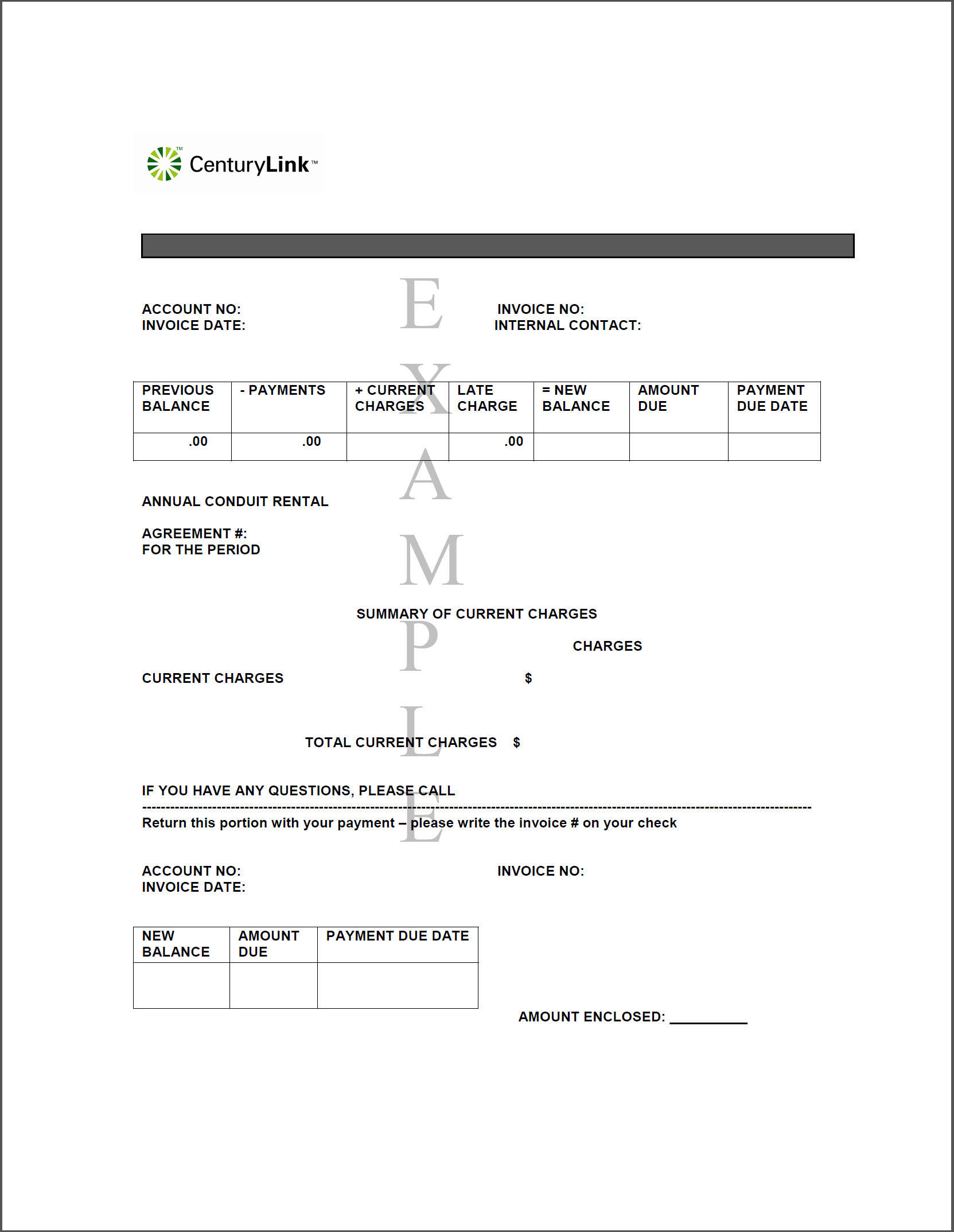
Your account will be established CenturyLink's Billing and Receivables Tracking (BART) System. Annual and nonrecurring charges for PDR are billed on a BART Bill. Billing and Receivable Tracking (BART) billing is described in Billing Information - Billing and Receivable Tracking (BART).
Click here to view the example of a yearly invoice for an Annual Pole Attachment fee billing statement.
Payment may also be made by EFT (Electronic Funds Transfer). See EFT instructions.
Training
View CenturyLink courses in the Course Catalog.
Contacts
CenturyLink contact information is located in Wholesale Customer Contacts.
For additional information regarding Access to PDR and for order inquiries, contact the Joint User.
Frequently Asked Questions (FAQs)
1. Can I lease CenturyLink innerduct going into a building?
Yes. CenturyLink will lease innerduct that CenturyLink owns or controls. Access
to innerduct is available on a first-come, first-served basis to
existing facilities that are not allocated for repair, emergency
or projects in progress.
2. Where can a CLEC get access to Telcordia Documentation mentioned
in this document?
CLECs can click on the Telcordia link above or use the following
address to order applicable materials. http://telecom-info.telcordia.com/site-cgi/ido/index.html
Last Update: September 12, 2019