Product Catalog (PCAT)
Self-Healing Network Service (SHNS) - V14.0

Product Description
Self-Healing Network Service (SHNS) provides a failure-resistant telecommunications network. SHNS offers a service arrangement that provides high-capacity digital services between multiple customer-designated premises (Access Nodes) within a Local Access Transport Area (LATA) and a minimum of one CenturyLink™ Wire Center (Hub Node). The service will survive in the event of any single failure within the Self-Healing Network. The service is designed to automatically detect a service degradation or a single failure anywhere within the system and reconfigure itself around the point of failure to ensure a near continuous flow of information between those locations that are within the survivable network. Under certain circumstances, the SHNS network is capable of surviving multiple failures, as well.
Self-Healing Network Service (SHNS) provides network survivability through an integrated combination of Intelligent Network Elements (INE) and fiber ring topology, which includes automatic protection switching functions and diverse routed facilities. SHNS also provides Hub Central Office connections to other Private Line Transport Service(s) (PLTS).
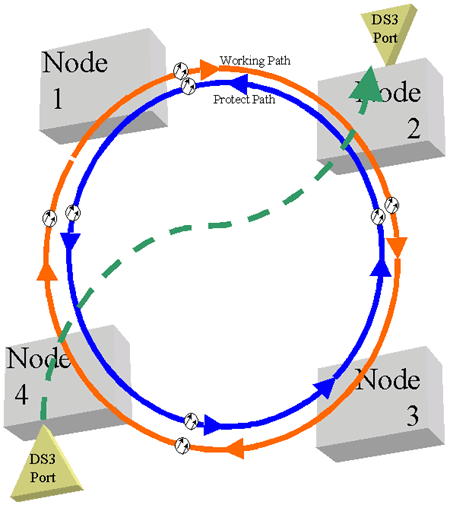
Self-Healing Network Service (SHNS) is a dedicated facility between multiple node locations that are customer specified. Access Nodes are located at customer premises, and Hub Nodes are located at CenturyLink Serving Wire Centers. A minimum of three nodes with at least one Hub Node is required to provision a SHNS ring. Each circuit is then configured to travel all around the ring and drop at any two nodes on the ring. The ring can support multiple bandwidths and will allow a variety of interfaces within the same ring.
Product Diagram
Availability
Self-Healing Network Service (SHNS) is available where facilities exist throughout CenturyLink QC.
Terms and Conditions
Terms and Conditions for Self-Healing Network Service (SHNS) are set forth in the CenturyLink Corporation Rates and Services Schedule No. 1 (QC RSS No. 1) and/or state tariffs located in Tariffs/Catalogs/Price List.
Technical Publications
Technical characteristics, including Network Channel /Network Channel Interface (NC/NCI™) codes, are described in Technical Publication, CenturyLink SELF HEALING NETWORK SERVICE, 77332.Pricing
Rate Structure
Recurring charges are comprised of the following rate elements:
- Access Node
- Access Port
- Hub Node
- Hub Port
- Ethernet Port
- Interoffice Transport
- Central Office Connecting Channel
- Control Node
- Optional Features & Functionality
Nonrecurring charges are comprised of the following rate elements:
- Access Port
- Hub Port
- Optional Features & Functionality
- Ethernet Port
- Ethernet Bandwidth
Rates
Rates are available in QC RSS No.1 and/or and/or in the state specific Tariffs/Catalogs/Price List.
Additional rate information is available through your Account Team / Sales Executives and Service Managers.
Tariffs, Rates and Services Schedule (RSS), Regulations and Policies
Tariffs, RSS, regulations and policies are located in the interstate QC RSS No. 1 or state specific Tariffs/Catalogs/Price Lists.
Optional Features
Software Reconfiguration Capability option that is part of SHNS gives businesses an additional advantage by allowing them to more efficiently manage their network simply by entering commands on their own computer.
OC3 CO Multiplexing is available on SHNS bandwidth capacities greater than or equal to 622.08 Megabits per seconds (Mbps) for distribution on and off the ring. The OC3 CO Multiplexer may be configured to provide eighty-four (84) 1.544 Mbps channels, three (3) 44.736 Mbps channels or any combination of 1.544 Mbps and 44.736 Mbps channels not to exceed the capacity of three (3) 44.736 Mbps channels. A COCC and OC3 CO Multiplexing 1.544 Mbps (DS1) Port or Hub Port 44.736 Mbps (DS3) is required per channel. OC3 CO Multiplexing is available on bandwidth capacities 622.08 Mbps, 2.488 Gigabits per second (Gbps) and 9.952 Gbps only.
Ethernet circuits can ride SHNS via the use of Ethernet interfaces. CenturyLink supports 10 Megabit Ethernet, 100 Megabit Ethernet and 1,000 Megabit Ethernet interfaces. Bandwidth speeds of 10M, 50M, 100M, 150M, 300M, 450M, 600M and 1000M are available via the Ethernet ports. Typically, an Ethernet circuit will have Ethernet interfaces at both ends of the circuit. However, CenturyLink can support circuits that have an Ethernet interface at one end and a SONET interface at the other end.
Features/Benefits
| Features | Benefits |
| Immediate Service Restoration | |
| Premium Protection | |
| Customized Solutions | |
| Greater Network Control |
Applications
Broad Applications for Networks of All Sizes
Backed by SONET-based technology, SHNS offers Digital Signal Level 1 (DS1), Digital Signal Level 3 (DS3), Synchronous Transport Signal (STS1) level, Optical Carrier Level 3 (OC3) and Concatenated Optical Carrier Level 3 (OC3-C) (concatenated signal) Optical Carrier Level 12 (OC12)/Concatenated Optical Carrier Level 12 (OC12-C), and Optical Carrier Level 48 (OC48)/Concatenated Optical Carrier Level 48 (OC48-C) options, 10 Megabit, 100 Megabit and 1,000 Megabit Ethernet options separately or in combination, to meet a broad spectrum of volume needs. Not only is SHNS the backup answer for large operations with high volume levels, but it is also designed to meet the recovery needs of lower volume customers.
These two benefits, combined with an expanded range of capacities, let customers create a system that fits their needs. Some candidates for SHNS:
- Medium-to-large businesses with applications in telemarketing or data centers requiring voice, data and video applications.
- Businesses with bandwidth requirements of DS1 or higher that require backup between two hosts or the addition of videoconferencing between two or more sites.
Off-Network Services Connections
DS1 Service, DS3 Service, Self-Healing Alternate Route Protection (SHARP) and SHARP Plus* and other services can be connected to a SHNS. SHARP and SHARP Plus can add survivability protection to DS1/DS3 Service circuits outside of the SHNS network.
* NOTE: SHARP Plus is no longer available for new service requests. The grandparenting action will affect you in the following ways:
- No new requests for Sharp PLUS will be accepted.
- Existing 12, 24 36 and 60-month customers can, and would be expected to, remain on the plan for the duration of their contract life or until they convert to a new plan.
- Renewals or extensions to existing agreements are no longer available.
For additional information about the grandparenting of SHARP Plus contact your CenturyLink Service Manager.
Implementation
Product Prerequisites
If you are an Interexchange Carrier (IXC), Internet & Data (ISP) or Wireless Service Provider (WSP) and have questions regarding your contract with CenturyLink, contact your Account Team / Sales Executives and Service Managers for more information.
Pre-Ordering
An AQCB form must be submitted to the CenturyLink System Design Engineer or the Custom Solutions Engineer for a facilities check, by your Account Team / Sales Executives and Service Managers. If facilities are not available, then a Notification of Potential Sale will be submitted, by your CenturyLink Account Team representative. A mini-business case will be developed to determine if it is economical for CenturyLink to build facilities to support this request. In the event a facility build is required, additional information regarding the equipment and space requirements at the customer premise are found in the Customer Premise Site Visit Requirements for Fiber Based Services.
Contract Process: Interstate Self-Healing Network Service (SHNS) must be purchased under contract.
Ordering
Self Healing Network Service (SHNS) service requests are submitted using the following Access Service Ordering Guidelines (ASOG) forms:
- Access Service Request (ASR)
- Administration Information (ADM)
- ASR Ring (RNG)
- ASR Additional Ring Information (ARI)
- Service Address Location Information (SAL)
Field entry requirements are described in the Access Service Request (ASR) Forms.
When submitting a service request for a one-time renewal of a fixed term agreement which qualifies for a 10% discount in QC RSS No.1, within the last 6 months of the contract for 12, 24 and 36 month term, or the last 12 months of a 60 month term. A remark of "ONE TIME RENEWAL", is required of the contract for the ring.
All ports on the ring go to monthly pricing at the expiration of the original fixed term of the ring. No additional service requests will be required for the ports in this situation
Ethernet Over SONET (EoS)
CenturyLink requires that all order requests for Ethernet Over SONET (EoS) go through the AQCB pre-order process before you submit your service request. The AQCB inquiry is reviewed to ensure that the equipment deployed for your SONET system supports EoS, and to determine any additional requirements that might be necessary to provide the service. Contact your CenturyLink account team to initiate the pre-order request; they will provide you with the AQCB inquiry number to include on your service request.
If an AQCB ID number has been provided to you, that information must be populated into the VTA field after the contract term period: i.e. "36 AQCBID#".
Provisioning and Installation
Self-Healing Network Service (SHNS) is provisioned as a customized service to customers, it is provided on an Individual Case Basis due date.
Maintenance and Repair
Self-Healing Network Service (SHNS) is a ring that uses Path Protection Switching to substitute standby equipment or facilities when a failure occurs. Information on the primary path on the ring flows in a clockwise direction. On the protect path, it flows counterclockwise.
For assistance in maintenance and repair issues, contact the CenturyLink Customer Service at 800 533-9125 or contact your Account Team / Sales Executives and Service Managers .
Billing
Carrier Access Billing System (CABS) billing is described in Billing Information - Carrier Access Billing System (CABS).
Customer Records and Information System (CRIS) billing is described in Billing Information - Customer Records and Information System (CRIS).
Training
Local CenturyLink 101 "Doing Business With CenturyLink"
- This introductory web-based training course is designed to teach the Local CLEC and Local Reseller how to do business with CenturyLink. It will provide a general overview of products and services, CenturyLink billing and support systems, processes for submitting service requests, reports, and web resource access information. Click here for Course detail and registration information.
View additional CenturyLink courses in the Course Catalog.
Contacts
CenturyLink contact information is located in Wholesale Customer Contacts.
Frequently Asked Questions (FAQs)
1. Would a node in a customer collocation at a CenturyLink Central
Office be considered a Hub Node or an Access Node?
Placing a node in collocation space is not permissible. However,
a node can be placed in the common space of a CO where the collocation
space exists. Since this node is in a CO, it is a Hub Node.
Last Update: January 30, 2017
Last Reviewed: October 24, 2023