Product Catalog (PCAT)
Enhanced Extended Loop (EEL) - V65.0

NOTE: The Federal Communications Commission ("FCC" or "Commission") released Order FCC 19-166 on July 12, 2019, Order FCC 19-72 on August 2, 2019, and altered CenturyLink's obligations to provide certain unbundled network elements. As such, these services will no longer be available after the following transition periods, consistent with the terms of the FCC Orders: 1) Unbundled Dedicated Interoffice Transport - new orders not available after January 12, 2020; 2) Enhanced Extended Loops and Loop Mux Combinations - new orders not available as of January 12, 2020. The wire center lists pertaiing to this order can be found at: http://www.centurylink.com/wholesale/clec.html.
Product Description
Enhanced Extended Loop (EEL) is a combination of the Unbundled Local Loop and Unbundled Dedicated Interoffice Transport (UDIT) between CenturyLink™ Wire Centers. An EEL can also be a multiplexed dedicated transport facility between CenturyLink wire centers that carries multiple EEL Loops.
EEL transport and loop facilities may utilize Digital Signal Level 0 (DS0) – Analog Voice Grade, Digital Signal Level 1 (DS1), and Digital Signal Level 3 (DS3) bandwidths.
Enhanced Extended Loop (EEL) provides you with the ability to access either residential or business end-users served by a different CenturyLink™ Wire Center than the wire center where your collocation is located. Transport involving EEL circuits, commingled or not, must originate from your Collocation located in a CenturyLink wire center, and terminate to a CenturyLink wire center in the same Local Access and Transport Area (LATA). The EEL Loop must terminate at an end-user’s premises/demarcation point.
When an end-user is served by a Remote Serving Unit (RSU) and you are collocated in the RSU’s host Central Office (CO), you can provide service to those end-users with an EEL.
DS0 - Analog Voice Grade is a two-point circuit that provides such services as:
- One Flat Rate Residential (1FR) or One Flat Rate Business (1FB) Plain Old Telephone Service (POTS), off-premises extensions, or off-premises station lines.
- Private Branch Exchange (PBX) trunks or trunk type tie lines
- Voice Grade Private Line
Product Diagram
Enhanced Extended Loop (EEL) is available in two configurations, the Point-To-Point EEL and Multiplexed EEL.
Point-to-Point EEL Configuration
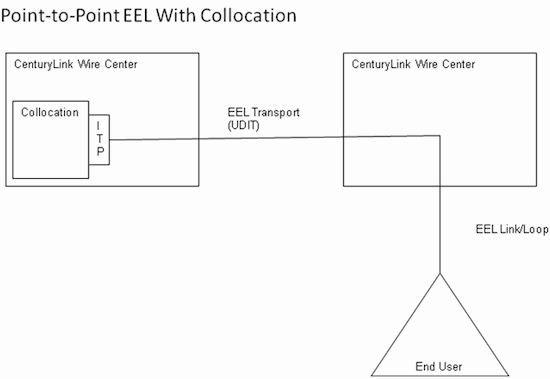
The Point-To-Point EEL is a CenturyLink facility that provides a connection from your collocation to an end-user premises/demarcation point served by a different CenturyLink Serving Wire Center.
Point-to-Point EEL With Collocation
Multiplexed EEL Configuration
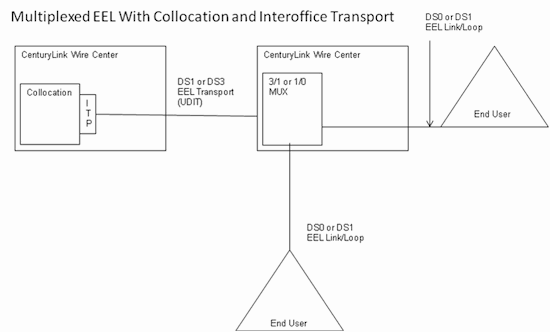
A Multiplexed EEL provides transport from your collocation in one CenturyLink Wire Center to a multiplexer in a different CenturyLink Wire Center. Multiple EEL Loops may be connected to the multiplexer.
Multiplexed EEL With Collocation and Interoffice Transport
Availability
Enhanced Extended Loop (EEL) is available where facilities exist and where required by law throughout CenturyLink QC.
Terms and Conditions
EEL circuits must meet the same impairment criteria that apply to DS1 and DS3 Unbundled Dedicated Interoffice Transport (UDIT) and Unbundled Local Loops as determined by the FCC in the Triennial Review Remand Order, FCC 04-290).
Enhanced Extend Loop (EEL) services that extend to designated high voltage (HV) environments are required to have high voltage protection (HVP). HVP devices may be provided by you, the end user, or may be requested from CenturyLink. General High Voltage Protection activities are described in High Voltage Protection.
Transport
- CenturyLink offers unbundled DS1 transport between any pair of CenturyLink Wire Centers except where, through application of “Tier” classifications, both Wire Centers defining the route are Tier 1 Wire Centers. CenturyLink offers unbundled DS1 transport if the Wire Center at either or both ends of the requested route is not a Tier 1 Wire Center. For more information on where required by law, see Non-Impaired Wired Center Lists for Loops and Dedicated Transport.
- CenturyLink offers unbundled DS3 transport between any pair of CenturyLink Wire Centers except where, through application of “Tier” classifications, both Wire Centers defining the route are either Tier 1 or Tier 2 Wire Centers. CenturyLink offers unbundled DS3 transport if a Wire Center on either end of a requested route is a Tier 3 Wire Center. For more information on where required by law, see Non-Impaired Wired Center Lists for Loops and Dedicated Transport.
- CLEC may obtain a maximum of ten (10) unbundled DS1circuits on each route where DS3 dedicated transport is not available on an unbundled basis. There is a limit of twelve (12) DS3 circuits per carrier for any route on which carriers are not impaired
- CenturyLink offers DS1 unbundled loops to any building not served by a Wire Center with at least 60,000 Business Lines andat least four fiber-based collocators.
- CenturyLink offers DS3 unbundled loops to any building not served by a Wire Center with at least 38,000 Business Lines andat least four fiber-based collocators.
- A maximum of ten (10) DS1 Loops or one (1) DS3 Loop is allowed to any single building on an unbundled basis.
Prior to submitting a DS1 or DS3 EEL request, you must have a certification form on file. The certification form is required for each state that you do business in. This form certifies that the CLEC:
- Is ordering a circuit in an impaired Wire Center as filed by CenturyLink
- Is ordering a circuit that does not exceed the cap in an impaired Wire Center as filed by CenturyLink
- Is not accessing an unbundled network element for the exclusive provision of mobile wireless services or interexchange services.
The Certification of Remand Order Criteria High Capacity Unbundled Transport, Unbundled Loop, and Combinations form is kept on file at CenturyLink subsequent to submission to the Account Team / Sales Executives and Service Managers.
Enhanced Extended Loops (EEL) are available within the same Local Access and Transport Area (LATA) and state where facilities exist and/or where you have CLEC Requested UNE Construction per the terms and conditions of your Interconnection Agreement.
Border town cities are physically located in one state with service provided from a CenturyLink Serving Wire Center located in an adjacent state. EEL Loop requests that involve a border town will be provisioned if facilities are available; and the transport is between CenturyLink Wire Centers in the same LATA and state. The end-user customer location must be located within the CenturyLink border town’s Serving Wire Center Area. EEL Loops involving a border town will be billed and provisioned under the rates and terms of your Interconnection Agreement for the state in which the CenturyLink Serving Wire Center is located.
You may utilize the EEL DS1 Loop product to serve a location where you have multiple end user customers at a single multi-tenant location. EEL Loops are not available for telecommunications services provided directly to you for your own administrative purposes. An unbundled loop is defined as transmission facility between a distribution frame (or its equivalent) in a CenturyLink central office and the loop demarcation point at an end user customer premises.
Service guarantees associated with Private Line/Special Access circuits converted to EEL do not apply after the circuits have been converted to EEL.
Eligible circuits that are converted from Private Line/Special Access Service to EEL will retain all optional features and functions that were associated with the existing service as requested from the tariff(s). After a circuit has been converted to EEL, if you wish to make design changes to that service, the change requested must be in compliance with the design requirements identified in Technical Publication, TRRO- Enhanced Extended Loop (EEL) and TRRO Loop Mux Combinations (LMC), 77418. If the change is outside of the scope of Technical Publication, TRRO - Enhanced Extended Loop (EEL) 77418 the Special Request Process must be followed.
The Special Request (SR) process is used when you are requesting nonstandard combination of previously available UNEs, or certain UNEs that CenturyLink does not offer as a standard product but have been identified by the Federal Communications Commission (FCC) or State Commission as network elements. Special Requests information is described in Bona Fide Request (BFR) and Special Request (SR) Processes.
Each EEL must meet the service eligibility criteria established by from the Federal Communications Commission (FCC) on August 21, 2003 in CC Docket Nos. 01-338, 96-98, 98-147, known as the Triennial Review Order. Prior to submitting a DS1 or DS3 EEL request, you must have a certification form on file. The Certification of Service Eligibility Criteria Transport and Unbundled Loop Combinations and Commingling form is required for each state that you do business in and is submitted to your assigned Account Team / Sales Executives and Service Managers.
The CLEC must certify the following service eligibility criteria to show that it is a bona fide provider of qualifying services before converting High Capacity Private Line or Special Access Services to EEL or prior to ordering new EELs.
- The CLEC must have a state certification of authority to provide local voice service. Evidence of registration, tariffing, filing of fees, or other regulatory compliance can demonstrate satisfaction of this criterion.
- To demonstrate that the CLEC provides a local voice service to the customer over every DS1 circuit, the CLEC must have at least one local number assigned to each DS1 EEL and 28 local telephone numbers assigned to each DS3 EEL and must provide 911 or E911 capability to each circuit. The origination and termination of local voice traffic on each local telephone number assigned to an EEL shall not require dialing special digits beyond those normally required for a local voice call.
-
The following additional circuit-specific architectural service eligibility criteria are also required:
- Each circuit must terminate into a collocation governed by section 251(c)(6) at a CenturyLink central office within the same LATA as the end user customer premises and cannot be at an inter-exchange carrier Point of Presence (POP) or Internet Service Provider (ISP) POP location. When the DS1 or DS3 EEL Loop is connected to a multiplexed facility, the multiplexed facility must be terminated in the CLEC’s collocation.
- At a minimum, each DS1 EEL circuit must be served by a Local Interconnection Service (LIS) trunk in the same LATA as the customer premises served by the EEL; and for every 24 DS1 EELs or the equivalent, the CLEC must maintain at least one active DS1 interconnection trunk for the exchange of local voice traffic. Where a CLEC strips off the calling party number (CPN) on calls exchanged over the interconnection trunk, that trunk shall not be counted towards meeting the trunk/EEL ratio. The CLEC must arrange for the meaningful exchange of traffic which must include hand-offs of local voice calls that flow in both directions.
- Each circuit must be served by a Class 5 switch or other switch capable of providing local voice traffic. To ensure that the traffic carried over each EEL is not exclusively non-local, the CLEC must certify that the switching equipment is either registered in the LERG as a Class 5 or that it can switch local voice traffic.
Additional information about the certification process is available in the Product Prerequisites section of this web page.
Audits
In order to confirm reasonable compliance with these eligibility requirements of your options, CenturyLink may perform audits of Competitive Local Exchange Carriers (CLEC) records according to the guidelines outlined below. CenturyLink may, upon thirty (30) Days written notice to a CLEC that has purchased high capacity combination and commingled facilities, conduct a Service Eligibility Audit to ascertain whether those high capacity facilities were eligible for UNE treatment at the time of provisioning or conversion and on an ongoing basis thereafter.
CLEC shall make reasonable efforts to cooperate with any Service Eligibility Audit by CenturyLink and shall maintain and provide CenturyLink with relevant records (e.g., network and circuit configuration data, local telephone numbers), which demonstrate that CLEC’s high capacity combination and commingled facilities meet the Service Eligibility Criteria.
An independent auditor hired and paid for by CenturyLink shall perform any Service Eligibility Audits, provided, however, that if a Service Eligibility Audit reveals that the CLEC’s high capacity combination and commingled facility circuit(s) do not meet or have not met the Service Eligibility, then the CLEC shall reimburse CenturyLink for the cost of the audit. To the extent the independent auditor's report concludes that CLEC complied in all material respects with the Service Eligibility and Qualifying Service Criteria, CenturyLink shall reimburse CLEC for its costs associated with the audit.
An independent auditor must perform its evaluation in accordance with the standards established by the American Institute for Certified Public Accountants (AICPA) and during normal business hours, unless there is a mutual agreement otherwise.
CenturyLink shall not exercise its Service Eligibility Audit rights with respect to CLEC (excluding affiliates) more than once in any calendar year, unless an audit finds noncompliance. If a Service Eligibility Audit does find non-compliance, CenturyLink shall not exercise its Service Eligibility Audit rights for sixty (60) Days following that audit, and if any subsequent Service Eligibility Audit does not find non-compliance, then CenturyLink shall not exercise its Service Eligibility Audit rights for the remainder of the calendar year.
At the same time that CenturyLink provides notice of a Service Eligibility Audit to CLEC, under this paragraph, CenturyLink shall send a copy of the notice to the Federal Communications Commission.
Service Eligibility Audits conducted by CenturyLink for the purpose of determining compliance with Service Eligibility Criteria shall not effect or in any way limit any audit or Dispute Resolution rights that CenturyLink may have pursuant to other provisions of a CLEC’s interconnection agreement.
CenturyLink shall not use any other audit rights it may have under a CLEC’s interconnection agreement to audit for compliance with Service Eligibility Criteria. CenturyLink shall not require a Service Eligibility Audit as a prior prerequisite to provisioning combination and commingled facilities.
CLEC shall maintain appropriate records to support its Service Eligibility Criteria. However, CLEC has no obligation to keep any records that it does not keep in the ordinary course of business.
If a Service Eligibility Audit demonstrates that a high capacity combination and commingled facilities do not meet the Service Eligibility Criteria above, the CLEC must convert all non-compliant circuits to Private Line/Special Access circuits and CLEC must true-up any difference in payments within thirty (30) days.
Technical Publications
Technical characteristics, including Network Channel/Network Channel Interface (NC/NCITM) codes are described in Technical Publication, TRRO-Enhanced Extended Loop (EEL) and TRRO Loop Mux Combinations (LMC), 77418.
Pricing
Rate Structure
Recurring charges are comprised of the following rate elements:
- Enhanced Extended Loop (EEL) Loop
- Enhanced Extended Loop (EEL) Transport
- Enhanced Extended Loop (EEL) Multiplexing
- Interconnection Tie Pair (ITP)
- Channel Performance at DS0 Analog Voice Grade level
There are three different types of EEL nonrecurring charges. The one that is applied to your service request is dependent upon the work CenturyLink must perform to fulfill your request. The following provides a brief description of each EEL nonrecurring charge.
- Full installation nonrecurring charges are assessed when provisioning new EELs.
- A conversion nonrecurring charge is assessed when converting an existing Private Line/Special Access circuit to EEL. This is a billing change only and referred to as Conversion As Is. No Physical work or redesign of the circuit is involved.
- A rearrangement nonrecurring charge may apply for some Conversion
as Specified requests:
- Roll an existing Private Line circuit from an existing Private Line Multiplexed facility to an existing EEL Multiplexed facility and convert the Private Line circuit to EEL.
- Reterminate an existing Multiplexed Private Line circuit from one slot to another at the same CLEC's collocation Alternate Point of Termination (APOT); and convert the Multiplexed Private Line circuit to a Multiplexed EEL facility.
- Redesign an existing Point-to-Point Private Line circuit to ride an existing Multiplexed EEL facility and; convert the Private Line to an EEL Loop.
- Redesign an unbundled local loop to an EEL Loop connected to a Multiplexed EEL facility when the multiplexer is located in the same wire center as the end user customer's address
Full EEL Installation Nonrecurring charges apply to the following Conversion As Specified requests:
- The conversion of an existing POTS service to EEL Loop
- An existing EEL migrating from one CLEC to another.
A rearrangement nonrecurring charge may be assessed on some requests for work to be performed by CenturyLink on an existing EEL:
- Move an EEL Loop from one slot to another on the same Multiplexed EEL.
- Reterminate an EEL from one slot to another at your collocation APOT.
For coordinated project installations scheduled to commence out of hours, or rescheduled by a CLEC to commence out of hours, additional nonrecurring charges will be applied to each EEL circuit for the work performed by CenturyLink outside of normal business hours. If this offering is not included in your current ICA, an amendment will be required. Out of Hours Project Coordinated Installations are offered only in those states that contain the appropriate rates found under Miscellaneous Charges in Section 9.20 of Exhibit A for the specific state.
Additional rate information can be located in Exhibit A or the specific rate sheet in your Interconnection Agreement. The nonrecurring charges, either full installation or rearrangement, applied to Conversion as Specified requests are dependent upon the physical work CenturyLink must perform. Full EEL installation nonrecurring charges will apply on all Conversion as Specified requests unless your current Interconnection Agreement includes the EEL rearrangement nonrecurring charge. If you wish to amend your current Interconnection Agreement to include either EEL or the rearrangement nonrecurring charge, contact your CenturyLink Service Manager.
When providing an EEL to an end-user served from an RSU, the facility between the host office and the RSU is billed at EEL transport rates. If the RSU has the same NPA NXX as the host switch, CenturyLink will zero rate the recurring cost of the transport between the host and the remote office.
For Private Line/Special Access Services that are converted to EEL, minimum service period, termination liability and shortfall charges for the product from which the circuit is being converted will apply and will be assessed as described in the individual state Tariffs/Catalogs Price Lists. If you wish to convert services to EEL, the conversion of these services will not be delayed due to the applicability of minimum service period, shortfall or termination liability charges.
Information regarding Geographic Deaveraging is available in Geographic Deaveraging - General Information.
Rates
Wholesale rates for this product or service, including tariff references and any applicable discounts, are provided in your current Interconnection, Resale, Commercial, or other governing agreement.
Tariffs, Regulations, and Policies
Tariffs, regulations and policies are located in the state specific Tariffs/Catalogs/Price Lists.
Optional Features
There are no optional features available with EEL.Features/Benefits
| Features | Benefits |
| Ability to provide local service to end-users served by distant Wire Centers where you do not have collocation. |
|
Applications
See Features/Benefits.
Implementation
Product Prerequisites
If you are a new CLEC and are ready to do business with CenturyLink, view Getting Started as a Facility-Based CLEC. If you are an existing CLEC wishing to amend your Interconnection Agreement or New Customer Questionnaire, additional information is located in the Interconnection Agreement.
Before submitting your first request to either convert or provision new EEL service, you should review your Interconnection Agreement. If your Interconnection Agreement includes provisions for UNE combinations, all of the UNEs (e.g., loop and transport) making up the EEL and all of the appropriate recurring and nonrecurring billing elements comprised in an EEL, an amendment to your Interconnection Agreement is not required. The following EEL billing elements must be included your Interconnection Agreement:
- Interconnection Tie Pair (ITP) for connection to your collocation. Only recurring charges apply.
- Unbundled Dedicate Interoffice Transport (UDIT) for transport between CenturyLink Wire Centers. Recurring charges will apply.
- Digital Signal Level 0 (DS0), DS1, DS3 Unbundled Local Loops to provide the loop segment to your end-user. Recurring and nonrecurring charges apply. Your Interconnection Agreement must include the nonrecurring rate for Basic Installation with Cooperative Testing.
- Digital Signal Level 0 (DS0) , DS1, DS3 Unbundled Local Loops to provide the loop segment to your end-user. Recurring and nonrecurring charges apply. Your Interconnection Agreement must include the nonrecurring rate for Basic Installation with Cooperative Testing.
- Digital Signal Level 1 (DS1) to DS0 and DS3 to DS1 Multiplexing for the installation of Multiplexed EELs. Both recurring and nonrecurring charges apply.
- Channel Performance for the installation of DS0 - Analog Voice Grade EEL circuits. Recurring and nonrecurring charges will apply.
Without an EEL amendment, full nonrecurring charges for loop, transport, and multiplexing as described in your Interconnection Agreement will apply when converting Private Line/Special Access circuits to EEL and when provisioning new EELs.
If you are amending your Interconnection Agreement, a New Customer Questionnaire must be updated and provided to your CenturyLink Service Manager.
Before submitting requests to convert a Private Line/Special Access circuit to EEL or to provision a new EEL, you must complete the Certification of Service Eligibility Criteria Transport and Unbundled Loop Combinations and Comminglingform is required for each state that you do business in and is submitted to your assigned Account Team / Sales Executives and Service Managers.
For large volume (25 or more) conversion requests from PLT/SA to EEL, complete the PLT/SA to UNE Conversion Project Template which identifies the circuits to be converted, and return it to your CenturyLink Service Manager. Your CenturyLink Service Manager will project manage and coordinate your conversion requests with the Service Delivery Center.
For all requests to convert an existing PLT/SA circuit to two commingled circuits of the same bandwidth (e.g. DS1 PLT transport and DS1 EEL Loop), you must contact your CenturyLink Service Manager. Your CenturyLink Service Manager will project manage each of your requests.
Pre-Ordering
General pre-ordering activities are described in the Pre-Ordering Overview.
Requirements for pre-ordering are described in Local Service Ordering Guidelines (LSOG) Pre-Order.
The EASE-LSR User's Guide specifically details the information available for the pre-ordering functions.
CenturyLink recommends use of pre-ordering functionality to assist in achieving increased service request flow through and accuracy that will result in reduced service request rejects.
Pre-Ordering activities applicable to EEL include:
- Validate address
- Check facility availability
- Customer Service Record (CSR) retrieval
- Query Raw Loop Data (RLD) tools
- RLD via EASE-LSR
- Wire Center RLD
You may verify if the DS1 or DS3 facility is available by doing a high capacity facility check using the inquiry function in EASE-LSR. Information is available in the EASE-LSR User's Guide.
CSR retrieval is available through EASE-LSR for the following Local Service Request (LSR) ACT types:
- C = Change
- D = Disconnect
- V = Conversion as specified
On-line CSR retrieval is not available for ‘Conversion as is’ requests as the account resides in the Carrier Access Billing System (CABS). EASE-LSR does not have the ability to access records in CABS.
If you are unable to locate the CSR, contact the CenturyLink Customer Service Inquiry and Education (CSIE) and select the Centrex and Complex Resale Option to reach the appropriate workgroup.
When contacting the CenturyLink CSIE, be prepared to provide:
- End-user name
- Account Number
- Common Language Circuit ID (CLS) or Common Language Facility ID (CLF) information
- Proof of Agency authorization
Depending on your needs, the CenturyLink CSIE can:
- Provide you with the account number of the facility so you can find the CSR in EASE-LSR
- Fax, mail or e-mail the CSR to you
- Review the CSR with you on the telephone.
The RLD Tools provide the physical characteristics of the facility at either the Wire Center level or at the individual loop level. Data may include, but is not limited to, the physical characteristics by segment:
- CLLI Code
- Load Coils
- Bridged Taps
- Wire Gauge
- Cable and Pair make-up
- Spare Facility
The Wire Center RLD Tool provides the physical characteristics of the facilities for a Wire Center.
The EASE-LSR RLD Tool provides loop specific information. This tool also enables you to obtain the physical characteristics of the facilities.
Information regarding the EASE-LSR RLD Tool is described in the EASE-LSR User's Guide. The EASE-LSR Loop Qualification and Raw Loop Data-CLEC Job Aid provides loop makeup information and instructions on how to use the EASE-LSR based loop qualification tools and the Wire Center RLD Tool. The Wire Center RLD Tool requires a digital certificate.
It is important to understand the network topology, in understanding the difference between a 'stand alone' Serving Wire Center or Serving Central Office, a Host Central Office, a remote and a Remote Service Unit (RSU). Generally, Serving Wire Center is a term used to describe a Central Office that directly serves a specific geographic area of end-users. In this circumstance, there are no intermediary offices between the end-user and the Central Office. Contrarily, Host Office is a term generally used to describe a Central Office that directly serves sub-tending office(s) in addition to its own end-users. For example, the Dry Creek, Colorado Central Office has some direct end-users and is also the originating end of the cable that fed the Tech Center in its remote status (not as a stand-alone Serving Central Office). A remote is a piece of field equipment attached to the Serving Wire Center that provides capability that the end-user's distance would otherwise prohibit. Thru time, if or when a remote grows to accommodate a significant number of its own end-users, it can be deemed a sub-tending office. This sub-tending office is generally referred to as an RSU and becomes a Serving Central Office (i.e., no longer a remote, but a Remote Service Unit).
A distinct cable naming convention is used when an end-user is not directly served by the Host Central Office (i.e., served from a remote), an "EX" prefix will appear in the end-users distribution cable pair (e.g., F2 ca EXA7). The "EX" prefix designates the cable that extends from a remote to the end-user. When an end-user is served from a Remote Serving Unit (RSU), Unbundled Local Loops are available only when you are collocated in the same RSU that your end-user is served by. If you are not collocated in the same RSU as an end-user, Enhanced Extended Loops (EELS) are available to serve end users that have EX cable designations in their distribution pair. Where an end-user is fed out of a Serving Central Office other than one where the Collocation is present, an EEL is also used.
Unbundled Loops are available when you are collocated in the same Serving Central Office that your end-user is served by. Generally, once a remote becomes a Serving Central Office, you can now collocate in the RSU and serve the customer with an Unbundled Loop (UBL) or continue to serve from the old Host Central Office under the EEL.
In rare instances where the facility between the Host office serving that RSU and the end user has been included in the Unbundled Loop cost models, CenturyLink will continue to make Unbundled Loops available to you to serve that end user. These instances will need to be evaluated on an ICB basis, contact your CenturyLink Sales Executives for assistance if you believe you have such an instance. The Chandler Main AZ central office is one such exception. Unbundled Loops are available in Chandler Main when an "EX" prefix appears in the end-users distribution cable pair.
Ordering
General ordering activities are described in the Ordering Overview.
Enhanced Extended Loop (EEL) service requests are submitted using the following LSOG forms:
- LSR
- Resale Private Line (RPL)
Field entry requirements are described in the LSOG.
Service requests should be placed using EASE-LSR Extensible Markup Language (XML) or EASE-LSR Graphical User Interface (GUI).
A Design Layout Record (DLR) request is described in the EASE-LSR XML Network Disclosure Document or the EASE-LSR User's Guide.
Point-to-Point and EEL Loop requests are issued using a Common Language Circuit ID, which are identified on the CSR as CLS. Multiplexed EEL requests use the Common Language Facility ID format, which are identified on the CSR as CLF.
Enhanced Extended Loop (EEL) service request are placed using the LSR and Resale Private Line (RPL) forms. Detailed information regarding field entry requirements is described on the Local Service Ordering Guidelines (LSOG) web page. Service requests should be placed via EASE-LSR.
A separate service request is required for each of the following:
- Point-To-Point EEL
- Multiplexed EEL
- Each EEL Loop connected to a multiplexer.
- EEL Transport or EEL Loop circuits commingled with a PLT circuit of the same bandwidth
Valid REQTYP is MB.
Valid LSR ACT types are:
- C = Change
- D = Disconnect
- M = Inside Move
- N = New Installation
- T = Outside Move
- V = Conversion as specified
- W = Conversion as is
Valid TOS Types include:
- 1 = Business
- 3 = Government
NOTE: EELs used for residential service require a TOS of 1.
The Remarks field on the LSR form may indicate your request is for “EEL,” but is not a required entry.
When an EEL Loop is connected to a multiplexed facility, the Primary Location on the RPL form is the CLLI for the wire center where the multiplexer is located. When submitting orders for DS1 EEL loops which will connect to a DS3 multiplexed facility, the CFA of the DS3 facility must belong to you.
Service interval guidelines are located in the Service Interval Guide (SIG). Standard intervals do not apply to commingled circuits of the same bandwidth and will be handled on an individual case basis.
"When submitting EEL DS1 Loop requests where the end user location is a multi-tenant environment, you must place your company name followed by the acronym "MTE" in the "Name" field in the Secondary Location on the Resale Private Line (RPL) form."
Enhanced Extended Loop (EEL) Conversion Requests
Enhanced Extended Loop (EEL) ‘Conversion As Is’ is the conversion of an existing Private Line/Special Access circuit. The conversion does not require redesign of the circuit and will not disrupt service. There is a change in billing and the service code modifiers within the circuit ID. Coordinate requests for conversion of more than 25 circuits with your CenturyLink Service Manager.
A separate service request is required for each ‘Conversion As Is’ circuit requested. The ACT field of the LSR must show a ‘W’ for ‘conversion as is’. In the remarks section of each LSR, you may specify:”EEL”
Enhanced Extended Loop (EEL) Conversion as Specified requires CenturyLink to redesign and perform physical work on a circuit at the time of conversion from Private Line/Special Access to EEL. The end user address must remain the same for all Conversion as Specified requests. All work must be performed in the same CenturyLink Wire Center.
The following options are available with Conversion As Specified:
- Roll an existing Private Line circuit from an existing Private Line Multiplexed facility to an existing EEL Multiplexed facility in the same CenturyLink Wire Center; and convert the Private Line circuit to EEL.
- Reterminate an existing Private Line circuit from one slot to another at the same CLEC's collocation Alternate Point of Termination (APOT); and convert the Private Line circuit to a Multiplexed EEL facility.
- Redesign an existing Point-to-Point Private Line circuit to ride an existing Multiplexed EEL facility or an existing PLT/SA transport multiplexed facility and; convert the Private Line to an EEL Loop. All work must be performed in the same CenturyLink Wire Center where the multiplexer is located.
- Redesign an existing DS1 Private Line Transport circuit, eliminating the DS1 transport, and re-terminate the DS1 Loop to ride an existing DS3 Multiplexed EEL facility. The DS1 Private Line Transport circuit will be converted to a DS1 EEL Loop. The DS3 multiplexer must be located in the same CenturyLink wire center that serves the end user address.
- An existing EEL can be moved from one CLEC to another. The end-user address on point-to-point EELs and the multiplexing location on Multiplexed EEL facilities must remain the same.
- The conversion of an existing POTS service to EEL Loop is offered at the DS0 Analog Voice grade level. If your request involves a multiplexed facility, your request to convert an existing or order a new DS1 multiplexed EEL facility must be submitted prior to the request to convert POTS service (e.g., 1FR or 1FB) to an EEL DS0 Analog Voice Grade loop. The end user address of the POTS service must remain the same.
- Convert an existing Unbundled Loop to EEL loop; and reterminate from the collocation to an existing EEL or PLT/SA transport multiplexed facility within the same wire center.
Conversions as Specified with circuits converting from Private Line to EEL require an Access Service Request (ASR) and an LSR. An ASR is required to disconnect the existing Private Line circuit. The activity field must be populated with a "D". The RPON field must be populated to relate the ASR to the LSR and the REMARKS section of the ASR must state:
- "EEL"
- Reuse facilities from related ASR PON#_____
- Physical work required.
- Validation code _____
- FCC Option # ____.
An LSR is required to establish the circuit as EEL. The activity field on the LSR must be populated with 'V'. Your LSR must include the new information associated with the Conversion as Specified request to establish the circuit as an EEL. The REMARKS section of the LSR must state:
Conversion of Private Line to EEL. Reuse facilities from ASR PON #.”
Enhanced Extended Loop (EEL) New Requests
A separate LSR is required for each new EEL circuit requested. The ACT field of the LSR must show an "N" for "new service", in the REMARKS section of the LSR, you may specify: "EEL"
Enhanced Extended Loop (EEL) Commingling Requests
When commingling an EEL Loop with the same bandwidth PLT transport, an LSR and an ASR is required. Your LSR for EEL Loop must be submitted first and must include the following specific information:
- PriLoc Section = End user Location
- Sec Loc Section = Dangling Wire Center
- Remark = “EEL, Install Dangling/Commingled Circuit.”
- The REQTYP field on the ASR form must be populated with “S.”
- The ACTL field on the ASR must be populated with a collocation ACTL.
- The SECLOC indicator on the ASR transport form will be “C” with the 8-character CenturyLink C.O. CLLI code where the ASR (PLT transport) circuit and LSR (EEL Loop) circuit are to be connected.
- “Commingled with circuit ID XX.XXXX.123456.XX/PON #, please cross connect” in Remarks
- Populate the WACD1 field on the ASR transport form with the circuit ID of the EEL Loop circuit (XX.XXXX.123456.XX). This indicates that the PLT transport circuit is to be cross connected to the EEL Loop circuit.
- The SPEC field on the ASR from must be populated with the following SPEC Code: CMSBEEL
When commingling an EEL transport with the same bandwidth PLT channel termination, an LSR and an ASR is required. Your LSR for EEL transport must be submitted first and must include the following information:
- PriLoc Section = Collocation
- SecLoc Section = Dangling Wire Center
- Remark = “EEL, Install Dangling/Commingled Circuit”
Once you have received the FOC with circuit ID for your commingled EEL Transport, you may submit your ASR for a PLT channel termination to be commingled with EEL transport of the same bandwidth. You ASR must include the following information:
- The REQTYP field on the ASR form must be populated with “S.”
- The ACTL field on the ASR must be populated with a collocation ACTL.
- The SECLOC indicator on the ASR transport form will be “C” with the 8-character CenturyLink C.O. CLLI code where the ASR (PLT channel termination) circuit and LSR (EEL Transport) circuit are to be connected.
- “Commingled with circuit ID XX.XXXX.123456.XX/PON #, please cross connect” in Remarks
- Populate the WACD1 field on the ASR transport form with the circuit ID of the EEL Transport circuit (XX.XXXX.123456.XX). This indicates that the EEL transport circuit is to be cross-connected to the PLT channel termination circuit.
- The SPEC field on the ASR from must be populated with the following SPEC Code: CMSBEEL
When commingling an EEL Loop with a higher bandwidth tariffed multiplexed facility, the CFA on your LSR will be the name and channel of the multiplexed facility. All other LSR information remains the same as on a non-commingled EEL Loop.
Enhanced Extended Loop (EEL) Commingling Conversion Requests
In addition to the ASR/LSR requirements for single bandwidth commingled circuits as stated above, all requests to convert an existing PLT/SA circuit to two commingled circuits of the same bandwidth will require:
- Contact with your CenturyLink Service Manager
-
An ASR to rearrange your existing PLT/SA circuit and establish billing for a COCC.
- The REMARKS section must include: “Rearrange to establish dangling commingled ckts, reuse facilities for RPON.”
- The PON of your LSR must be populated in the RPON field of your ASR.
- The SPEC field on the ASR form must be populated with “CMSBEEL”
-
An LSR to establish the new EEL circuit ID. The REMARKS section of your LSR must include:
- “Dangling commingled ckt”
- “Conversion to reuse facilities from ______” (fill in the existing PLT/SA circuit ID and PON number of your Private Line ASR).
- “EEL,
Enhanced Extended Loop (EEL) Rearrangement Requests
The CLEC and the end-user address must remain the same on all rearrangement requests. All work performed must be in the same CenturyLink Wire Center. Rearrangements to an existing EEL may include the following:
- Move an EEL Loop from one slot to another on the same Multiplexed EEL.
- Roll an EEL Loop from one Multiplexed EEL to a different Multiplexed EEL in the same CenturyLink Wire Center.
- Reterminate an EEL from one slot to another at your collocation APOT.
- Redesign an existing DS1 EEL, eliminating the DS1 transport, and re-terminate the DS1 EEL Loop to ride a DS3 Multiplexed EEL. The DS3 multiplexer must be located in the same CenturyLink wire center that serves the end user address.
A separate LSR is required for each EEL rearrangement request. The ACT field of the LSR must show a "C" for rearrangement." In the REMARKS section of the LSR, you may specify: "EEL”
Provisioning and Installation
General provisioning and installation activities are described in the Provisioning and Installation Overview.
Firm Order Confirmation (FOC) intervals are found in the SIG. FOC information is available in the Provisioning and Installation Overview.
If no facilities are available to meet the parameters required for your requested service, CenturyLink will look for an existing engineering job order that could fill your service request in the future. If an engineering job order is identified, CenturyLink will provide the Ready For Service (RFS) date. You will have the opportunity to wait for the service to be delivered or cancel your service request.
If facilities cannot be located and there is no planned engineering job, your service request will be held for 90-business days. Availability of facilities is on a first come, first served basis. If spare facilities become available, a Firm Order Confirmation (FOC) is generated and sent to you in response to your original service request. If at the conclusion of the 90-business day hold, your request cannot be fulfilled without installing or constructing new facilities, the Service Order will be cancelled and your service request will be rejected. For exceptions and detailed information, refer to the Provisioning and Installation Overview.
If no facilities are available, the service request will be rejected for a No Facilities reason. Information describing reject codes is located in the Ordering Overview.
A jeopardy on a service request results if a condition exists that threatens timely completion of the request. Detailed information regarding jeopardy codes is described in the Provisioning and Installation Overview.
A DLR will be provided when requested on the LSR. Information describing DLR viewing options is available in the EASE-LSR User's Guide.
For order status information for EEL above DS0 signal levels, refer to theCustomer Electronic Maintenance and Repair-Maintenance Ticketing Gateway (CEMR-MTG). This tool requires a digital certificate. For additional information about CEMR-MTG, access the Customer Electronic Maintenance and Repair-Maintenance Ticketing Gateway (CEMR-MTG) Online Help.
CenturyLink offers Out of Hours Project Coordinated Installations. CenturyLink's standard installation hours are 8:00 a.m. to 5:00 p.m., Monday through Friday, excluding CenturyLink holidays. Installations requested outside of these hours are considered to be Out of Hours Project Coordinated Installations. You must first contact your assigned CenturyLink Service Manager to ensure you have provisions in your existing ICA that allow for Out of Hour Project Coordinated Installations of EEL circuits. An amendment may be required before submitting your first request.
The date and time of the project coordinated installation requires up-front planning and must be negotiated between CenturyLink and the CLEC. Contact your CenturyLink Service Manager to negotiate project dates and times. All requests will be processed on a first come, first served basis and are subject to CenturyLink's ability to meet a reasonable demand. Considerations such as volumes, system down time, switch upgrades, switch maintenance, and contention with other CLECs requesting the same appointment times in the same switch must be reviewed. To request Out of Hours Project Coordinated Installations, you will submit an LSR designating "Out of Hours Project Coordinated Installation" in the Remarks section of the LSR.
Maintenance and Repair
General maintenance and repair activities are described in the Maintenance and Repair Overview.
The process for reporting trouble on EEL circuits commingled with tariffed circuits of the same bandwidth is described in the Maintenance and Repair section of the Commingling and UNE-Combinations PCAT.
CenturyLink's Repair Centers will assist you in your EEL repair needs. CenturyLink repair call-handling centers are described in the Wholesale Customer Contacts PCAT.
Trouble isolation and testing is a joint process. Details of this process are described in the Test Results Information download found in the Maintenance and Repair Overview under CenturyLink Design Services Trouble Ticket Codes and CenturyLink Non-Design Disposition & Cause Codes.
Billing
Customer Records and Information System (CRIS) billing is described in Billing Information - Customer Records and Information System (CRIS).
Carrier Access Billing System (CABS) billing is described in Billing Information – Carrier Access Billing System (CABS).
When the Special Access circuit converts to an EEL the circuit is removed from the CABS Billing Account Number (BAN) (for billing purposes only) effective with the completion date of the EEL conversion service request. Charges will be prorated from the service order completion date to the bill date for circuits converted to EEL.
The account will be established in CRIS, effective with the completion date of the EEL conversion and/or new service request.
The Universal Service Order Codes (USOCs) will be a combination of retail (i.e., tariffed) and EEL specific USOCs. The recurring multiplexing, transport (fixed and per mile) and the loop (channel termination) USOCs are retail USOCs utilizing the rates from your Interconnection Agreement. All other EEL USOCs are product specific and also utilize the rates from your Interconnection Agreement.
Enhanced Extended Loop (EEL) are billed on a CRIS Summary Bill on a month-to-month basis. Term contracts are not available.
Loss and Completion Reports are based on loss and gain account activity. Completion notification, including Loss and Completion Reports, is described in Billing Information - Additional Outputs - SMDR, Completion Report, Loss Report.
Training
View CenturyLink courses by clicking on Course Catalog.
Contacts
CenturyLink contact information is located in Wholesale Customer Contacts.
Frequently Asked Questions (FAQs)
This section is being compiled based on your feedback
Last Update: November 18, 2021
Last Reviewed: October 25, 2023
Common Language® is a Registered Trademark of is a Trademark of iconectiv®.
CLLI™, LERG™ and NC/NCI™ are Trademarks of is a Trademark of iconectiv®.