Product Catalog (PCAT)
Common Channel Signaling Access Capability (CCSAC)/Signaling System 7 (SS7) - V20.0

Product Description
Common Channel Signaling Access Capability (CCSAC) allows you to connect with the CenturyLink™ Signaling System 7 (SS7) network. CCSAC/SS7 provides the means for transmitting SS7 out-of-band signaling information via Common Channel Signaling (CCS) Links between your Signaling Point of Interface (SPOI) and CenturyLink's Signal Transfer Point (STP), or Facility Signaling Point of Interconnection (FSPOI). The STP provides translations and routing functions for SS7 signaling messages received from CenturyLink's network signaling points and the SS7 networks of other entities. These SS7 signaling messages are: Integrated Switched Digital Network User Part (ISUP) messages, used for call set-up (establishing and closing transmission paths for voice and data calls over the public switched network), and Transaction Capabilities Application Part (TCAP) messages, used to carry information between signaling points for call related database services.
CCSAC/SS7 acts as a platform for the following applications:
- Call Set-Up (ISUP) on Feature Group D (FG-D) and/or Local Interconnection Service (LIS) as well as call set-up on calls that do not utilize CenturyLink's switched access network
- Data Base Services, either CenturyLink databases or non-CenturyLink databases
if available via CenturyLink:
- 8XX Database Query Service
- InterNetwork Calling Name (ICNAM)
- Line Information Data
Base (LIDB) which includes:
- Alternate Billed Services (ABS)
- Query Service
- Local Number Portability (LNP)
CCSAC is provided by a CCS Link. The CCS Link provides digital bi-directional transmission and operates at a Digital Service Level 0 (DS0) (i.e., 56 Kilobit Bits Per Second (Kbps) of CCS7 signaling data and 8 Kbps of control/supervisory data). Each DS0-A (Access) channel occupies a single DS0 (i.e., 64 Kbps) channel of a 24-channel Digital Service Level 1 (DS1) digital transmission system that is used exclusively for signaling. The DS0-A channel is multiplexed into a DS1 format for hand off at your SPOI. One Signal Transfer Point (STP) Port is required for each 56 Kbps signaling link utilized for CCSAC at CenturyLink's Local Signal Transfer Point (LSTP). Your SPOI and CenturyLink's serving wire center must be located within the same Local Access and Transport Area (LATA). In certain states connection to a designated CenturyLink LSTP pair will provide signaling access to multiple LATAs. For more information see Network Disclosure 501. The STP Port is the point of termination to the signal switching capability of the STP and is dedicated to you.
If you are connecting a Signal Switching Point (SSP) to CenturyLink's LSTP pair or FSPOI pair, a minimum of two CCS Links is necessary. To connect a STP pair to CenturyLink's LSTP pair, or FSPOI pair, a minimum of four CCS Links is necessary.
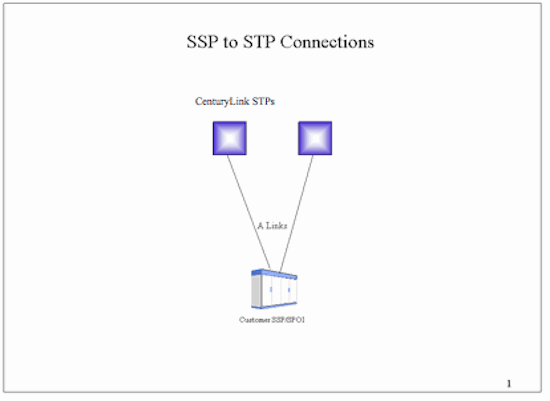
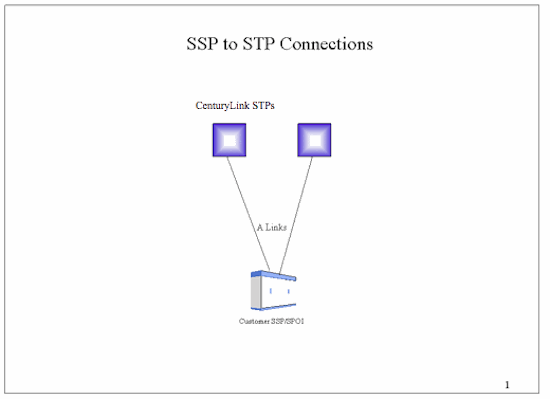
Each Signaling Point (SP), in the SS7 network, is uniquely identified by a numeric point code. Point codes are carried in signaling messages exchanged between signaling points to identify the source and destination of each message. Each SP uses a routing table to select the appropriate signaling path for each message. There are multiple signaling locations in the SS7 network. They are described below:
- STPs are switches that provide CCS translation and routing functions for signaling messages received from network signaling entities. STPs are the "tandem switch" of the signaling network and are the first nodes encountered in the CCS network. STPs use information stored in memory to route messages to the appropriate destination signaling point. STPs are deployed as LSTPs or Regional Signal Transfer Points (RSTPs) in geographically separated mated pairs for reliability and redundancy.
- SSPs can be end offices, , tandems, operator services switches, servers, or softswitches that have CCS and SSP capability. SSPs also serve as "control points" for data base query services by suspending call processing while accessing databases to obtain information required to complete the call.
- Service Control Points (SCP) are call-related databases connected to STPs to provide call control information. The SCP is a centralized on-line database that contains the application software and end-user related information required to provide transaction-based services, e.g., 8XX Database, ICNAM, LIDB and LNP.
- SPOI is much like a Point of Presence (POP) in that it is the component in CCSAC where requests for queries/information move to/from CenturyLink's CCSAC, to/from your internal CCSAC.
- FSPOI is a Company designated ordering point within a Company LATA to which customers may establish SS7 Signaling connections. FSPOIs are connected directly to LSTPs in other LATAs.
Availability
CCSAC/SS7 is offered per CenturyLink Operating Companies Tariff F.C.C. No. 11, Section 20 and State Access Tariffs where facilities exist throughout CenturyLink QC.
Terms and Conditions
CCSAC/SS7 is provided in compliance with provisions stated per CenturyLink Operating Companies Tariff F.C.C. No. 11, Section 20 and/or the relevant State Access Tariffs.
Facility Signaling Point of Interconnections (FSPOI) will be established in the locations where CenturyLink is decommissioning STPs. Connection to an FSPOI will only provide signaling for the LATA where the FSPOI is located. If a customer has the same point code active in multiple LATAs in the same STP consolidation area, they must connect at the STP (e.g., if you use the same switch, same point code, to serve LATAs 620 and 624 you will need to connect at the Minneapolis/St. Paul STP pair for MultiLATA service. This is due to the limitations of the SS7 protocol.) Only two diverse routes will be provided from the FSPOIs to the STPs.
Technical Publications
Technical characteristics, including Network Channel/Network Channel Interface (NC/NCI™) codes are described in Technical Publication - Common Channel Signaling (CCS) Network Interface Specification 77342 and the Network Disclosures.
Pricing
Rate Structure
Rates for CCSAC/SS7 consist of recurring monthly and nonrecurring rates.
Recurring charges are comprised of the following rate elements:
- Direct Link Transport (DLT)
- Entrance Facility (EF)
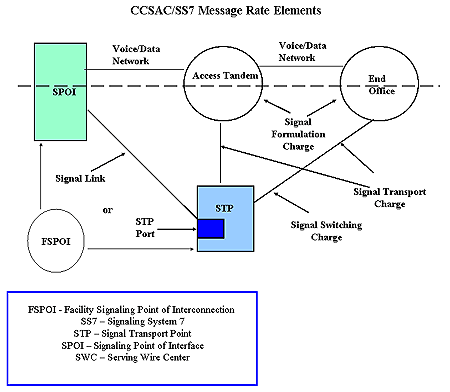
- Message* Charge has three individual message rates:
- Signal Formulation, ISUP
- Signal Switching Charge, ISUP or TCAP
- Signal Transport, ISUP or TCAP
- Multiplexing
- STP Port
Nonrecurring charges are comprised of the following rate elements:
- CCS Link
- Entrance Facility
- Option Activation
*Message Charges for ISUP are based on the quantity of call set-up requests that transit your linkset to the CenturyLink LSTPs that you are connected to. An ISUP call set-up request is defined as an IAM (Initial Address Message), either originating or terminating.
Rates
Rates are available in the appropriate Access Tariff, CenturyLink Operating Companies Tariff F.C.C. No. 11 or State Access Tariff by State.
Tariffs, Regulations, and Policies
Tariffs, regulations and policies are located in the FCC and state specific Tariffs/Catalogs/Price Lists.
Optional Features
Features/Benefits
| Features | Benefits |
| Enables you to obtain access to database services requiring SS7 connectivity |
|
| High Reliability |
|
| CCSAC/SS7 network is separate from the voice/data public switched network |
|
| Is supported by experienced CenturyLink SS7 translators and support staff |
|
Applications
See Features/Benefits
Implementation
Product Prerequisites
If you are a new CLEC and are ready to do business with CenturyLink, view Getting Started as a Facility-Based CLEC.
Your devices must be compatible with industry standards to order CSSAC/SS7. The manufacturer of your device should have this information available. For additional details regarding compatibility, refer to Technical Publication 77342 - Common Channel Signaling (CCS) Network Interface Specification.
Pre-Ordering
Ordering is handled on an Individual Case Basis (ICB) using service activation meetings between you and CenturyLink. These service activation meetings are called Pre-Order meetings. Prior to scheduling the Pre-Order meeting, you are required to complete design specifications for your locations. For information on Common Channel Signaling Network Interface Specification refer to Technical Publication, Common Channel Signaling Network Interface Specification, 77342. Diversity will be negotiated in the Pre-Order meeting. For additional information on diversity, refer to Technical Publication, Diversity and Avoidance, 77344.
Prior to the Pre-Order meeting, you will complete a Signaling Link Data Sheet by using the Signaling Link Data Sheet Instructions. Once the Signaling Link Data Sheet is complete, submit it to your CenturyLink Service Manager. The above activities must be completed prior to submitting the Access Service Request form (ASR).
When requesting new service, you may now also activate 8-bit Signaling Link Selection (SLS) when connecting to certain CenturyLink STPs by indicating your desire on the Signal Link Data Sheet. 8-bit SLS improves traffic load balancing on your linkset and supports more even distribution of traffic in a link outage situation. Your SSP or STP must also be equipped for 8-bit SLS in order to activate this feature. 5-bit SLS will continue to be supported. If you want to activate 8-bit SLS on a currently installed linkset, please contact your CenturyLink Service Manager. See Network Disclosure 491.
If you are ordering point code activation and do not own the point code being activated you must complete a Signaling Letter of Authorization, or have one on file prior to your orders being processed.
Ordering
Upon successful completion of the Pre-Ordering meeting and the acceptance of your completed Signal Link Data Sheet, you will have all the information you need to submit the ASRs.
Your CCSAC/SS7 design requirements must include (but are not limited to) the following:
- Direct Link Transport
- Entrance Facility
- Multiplexing
- Signaling routing requirements, this information is provided along with the Signal Link Data Sheet
- Specific Point Code detail (i.e., ISUP or TCAP requirements)
- STP Port
Refer to SS7 Message Waiting Indicator (SS7 MWI) for unique ordering requirements.
Service interval guidelines are located in the Service Interval Guide (SIG).
In all states, when initially ordering CCSAC, you must declare a CCSAC PIU (Percent Interstate Usage) and a CCSAC POM (Percent Other Messages) factor. The requirements are described in the Tariffs/Catalogs/Price Lists.
For purposes of CCSAC ISUP Call Set Up Requests (only), CCSAC POM shall include: local, EAS, IntraMTA (CMRS providers only), the Local Exchange Company portion of jointly provided Switched Access and CenturyLink originated toll. The total of the CCSAC PIU and CCSAC POM shall not exceed 100. CenturyLink will designate the number obtained by subtracting the projected CCSAC PIU and CCSAC POM factors furnished by the customer from 100 as the projected Intrastate percentage of use. If the total of the reported CCSAC PIU and CCSAC POM exceeds 100, the CCSAC PIU takes priority and the balance (100-CCSAC PIU) defaults to CCSAC POM. The projected CCSAC PIU factor is used by CenturyLink to apportion the message, monthly and nonrecurring charges associated TCAP Data Requests, the CCS Link, STP Port, Entrance Facility and Direct Link Transport between Interstate and Intrastate. Both the projected CCSAC PIU and CCSAC POM are used to apportion the ISUP Call Set Up Requests (only) as Interstate, Intrastate and Other for charging purposes. ISUP Call Set Up Requests reported as CCSAC POM will not be charged. If the CCSAC PIU is not reported it will default to 50. If the CCSAC POM is not reported it will default to 0. The PIU/POM/PCL Quarterly Update Form is used to change your CCSAC declarations
When initially establishing CCSAC service the ASR guidelines for declaring CCSAC POM are as follows:
- The CCSAC POM declaration is entered in the SPEC field
- This field does not allow the use of zero, so substitute X for 0
Examples:
- CCSAC POM declaration of 5% would be entered in the SPEC field as: POMXX5
- CCSAC POM declaration of 50% would be entered in the SPEC field as: POMX5X
- CCSAC POM declaration of 100% would be entered in the SPEC field as: POM1XX
Jurisdictional report requirements for CCSAC POM and CCSAC PIU are the same as for PIU. See Tariffs/Catalogs/Price Lists.
When ordering Basic or Database Translations one (1) ASR is required for each Customer Switch Location (CSL).
If you are requesting signaling access to multiple LATAs from a single LSTP pair, in states where available, the following must be on your ASR:
- enter the SPEC code of MLATSTP
- the first entry in the Remarks section must be multilata
If you are ordering a signaling connection via an FSPOI pair, the CenturyLink location on your ASR must be the 11-digit CLLI of the STP to which FSPOI will connect you. The SPEC code of FSPO1 must be entered on your ASR. (The system does not allow for the “I” character so the last character is a “1”.) The customer will only be charged mileage for the connection from their SPOI to the FSPOI.
Provisioning and Installation
During installation, you must complete additional testing to validate the accuracy of the installation. For additional information regarding the testing, refer to Technical Publication, Common Channel Signaling Network Interface Specifications, 77342.
SS7 network overload, due to extraordinary volumes of queries and/or other SS7 network messages, can have a detrimental effect on the performance of CenturyLink's SS7 network. CenturyLink, at its sole discretion, will employ certain automatic and/or manual overload controls in the CenturyLink SS7 network to safeguard against any detrimental effects. CenturyLink SS7 Network Technical Support team will contact your network staff by telephone, as agreed upon during initial service setup, regarding any instances where overload controls are invoked due to your SS7 network. You agree in those cases to take immediate corrective actions to remedy the situation. CenturyLink may need to temporarily discontinue database services if your network TCAP errors are generating excessive messages that jeopardize the viability of the service.
Billing
Carrier Access Billing System (CABS) billing is described in Billing Information - Carrier Access Billing System (CABS).
Message charges for ISUP call set-up requests are billed based on your self declared CCSAC PIU and CCSAC POM. All IAMs are counted, but your declarations determine how they are billed. Third party signaling providers must report the aggregate CCSAC PIU and, CCSAC POM of their customers. CenturyLink does not provide billing detail by OPC/DPC (Originating Point Code/Destination Point Code) for ISUP or TCAP message charges, nor does CenturyLink bill a third party signaling provider's customers. See FCC and state tariffs for rules and reporting procedures.
Maintenance and Repair
General maintenance and repair activities are described in the Maintenance and Repair Overview.
Training
View available CenturyLink courses in the Course Catalog.
Contacts
CenturyLink contact information is located in Wholesale Customer Contacts.
Frequently Asked Questions (FAQs)
This section is currently being compiled based on your feedback.
Last Update: January 30, 2017
NC/NCI™ is a Trademark of Telcordia Technologies, Inc.